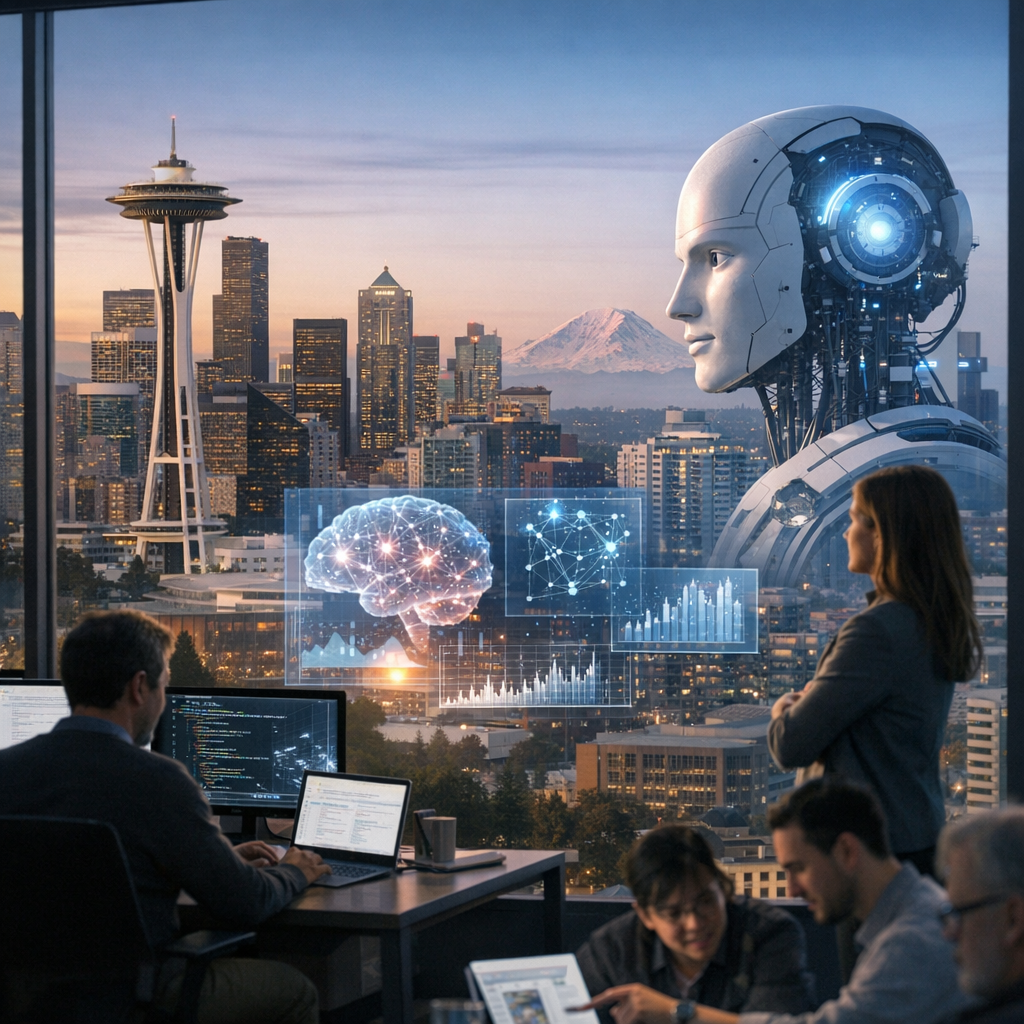
A recent GeekWire article titled “Microsoft’s reset: A new era for Seattle startups and how AI is changing everything for founders” argues that the technology giant’s shifting priorities are reverberating across the Pacific Northwest’s startup ecosystem, creating both uncertainty and opportunity for early-stage companies.
The piece situates Microsoft’s latest strategic recalibration within a broader transformation driven by artificial intelligence. As the company doubles down on AI infrastructure, cloud services, and enterprise applications, its evolving internal culture and investment focus are influencing the flow of talent, capital, and ideas throughout Seattle’s technology community. Historically, Microsoft has served as both an anchor employer and a training ground for entrepreneurs who later leave to found startups. GeekWire reports that this dynamic is entering a new phase, as AI reshapes not only what those founders build but also how they build it.
One of the central themes highlighted in the article is the accelerating pace at which AI tools are lowering barriers to entry. Founders are increasingly able to prototype, test, and scale products with smaller teams, relying on advanced machine learning models and cloud-based services such as Microsoft Azure. This shift is altering traditional assumptions about startup formation, reducing the need for large engineering teams and enabling faster iteration cycles. At the same time, it is intensifying competition, as more entrepreneurs can bring ideas to market with unprecedented speed.
Microsoft’s renewed emphasis on AI has also created a ripple effect in venture funding and startup strategy. GeekWire notes that investors are gravitating toward companies that can either build on top of AI platforms or differentiate themselves within an ecosystem increasingly dominated by large providers, a trend reflected in broader AI investment trends. For Seattle’s startup community, this creates a paradox: while Microsoft’s investments in AI infrastructure can serve as a powerful foundation for new ventures, they also risk concentrating influence among a small number of major platforms.
The article suggests that talent mobility remains a key factor. As Microsoft reorganizes and refocuses, experienced employees are once again entering the startup pipeline, bringing with them deep technical knowledge and familiarity with cutting-edge AI systems. This influx is reminiscent of earlier waves of entrepreneurship tied to Microsoft’s evolution, but with a critical difference: today’s founders are operating in an environment where AI capabilities are not just a competitive advantage but a baseline expectation, shaped in part by advances from organizations like OpenAI.
GeekWire also points to cultural and strategic shifts within Microsoft itself, describing a company that is more outward-facing and integrated with the broader tech ecosystem than in previous decades. Partnerships, developer platforms, and open collaboration are emphasized as part of its AI strategy, creating new touchpoints for startups that may have once operated more independently.
However, the transformation is not without risks. The concentration of resources in AI infrastructure raises questions about dependency and long-term sustainability for smaller companies. Startups building on top of large platforms may achieve rapid early growth, but they must also navigate shifting terms, pricing models, and competitive pressures from the very companies that provide their technological foundation.
In framing this moment as a “reset,” the GeekWire article captures a sense of transition rather than rupture. Seattle’s startup ecosystem is not being dismantled but reconfigured, shaped by both Microsoft’s strategic direction and the broader technological shift toward AI-driven development. For founders, the implications are profound: success will increasingly depend on the ability to leverage powerful tools while maintaining enough independence and innovation to stand out in a crowded field.
As the region adapts, the interplay between a dominant technology firm and a diverse startup community remains central. GeekWire’s reporting underscores that while Microsoft continues to exert significant influence, the next generation of Seattle startups will be defined by how effectively they harness—and occasionally challenge—the AI systems that now sit at the core of the industry.