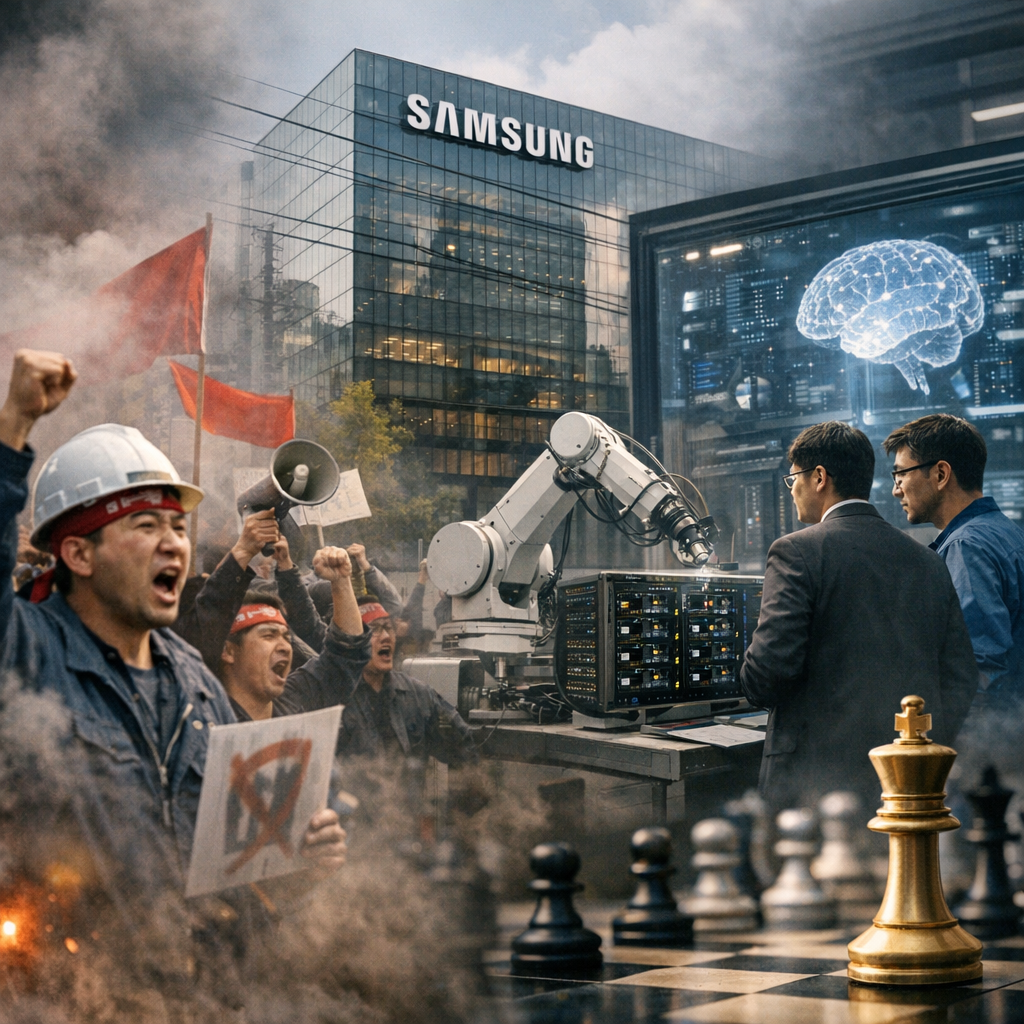
The rapid expansion of artificial intelligence technologies is reshaping corporate priorities across the global tech sector, but at Samsung Electronics, it is also intensifying internal strains. As reported by The Economic Times in its article “At Samsung, the global AI boom spurred a looming strike and deep divisions,” the company is confronting a complex mix of labor unrest, strategic pressure, and widening gaps between management and workers.
Samsung, long regarded as one of South Korea’s most influential conglomerates, has moved aggressively to position itself at the forefront of the AI-driven semiconductor boom. Surging demand for advanced chips—particularly those used in data centers and AI computing—has elevated expectations for growth and profitability. However, these ambitions have coincided with rising dissatisfaction among employees, culminating in the threat of industrial action.
At the heart of the dispute are concerns over compensation, working conditions, and the distribution of gains from the company’s recent performance. Workers argue that while Samsung has benefited significantly from the global surge in AI investment, the rewards have not been equitably shared. This sentiment has been amplified by the broader transformation within the semiconductor division, where intensified workloads and heightened production targets have become the norm.
Labor unions, which have historically had a limited presence within Samsung’s corporate culture, are playing a more assertive role. Their growing influence reflects a broader shift in South Korea’s labor landscape, where employees in once tightly controlled corporate environments are increasingly willing to organize and negotiate collectively. The possibility of a strike—once almost unthinkable at Samsung—now underscores the depth of dissatisfaction.
Management, for its part, faces a delicate balancing act. The company must maintain competitiveness in an industry defined by rapid innovation cycles and heavy capital expenditure, while also addressing employee grievances that, if left unresolved, could disrupt operations at a critical moment. With rivals also racing to capture opportunities in AI hardware, any prolonged internal disruption could have strategic consequences.
Beyond immediate labor concerns, the situation highlights deeper structural tensions within Samsung. The company’s transition toward high-value AI-related products requires not only technological investment but also organizational adaptation. Differences in priorities between executives focused on global competitiveness and employees seeking improved conditions have exposed underlying divisions that extend beyond pay disputes.
The developments at Samsung also reflect a broader pattern emerging across the global technology sector, where the benefits of AI-driven growth are unevenly distributed. As companies accelerate efforts to capitalize on new technologies, the pressure on workforces is intensifying, raising questions about sustainability and equity.
How Samsung navigates this moment may have implications well beyond its own operations. A resolution that addresses worker concerns while preserving the company’s strategic momentum could set a precedent within the industry. Conversely, a prolonged conflict risks illustrating the challenges of managing rapid technological transformation in large, complex organizations.
The tensions described in The Economic Times report suggest that the AI boom, while creating enormous economic opportunity, is also exposing fault lines within even the most established corporate giants.