Researchers have introduced a new framework designed to help robots translate complex human language into precise, executable actions, a development that could significantly expand the capabilities of machines operating in real-world environments.
The work, reported in the TechXplore article “Framework enables robots to turn complex language into precise actions,” addresses a longstanding challenge in robotics: bridging the gap between flexible human communication and the rigid, structured instructions that robots typically require. While recent advances in artificial intelligence have improved machines’ ability to understand natural language, turning that understanding into accurate physical behavior has remained a major obstacle.
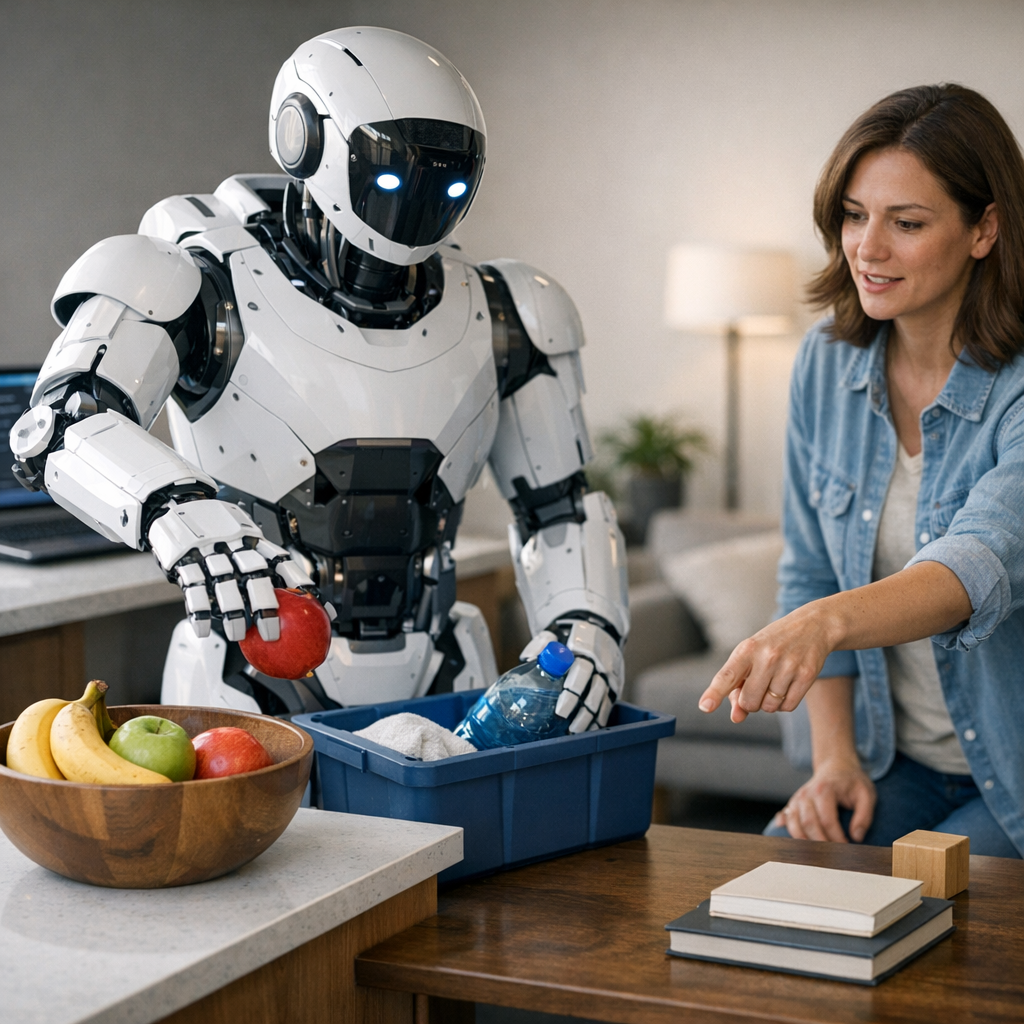
The newly proposed framework aims to solve this problem by breaking down human instructions into smaller, interpretable components that a robot can process step by step. Rather than attempting to map an entire sentence directly to a single action, the system decomposes language into a sequence of subtasks, each linked to specific, context-aware operations. This layered approach allows robots to handle more nuanced and multi-step requests, such as organizing objects in a particular way or navigating environments with conditional instructions.
A key feature of the framework is its ability to maintain alignment between linguistic intent and physical execution. By embedding contextual awareness into each stage of the process, the system helps ensure that a robot’s actions remain consistent with the user’s original request, even when instructions are ambiguous or involve multiple variables. This is particularly important in dynamic settings such as homes, warehouses, or hospitals, where conditions can change rapidly and require adaptive responses.
The researchers also focused on improving reliability and interpretability. Traditional end-to-end models can produce unpredictable outcomes, especially when faced with unfamiliar commands. In contrast, the new framework emphasizes transparency, allowing developers to trace how a given instruction is parsed and executed. This not only enhances performance but also makes it easier to diagnose errors and refine behavior over time.
The potential implications extend across several industries. In logistics, robots equipped with more advanced language understanding could respond to spoken instructions from human workers, reducing the need for specialized programming. In domestic settings, service robots could better assist with everyday tasks by interpreting natural conversation rather than relying on predefined commands. The technology may also play a role in healthcare, where precise execution of verbal instructions can be critical.
Despite the progress, the researchers acknowledge that challenges remain. Language is inherently ambiguous, and even humans rely heavily on shared context and experience to interpret meaning. Ensuring that robots can handle edge cases, cultural variations, and unexpected inputs will require further refinement and testing.
Still, the framework represents a notable step toward more intuitive human-robot interaction. By narrowing the divide between how people communicate and how machines act, it points to a future in which robots can operate more seamlessly alongside humans, responding to instructions with both accuracy and adaptability.