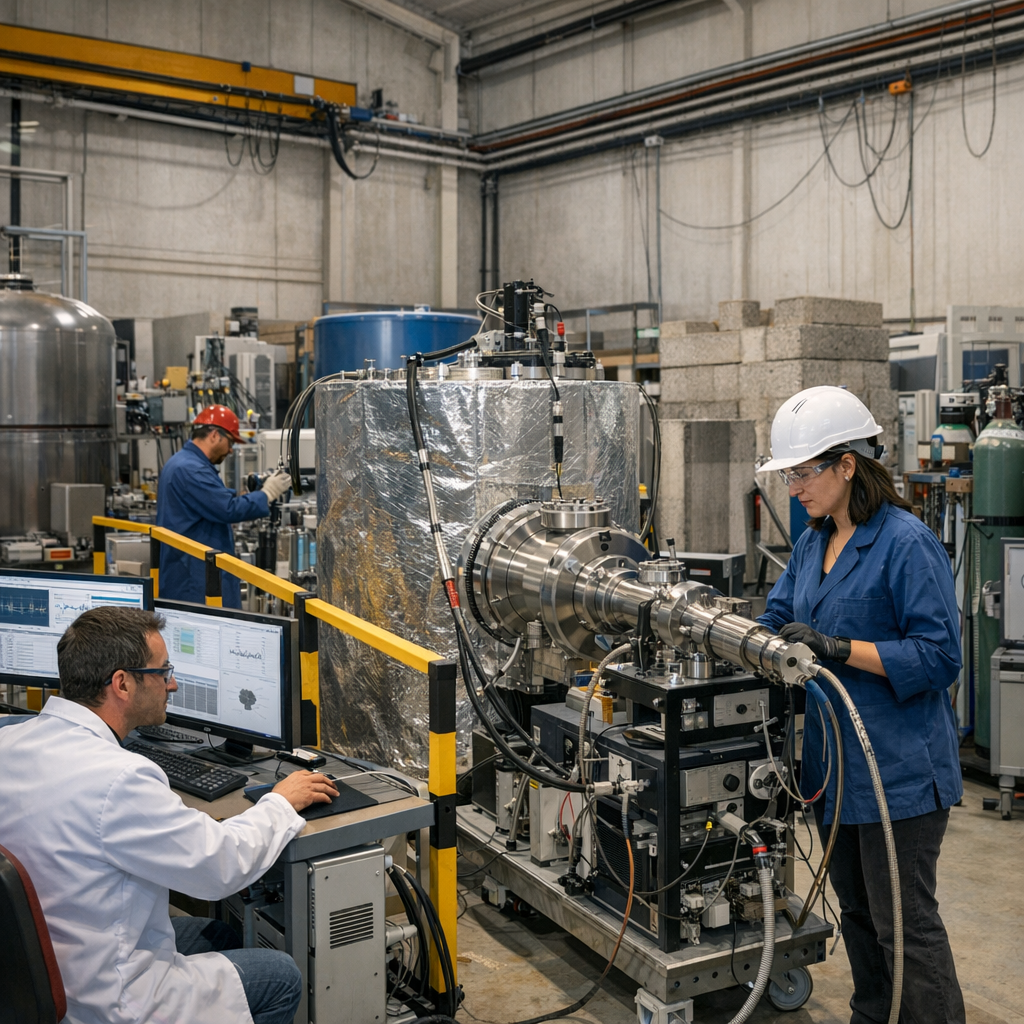
Spain’s Centro Nacional de Aceleradores (CNA) has taken a significant step forward in neutron science with the development of its compact yet highly adaptable facility known as “Hispanos,” a project highlighted in the article “CNA-Hispanos: the compact yet versatile Spanish neutron facility” published by Innovation News Network. The initiative reflects a broader European effort to expand access to neutron-based technologies beyond large-scale, centralized research infrastructures.
Traditionally, neutron research has depended on major facilities such as nuclear reactors or spallation sources, which require substantial investment and international coordination. These large installations, while powerful, can limit access due to cost, geographic constraints, and high demand. In contrast, the CNA’s approach focuses on a smaller, accelerator-driven neutron source designed to provide flexibility and local accessibility without sacrificing scientific capability.
Hispanos is built around a proton accelerator that generates neutrons through interactions with suitable target materials. Although its neutron flux is lower than that of large-scale facilities, its design prioritizes versatility and ease of integration into a wide range of experimental setups. This makes it particularly attractive for applied research, industrial testing, and education, where access to a reliable neutron source can unlock new possibilities.
One of the key strengths of the CNA facility lies in its ability to support diverse applications. Neutron techniques are widely used for materials characterization, non-destructive testing, cultural heritage studies, and even medical research. By enabling local experimentation, Hispanos allows researchers to conduct preliminary studies, refine methodologies, and train personnel before moving to larger international facilities if necessary.
The system’s compact footprint also aligns with current trends in scientific infrastructure, which increasingly favor distributed, specialized facilities over a small number of dominant centers. This shift is partly driven by the need for resilience and accessibility in research ecosystems, as well as the desire to foster regional innovation hubs. In this context, Hispanos represents a strategic investment in Spain’s scientific capacity, reinforcing its position within the European research landscape.
In addition to its scientific utility, the facility serves as a training ground for students and early-career researchers. By providing hands-on experience with neutron instrumentation and accelerator technologies, CNA is contributing to the development of a skilled workforce capable of supporting future advances in the field. This educational component is particularly important given the specialized knowledge required to operate and interpret neutron-based experiments.
The Innovation News Network article emphasizes that while Hispanos is not intended to replace large-scale neutron sources, it complements them by filling a critical gap. Smaller facilities can handle routine measurements, pilot studies, and industrial collaborations more efficiently, freeing up larger installations to focus on cutting-edge research requiring the highest հնարավոր neutron intensities.
Looking ahead, the success of CNA-Hispanos could serve as a model for similar initiatives across Europe and beyond. As governments and institutions seek cost-effective ways to expand scientific capabilities, compact neutron sources offer a compelling alternative to traditional approaches. Their scalability and adaptability make them particularly well suited to evolving research demands.
By combining technical innovation with a pragmatic understanding of user needs, the CNA has demonstrated how smaller-scale infrastructure can deliver meaningful scientific impact. As highlighted in Innovation News Network’s coverage, Hispanos embodies a shift toward more accessible, flexible research tools that broaden participation in neutron science while strengthening the overall research ecosystem.