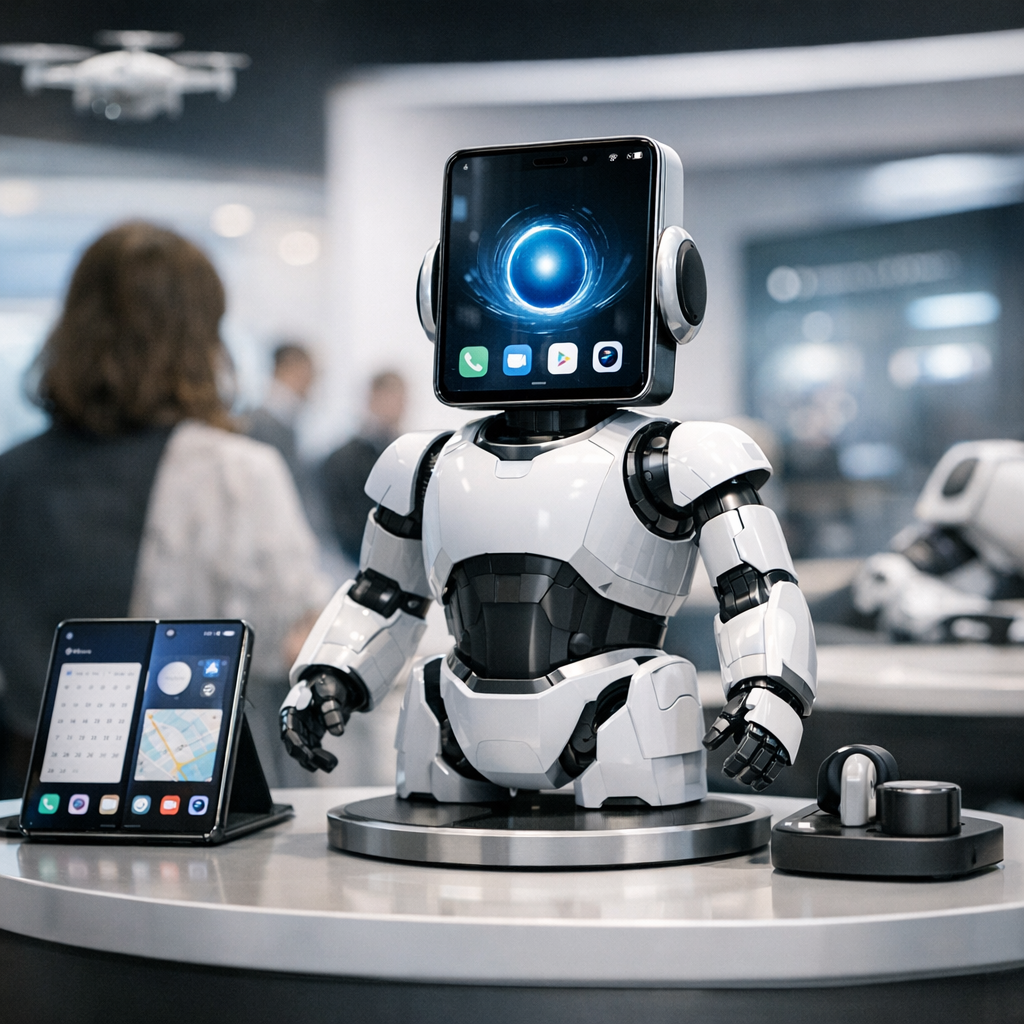
At the Mobile World Congress in Barcelona, Chinese smartphone maker Honor used the global technology gathering to showcase a concept that hints at how artificial intelligence could fundamentally reshape the way people interact with their phones. Demonstrated as a “robot phone,” the prototype introduced a new generation of AI-driven capabilities designed to allow devices to autonomously complete tasks on behalf of users rather than simply responding to commands.
According to an article titled “Robot phone is here: Honor unveils prototype with AI features at Mobile World Congress,” published by The Economic Times, the device is built around an advanced AI agent capable of navigating apps and services much like a person would. During demonstrations, the system was shown carrying out practical tasks such as booking reservations and coordinating services by interacting directly with mobile applications. Instead of requiring users to manually open apps and enter details themselves, the AI agent interprets instructions and completes the process automatically.
The demonstration represents part of a broader push by smartphone manufacturers to integrate so‑called “agentic” artificial intelligence into consumer devices. Rather than functioning solely as a voice assistant or chatbot, the technology is designed to perform multi-step operations across different apps and services. In practical terms, a user could ask the system to arrange a meeting at a nearby restaurant, and the AI could search for suitable options, check availability, factor in the user’s schedule and travel time, and make the reservation.
Industry watchers say such capabilities point toward a shift in the smartphone interface itself. If AI agents can reliably handle everyday digital tasks, traditional app-based interactions could become less central to the user experience. Instead of navigating menus and platforms individually, instructions given to an AI system could trigger a chain of automated actions across multiple services.
Honor framed its prototype as an early look at how smartphones might evolve in the coming years, as advances in machine learning allow AI assistants to operate with greater autonomy and contextual awareness. While still experimental, the concept aligns with a broader trend among technology companies racing to embed generative and task-performing AI directly into mobile devices.
Although the “robot phone” remains a prototype, the demonstration at Mobile World Congress signaled how aggressively smartphone makers are exploring new forms of device intelligence. As AI systems become more capable of understanding complex requests and interacting with digital services, the smartphone may gradually transform from a tool users operate into a platform that actively carries out tasks on their behalf.