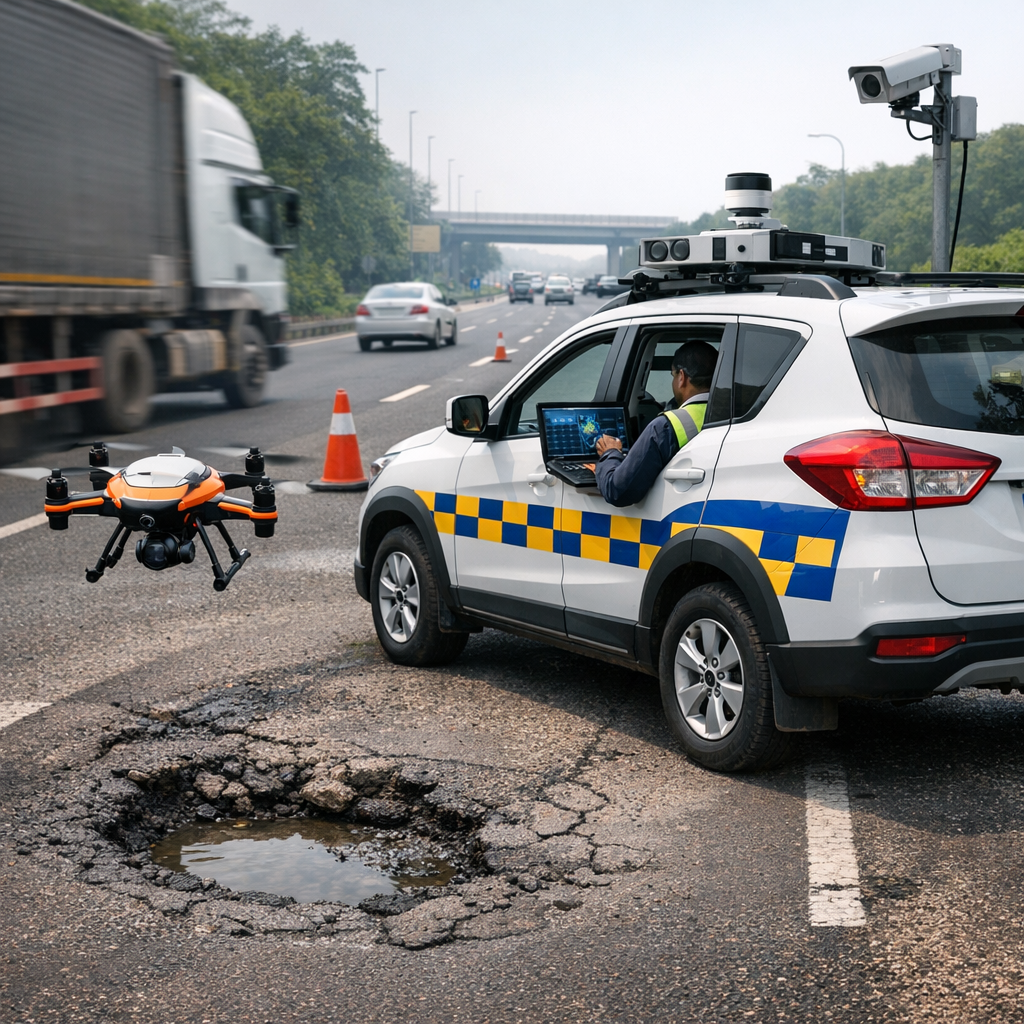
India’s national highway network is set to undergo a technological upgrade as authorities move to integrate artificial intelligence into routine road monitoring, an initiative aimed at improving safety and maintenance efficiency. The plan, reported in The Economic Times under the title “No more missed potholes: NHAI to deploy AI to patrol India’s highways,” reflects a broader shift toward data-driven infrastructure management.
According to the report, the National Highways Authority of India (NHAI) intends to deploy AI-enabled systems capable of identifying road defects such as potholes, cracks, and surface wear in near real time. These systems are expected to rely on a combination of sensors, cameras, and image-processing algorithms mounted on patrol vehicles or other platforms. By continuously scanning highway stretches, the technology could significantly reduce the lag between identification and repair of road damage.
The move addresses a longstanding issue in India’s highway maintenance regime, where periodic manual inspections can miss emerging defects or delay intervention. Potholes, in particular, have been a persistent safety hazard, contributing to accidents, vehicle damage, and traffic disruptions. Automating detection is seen as a way to create a more proactive maintenance cycle rather than a reactive one.
Officials are also expected to integrate the AI outputs into centralized monitoring systems, allowing authorities to prioritize repairs based on severity and location. This could lead to more efficient allocation of maintenance resources and improved accountability among contractors responsible for road upkeep. In theory, such systems can generate detailed audit trails, making it easier to track whether identified issues are resolved within mandated timeframes.
The initiative aligns with the government’s broader push toward digital infrastructure and smart mobility solutions. It also reflects a growing recognition that large-scale road networks require continuous, technology-assisted surveillance to maintain quality standards, especially as traffic volumes increase.
However, the success of the program will depend on execution. Challenges such as data accuracy, system calibration under varied weather and lighting conditions, and coordination between detection systems and on-ground repair teams could influence outcomes. There are also questions about cost, scalability, and the training required for personnel to effectively use and interpret AI-generated insights.
Even so, the proposed deployment signals a shift in how infrastructure maintenance is conceptualized in India—from periodic inspection to continuous monitoring. If implemented effectively, it could mark a meaningful step toward safer and more reliable highways, while offering a model for other sectors seeking to harness artificial intelligence for public service delivery.