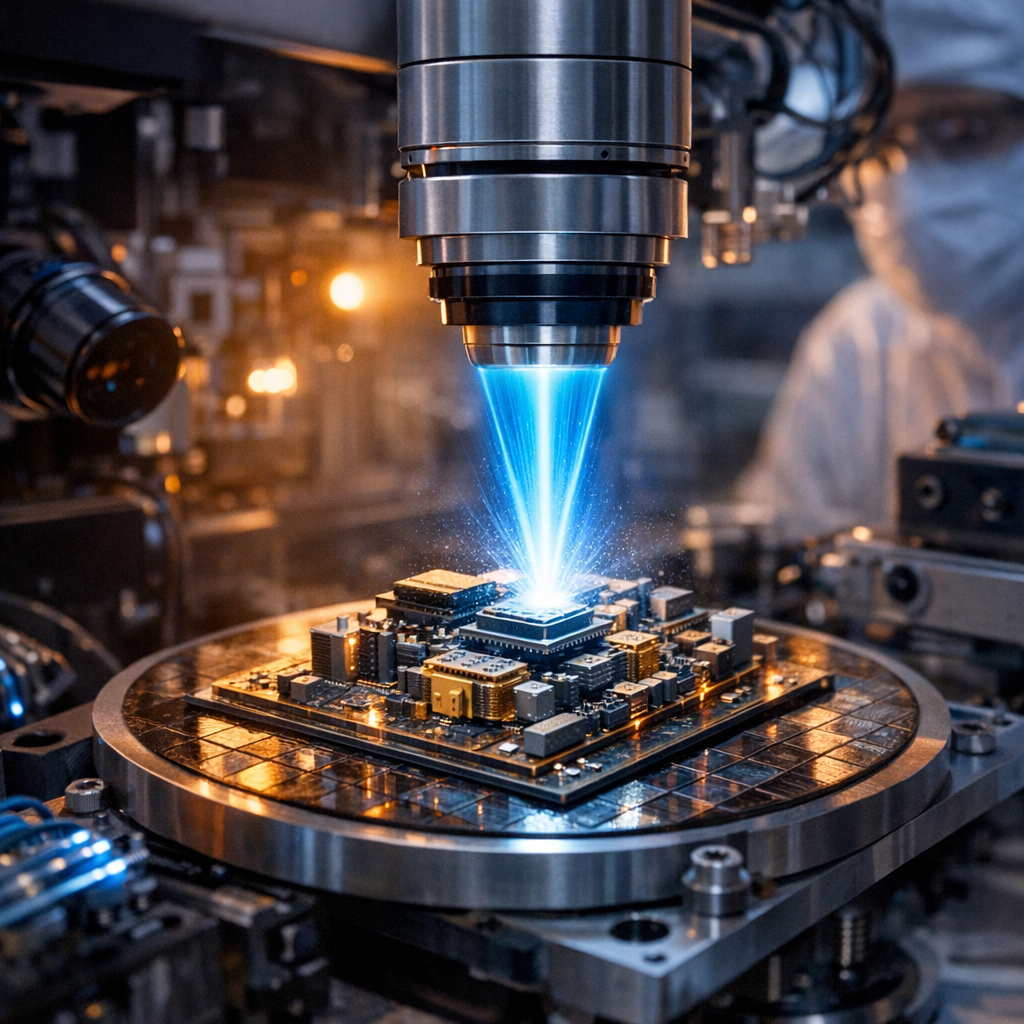
A new approach to manufacturing three-dimensional electronics using precisely focused microwaves could reshape how complex devices are built, offering a faster and potentially more flexible alternative to conventional fabrication methods. The development, detailed in the Tech Xplore article “3D electronics focused microwaves redefines …,” highlights a technique that leverages targeted microwave radiation to selectively heat and form electronic structures within materials.
Researchers behind the work are addressing a longstanding limitation in electronics manufacturing: the difficulty of producing intricate three-dimensional circuits without relying on layered assembly processes. Traditional methods typically build devices layer by layer, which can be time-consuming and restrictive when designing compact or unconventional geometries. By contrast, the new method uses focused microwave energy to directly create conductive pathways inside a material, enabling more complex architectures in fewer steps.
The technique relies on carefully controlling how microwaves interact with different regions of a substrate. Materials respond unevenly to microwave radiation, allowing engineers to localize heating with high precision. This targeted energy application can induce chemical or structural changes exactly where needed, effectively “writing” electronic components into the material without affecting surrounding areas.
Beyond efficiency gains, the approach may open the door to new classes of devices. Three-dimensional electronics are increasingly important in fields such as wearable technology, biomedical implants, and compact sensors, where space constraints and performance demands require innovative design strategies. The ability to embed circuitry within objects rather than on flat surfaces could lead to more durable and integrated systems.
The researchers also emphasize the potential scalability of the process. Because microwaves can penetrate materials more deeply than some other energy sources used in fabrication, the method could be adapted for larger or more complex components without sacrificing precision. This characteristic may be particularly valuable for advanced manufacturing sectors seeking to streamline production while maintaining high performance standards.
While the technology remains in a developmental stage, the findings suggest a significant shift in how electronic devices might be produced in the future. As reported by Tech Xplore, the work points to a convergence of materials science and electromagnetic engineering that could move the industry beyond planar fabrication constraints.
Further research will be needed to refine the technique, ensure reliability, and integrate it with existing manufacturing systems. However, the early results indicate that focused microwave processing could become a key tool in the evolution of next-generation electronics.