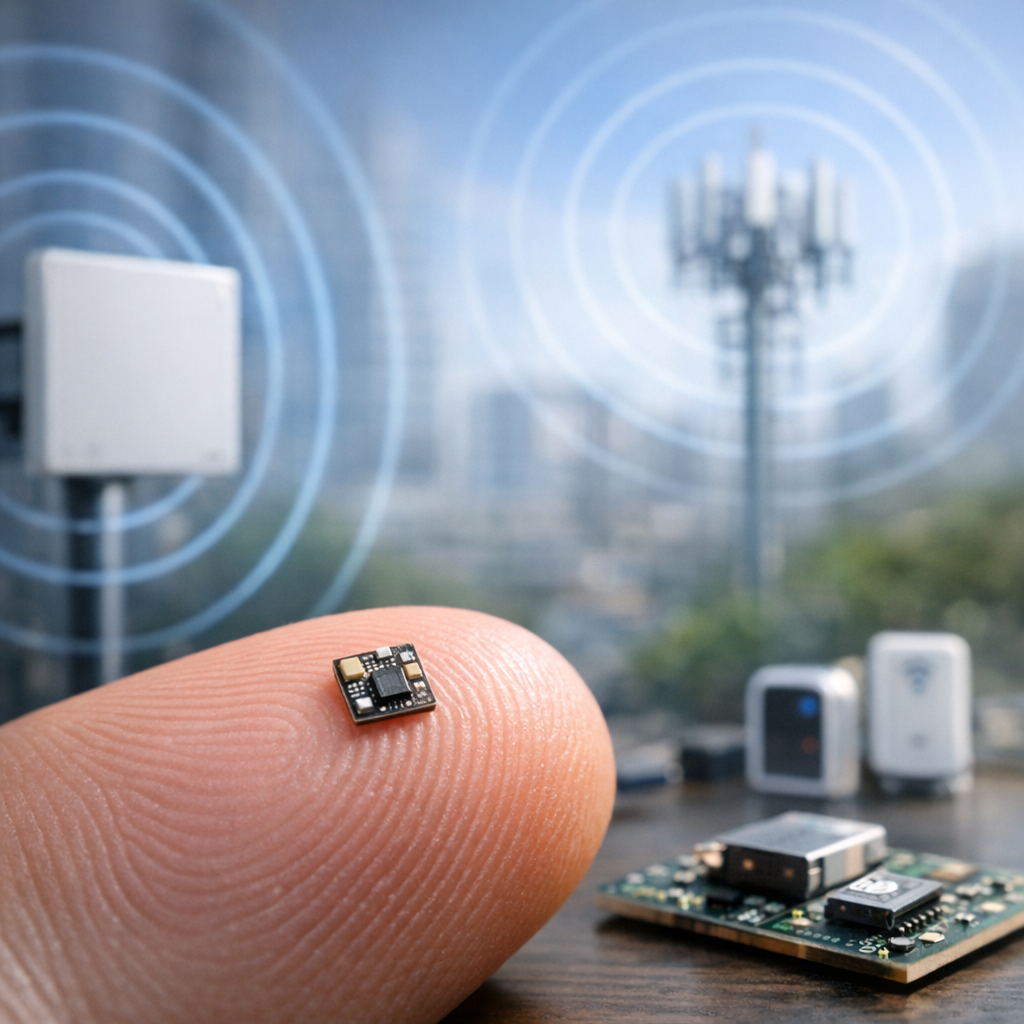
Researchers have developed a new class of ultra-small, battery-free tags capable of communicating using radio signals, a breakthrough that could significantly expand the scope of low-cost, maintenance-free sensing and tracking technologies. The advance, detailed in the Tech Xplore article “Tiny battery-free tags use radio signals to communicate,” highlights how engineers are pushing the limits of wireless communication by removing one of its most persistent constraints: the need for onboard power.
The devices operate without batteries by harvesting energy directly from ambient radio frequency (RF) signals in their environment. Instead of generating their own transmissions in the conventional sense, the tags reflect and modulate existing radio waves—a technique known as backscatter communication. This allows them to transmit data while consuming only minuscule amounts of energy, enabling designs that are dramatically smaller and longer-lasting than traditional wireless sensors.
In practical terms, these tags could be embedded into everyday objects, infrastructure, or even biological environments where replacing or recharging batteries would be impractical or impossible. Their diminutive size also opens the possibility of deploying dense networks of sensors that continuously monitor conditions such as temperature, movement, or structural stress.
What distinguishes this latest development is the combination of compact size and improved communication reliability. Historically, battery-free backscatter devices have struggled with limited range and susceptibility to interference. The researchers addressed these limitations by refining how the tags encode and reflect signals, allowing more robust data transmission even in complex environments saturated with competing wireless activity.
The system also leverages standard radio hardware, meaning it can integrate more readily with existing communication infrastructure. Receivers can interpret the reflected signals without requiring specialized equipment, which could ease adoption across industrial, healthcare, and consumer applications.
Potential uses are wide-ranging. In logistics, such tags could track goods throughout supply chains without the cost and maintenance burden of battery-powered trackers. In healthcare, they might enable unobtrusive monitoring devices that operate indefinitely. In smart cities, they could form the backbone of distributed sensing systems embedded in roads, bridges, or buildings.
Despite the promise, challenges remain. Signal strength and range are still constrained compared to conventional wireless devices, and ensuring reliable performance in highly variable real-world conditions will require further refinement. Security and privacy considerations will also need to be addressed as such tags become more pervasive and harder to detect.
Still, the research marks a significant step toward a future where computation and connectivity can be embedded almost invisibly into the physical world. By eliminating the need for batteries, engineers are not only reducing maintenance costs but also opening new possibilities for sustainable, scalable networks of intelligent devices.