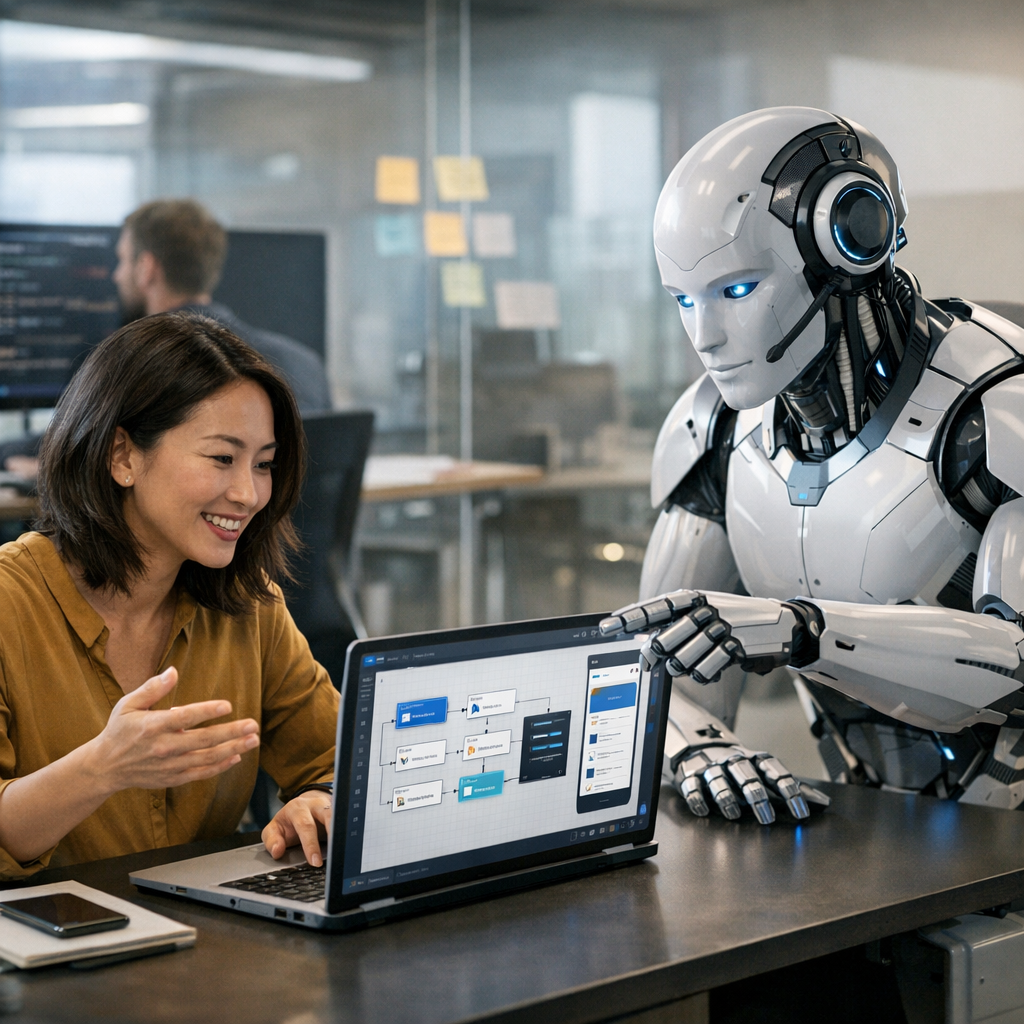
A new generation of tools aimed at so-called “citizen developers” is reshaping how non-technical professionals build and deploy software, reflecting a broader shift in enterprise technology toward accessibility and automation. As reported in “Citizen developers now have their own wingman,” published by Artificial Intelligence News, emerging platforms are positioning artificial intelligence not merely as a coding assistant for engineers, but as a collaborative partner for business users with limited programming experience.
The concept of the citizen developer has been gaining traction alongside the rise of low-code and no-code platforms, which allow employees outside traditional IT departments to create applications through visual interfaces and prebuilt components. What distinguishes the latest wave, however, is the integration of AI systems designed to guide users through development tasks, anticipate needs, and reduce errors in real time. These systems act as a kind of “wingman,” offering suggestions, automating workflows, and translating business requirements into functional applications.
According to the report, these AI-driven assistants are beginning to close the gap between technical and non-technical roles. By interpreting natural language inputs and converting them into structured logic, they allow users in areas such as operations, marketing, and finance to build tools tailored to their specific needs without deep coding knowledge. This not only accelerates development cycles but also reduces the burden on IT teams, which have historically struggled to keep pace with internal software demands.
The implications for organizations are significant. Businesses adopting such tools can decentralize innovation, enabling departments to experiment and iterate independently. This can lead to faster deployment of solutions and more responsive adaptation to changing market conditions. At the same time, it introduces new considerations around governance, security, and quality control, as applications are created outside traditional oversight frameworks.
The article also highlights the growing sophistication of these AI “wingmen.” Rather than simply automating repetitive tasks, they are increasingly capable of contextual reasoning, offering guidance based on best practices and flagging potential compliance risks. Some systems can even monitor how applications are used after deployment, suggesting optimizations or identifying inefficiencies.
Despite these advances, challenges remain. Organizations must balance empowerment with oversight, ensuring that citizen-developed applications meet enterprise standards. There is also the question of trust in AI-generated outputs, particularly in regulated industries where errors can have serious consequences. Training and clear governance structures are therefore likely to play a critical role in successful adoption.
The trend outlined in “Citizen developers now have their own wingman,” published by Artificial Intelligence News, underscores a broader evolution in how software is conceived and built. As AI continues to lower technical barriers, the distinction between developers and end users is becoming increasingly blurred, pointing toward a future in which application development is a more distributed and collaborative enterprise.