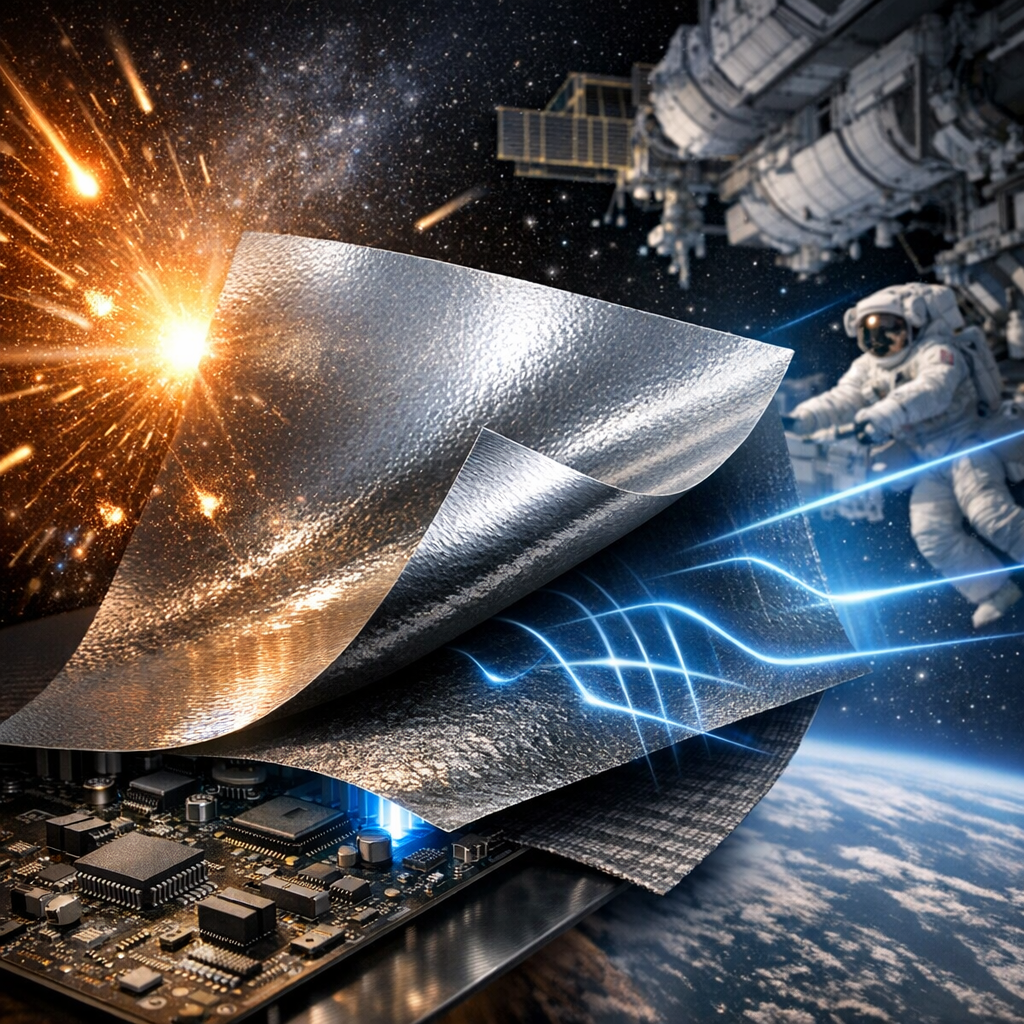
Scientists have unveiled a material so thin it is effectively comparable to a strand of hair, yet capable of shielding against both cosmic radiation and electromagnetic waves—a development that could significantly reshape how sensitive technologies and human explorers are protected in extreme environments.
The breakthrough, reported in the Innovation News Network article “New shield material thinner than a strand of hair but blocks both cosmic electromagnetic waves and radiation,” represents a notable advance in materials science, particularly for aerospace, electronics, and defense applications. Researchers have engineered a lightweight shielding layer that combines multiple protective functions traditionally requiring bulkier, heavier solutions.
At the core of the innovation is a finely structured material designed to absorb and deflect different forms of radiation simultaneously. Cosmic radiation, which poses a persistent hazard in space travel, can damage biological tissue and degrade electronic systems over time. Electromagnetic interference, meanwhile, disrupts the performance of modern devices, from satellites to communication systems. Achieving effective protection against both threats in a single, ultra-thin layer has long been a challenge.
The material’s performance stems from its carefully tuned composition at the microscopic or nanoscale level. By manipulating how the structure interacts with incoming waves and particles, the researchers have enabled it to dissipate energy efficiently without adding significant mass. This is particularly important for space missions, where every additional gram increases cost and complexity.
Beyond aerospace, the implications extend to consumer electronics and critical infrastructure. As devices become more compact and densely packed, managing electromagnetic interference is increasingly difficult. A shielding solution that is both highly effective and nearly weightless could help improve device reliability without compromising design constraints. Similarly, in medical or scientific environments where radiation exposure must be minimized, such materials may offer new protective options.
While the Innovation News Network report highlights promising laboratory results, further testing will be required to assess durability, scalability, and cost-effectiveness. Real-world deployment, especially in space, demands materials that can withstand extreme temperatures, mechanical stress, and prolonged exposure to radiation.
Still, the development points to a broader trend in materials engineering: the drive toward multifunctional, ultrathin systems capable of replacing heavier, single-purpose components. If successfully commercialized, this shielding technology could contribute to more efficient spacecraft, longer-lasting electronics, and enhanced protection in high-radiation environments.
As research continues, attention will likely turn to how the material can be manufactured at scale and integrated into existing technologies. For now, the findings signal a potentially transformative step forward in the quest to balance protection, performance, and minimal weight.