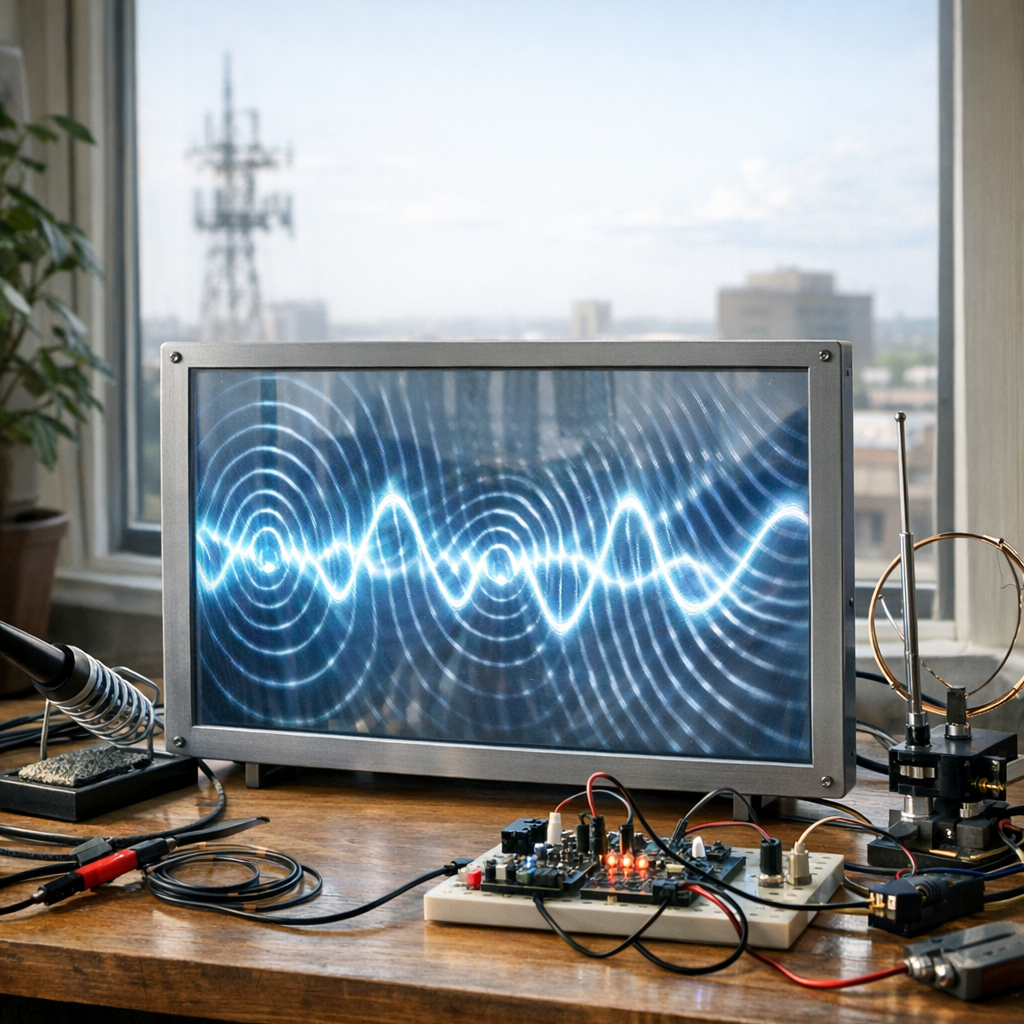
A recent piece published by Wired, titled “Build a Radio Wave Detector With Balls of Aluminum Foil,” highlights a deceptively simple experiment that brings an abstract aspect of modern life—radio frequency energy—into the realm of direct, physical observation. The article reflects a broader trend in science communication that seeks to demystify invisible technologies by translating them into tactile, accessible demonstrations.
At the center of the Wired article is a homemade device constructed from commonplace materials, including small balls of aluminum foil, insulating supports, and basic wiring. The apparatus functions as a rudimentary radio-wave detector, capable of responding to electromagnetic signals emitted by everyday devices such as smartphones and wireless routers. The principle is not new; it draws on long-standing concepts of electromagnetic induction and charge separation. What distinguishes the approach is its accessibility. Rather than relying on specialized instruments, the setup invites users to observe subtle physical movements—such as the deflection or interaction of foil components—as a proxy for otherwise imperceptible forces.
The experiment operates on the premise that radio waves, though intangible, can induce measurable electrical effects in conductive materials. When electromagnetic radiation passes through or near the detector, it can redistribute charges within the aluminum, producing small forces that manifest as motion. While the resulting signals are neither precise nor calibrated, they are sufficient to demonstrate the presence and variability of ambient radio frequency energy.
Wired’s framing of the experiment emphasizes its educational value, particularly in an era when wireless technologies are pervasive yet poorly understood by the general public. By reducing the barrier to entry, the article aligns with a long tradition of do-it-yourself science that encourages curiosity-driven exploration. It also underscores the gap between the sophistication of modern communication systems and the simplicity of the physical principles that underpin them.
At the same time, the article implicitly raises questions about interpretation and limitations. A device of this kind, while illustrative, is not a reliable measurement tool. It cannot distinguish between frequencies, quantify signal strength with accuracy, or account for environmental variables that influence readings. Without careful explanation, such experiments risk reinforcing misconceptions about electromagnetic exposure or overestimating the sensitivity of improvised detectors.
Nevertheless, as presented by Wired, the construction of a radio-wave detector using aluminum foil serves as a compelling entry point into discussions about physics, engineering, and the infrastructure of wireless communication. It bridges the gap between theory and experience, allowing users to witness the effects of phenomena that typically remain hidden behind layers of technology.
In an age defined by invisible networks and constant connectivity, the appeal of making the unseen visible—or at least perceptible—continues to resonate. The Wired article captures that impulse, offering a hands-on reminder that even the most advanced systems are ultimately governed by fundamental physical interactions that can be explored with surprising simplicity.