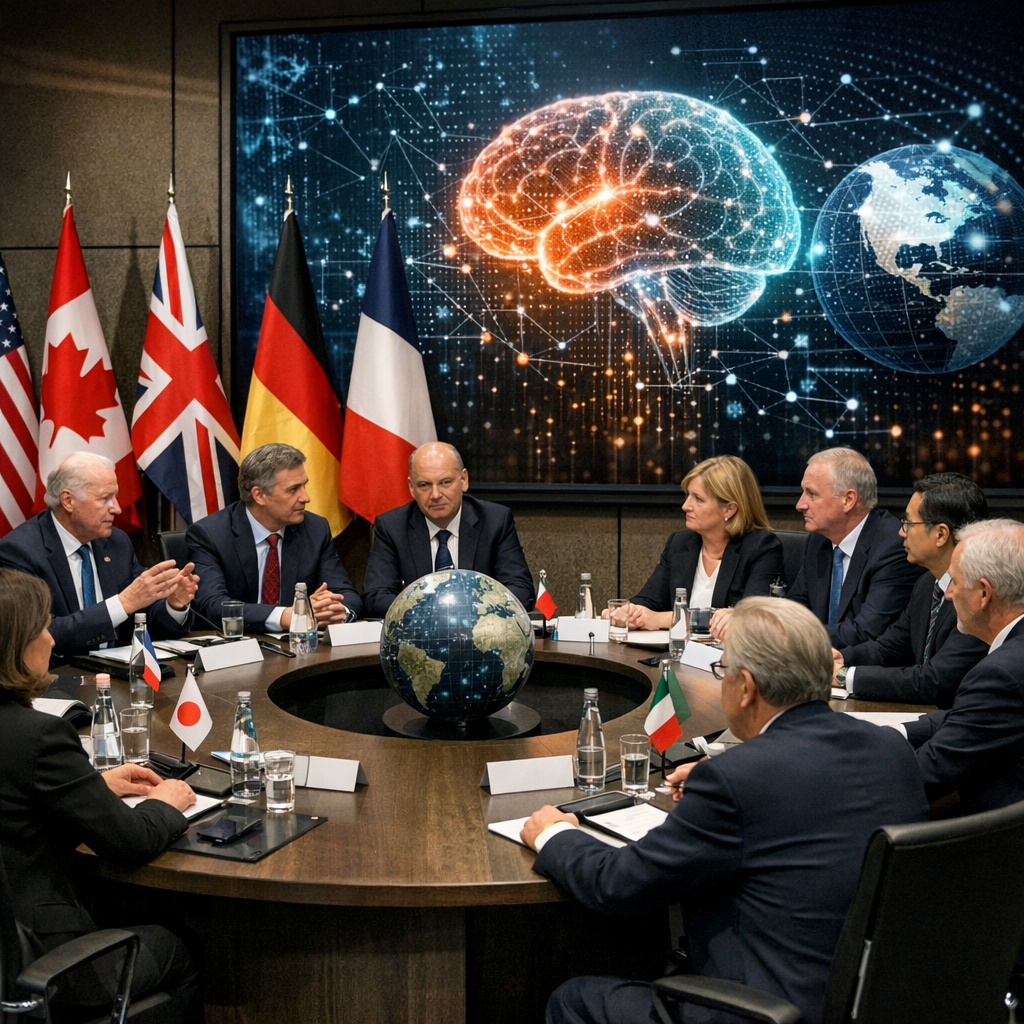
Leaders of the Group of Seven (G7) nations have signaled a renewed commitment to closer coordination on artificial intelligence, advancing discussions around a “trusted partners” framework aimed at shaping the governance of emerging technologies among like-minded economies. The move reflects a broader effort to align standards, manage risks, and secure supply chains as AI becomes central to economic competitiveness and national security.
According to reporting by The Economic Times in its article “G7 leaders vow closer ties on AI as they hash out trusted partners scheme”, the initiative centers on building deeper cooperation among countries that share democratic values and similar regulatory approaches. The proposed framework would emphasize collaboration on technical standards, data governance, research, and investment, while also reducing reliance on jurisdictions viewed as less aligned on transparency or security.
Officials involved in the discussions indicated that the “trusted partners” concept could serve as a foundation for coordinated policies on sensitive technologies, including advanced semiconductors and large-scale AI systems. By strengthening ties within this circle, G7 nations aim to ensure that critical infrastructure and innovation ecosystems are less exposed to geopolitical disruption. Related efforts build on broader international principles such as the OECD AI Principles and ongoing coordination within forums like the G7.
The push comes amid intensifying global competition over AI development, with governments seeking to balance innovation with safeguards against misuse. Concerns ranging from data privacy and algorithmic bias to national security implications have prompted policymakers to explore mechanisms for harmonized oversight. Frameworks like the NIST AI Risk Management Framework and regulatory efforts such as the EU AI Act illustrate the growing focus on structured governance. The G7’s approach suggests a preference for interoperability and shared norms rather than fragmented national regulations.
While details of the framework remain under negotiation, early signals point to an emphasis on voluntary standards backed by political commitments rather than binding treaties. This could allow for faster adoption while preserving flexibility, though it may also raise questions about enforcement and consistency across jurisdictions.
Industry stakeholders are likely to play a significant role in shaping the initiative, given their central position in developing and deploying AI technologies. Governments are expected to consult with major technology firms, research institutions, and civil society groups to ensure that policies remain practical and responsive to rapid technological change.
The discussions also highlight a broader strategic shift toward “friend-shoring,” where economic cooperation is concentrated among trusted allies. In the context of AI, such an approach may influence everything from data flows to research collaboration and hardware supply chains, potentially intersecting with policies like the CHIPS and Science Act aimed at strengthening semiconductor resilience.
As negotiations continue, the success of the G7’s efforts will depend on its ability to translate shared principles into actionable policies without stifling innovation. The balance between openness and security remains delicate, but the initiative underscores a growing consensus among leading economies that coordinated governance is essential in an era defined by artificial intelligence.