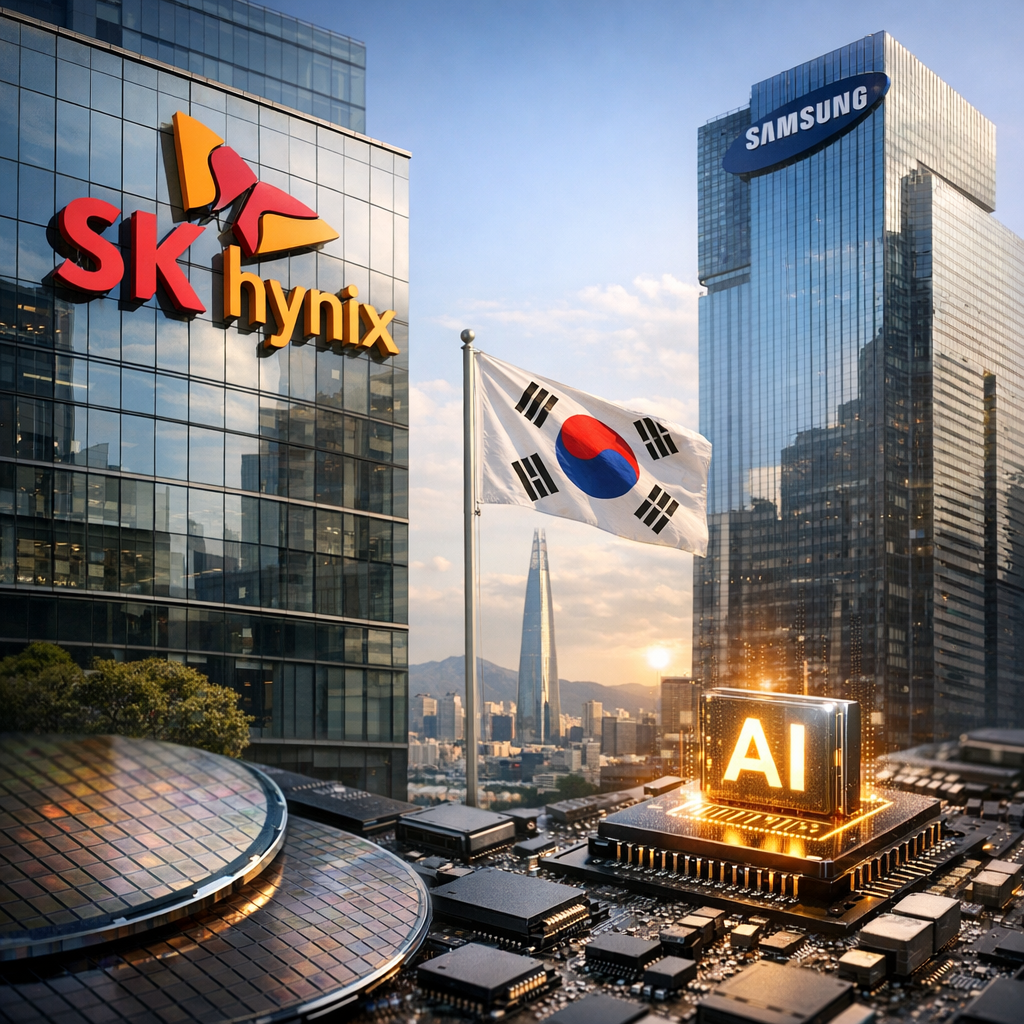
SK Hynix has overtaken Samsung Electronics as South Korea’s most valuable company, a symbolic shift that underscores how the global semiconductor race is being reshaped by surging demand for artificial intelligence infrastructure.
According to the Economic Times article titled “SK hynix dethrones Samsung Electronics as South Korea’s most valuable company,” the memory chipmaker’s market capitalisation edged past that of its larger rival as investors rallied behind firms positioned to benefit from the explosive growth in AI technologies. The report highlights how SK Hynix’s leadership in high-bandwidth memory (HBM) — a critical component used in advanced AI processors — has propelled its valuation during a period when traditional chip segments remain volatile.
The shift marks a notable reversal in South Korea’s corporate hierarchy. Samsung Electronics has long dominated the country’s equity markets, benefiting from its sprawling portfolio across memory chips, smartphones, and consumer electronics. However, its heavy exposure to cyclical demand in conventional memory products such as DRAM and NAND has weighed on investor sentiment, even as it attempts to strengthen its position in next-generation AI chips.
In contrast, SK Hynix has emerged as a key supplier to leading AI chipmakers, including Nvidia, whose graphics processing units depend on high-performance memory to handle complex machine learning workloads. The company’s early and aggressive investment in HBM technology has translated into strong earnings momentum and a clearer growth narrative at a time when capital markets are rewarding firms tied to AI infrastructure.
The divergence reflects a broader structural shift in the semiconductor industry. While traditional memory chips — such as DRAM and NAND — remain fundamental to global computing, their pricing cycles are notoriously volatile. AI-driven demand, by comparison, is creating a more sustained and premium market for specialized components like HBM, which are essential for training and running large-scale machine learning models.
Samsung has acknowledged the importance of this transition and is investing heavily to catch up in advanced memory segments. Yet the market’s response suggests that investors are prioritizing execution and current leadership over long-term potential. SK Hynix’s ability to secure major supply agreements and scale production of HBM has reinforced confidence in its near-term outlook.
The changing market capitalization ranking also carries symbolic weight within South Korea, where Samsung has historically been synonymous with the country’s industrial and technological prowess. SK Hynix’s ascent signals a diversification of leadership within the nation’s tech sector and reflects how quickly competitive dynamics can shift in the age of AI.
Despite the milestone, both companies remain central to the global semiconductor ecosystem, and the competitive landscape is likely to remain fluid. Samsung’s vast resources and manufacturing scale position it to challenge SK Hynix in advanced memory, while the latter must sustain its technological edge in a fast-evolving market.
As the Economic Times report indicates, the market’s verdict for now is clear: investors are betting that the next phase of semiconductor growth will be defined less by legacy dominance and more by the ability to deliver the specialized components powering artificial intelligence.