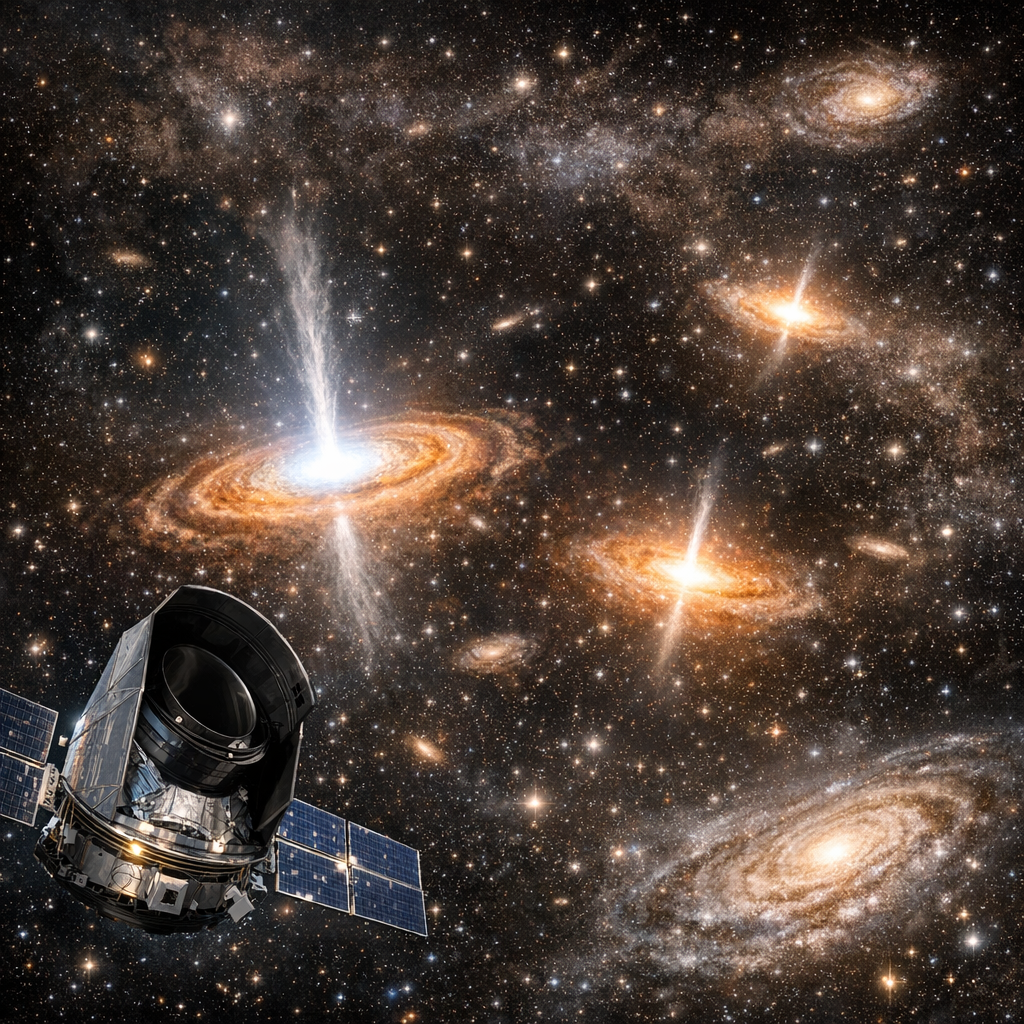
A recent report by Innovation News Network, titled “Euclid telescope uncovers ancient quasars from early universe,” highlights a significant milestone in cosmological research as astronomers begin to unlock new insights from the European Space Agency’s Euclid mission. The telescope, launched to map the geometry of the dark universe, is already demonstrating its broader scientific value by identifying some of the most distant quasars ever observed.
According to the report, Euclid’s early data have revealed previously undetected quasars dating back to the universe’s formative epochs, less than a billion years after the Big Bang. These quasars, powered by supermassive black holes at the centers of young galaxies, are among the brightest objects in the cosmos. Their detection provides crucial evidence about how such massive structures could form so quickly in cosmic history, a question that has long challenged astrophysicists.
Unlike previous surveys that relied heavily on ground-based telescopes or narrower observational fields, Euclid combines a wide-field view with high-resolution imaging and near-infrared capabilities. This allows it to peer through cosmic dust and capture faint, distant objects across vast regions of space. Researchers cited in the Innovation News Network article note that this combination is particularly effective for identifying early quasars that would otherwise remain hidden.
The discovery has implications beyond cataloguing distant objects. By studying these quasars, scientists can infer properties of the early universe, including the distribution of matter and the processes that governed galaxy formation. The presence of supermassive black holes at such early times also raises questions about their origins, suggesting that either black holes grew at extraordinary rates or formed through mechanisms not yet fully understood.
The Euclid mission’s primary objective is to investigate dark energy and dark matter by mapping billions of galaxies and tracing the large-scale structure of the universe. However, as the findings outlined by Innovation News Network demonstrate, its data are proving valuable across multiple domains of astronomy. The identification of early quasars is one of several unexpected benefits emerging from its initial observations.
Researchers anticipate that as Euclid continues its survey over the coming years, the number of known early quasars will increase substantially. Larger datasets will allow for statistical analyses that could refine models of cosmic evolution and provide more definitive answers about the growth of black holes and galaxies.
The early success reported in “Euclid telescope uncovers ancient quasars from early universe” underscores the mission’s potential to reshape current understanding of the universe’s first billion years. As more data become available, Euclid is expected to play a central role in addressing some of the most fundamental questions in modern cosmology.