Researchers have developed a soft robotic gripper inspired by the dexterity and strength of an elephant’s trunk, offering a new approach to handling objects that range from delicate to bulky. Reported by Tech Xplore in the article “Elephant-inspired soft robotic gripper”, the system—known as ELeTac—demonstrates how bioinspired engineering can overcome long-standing trade-offs in robotic manipulation.
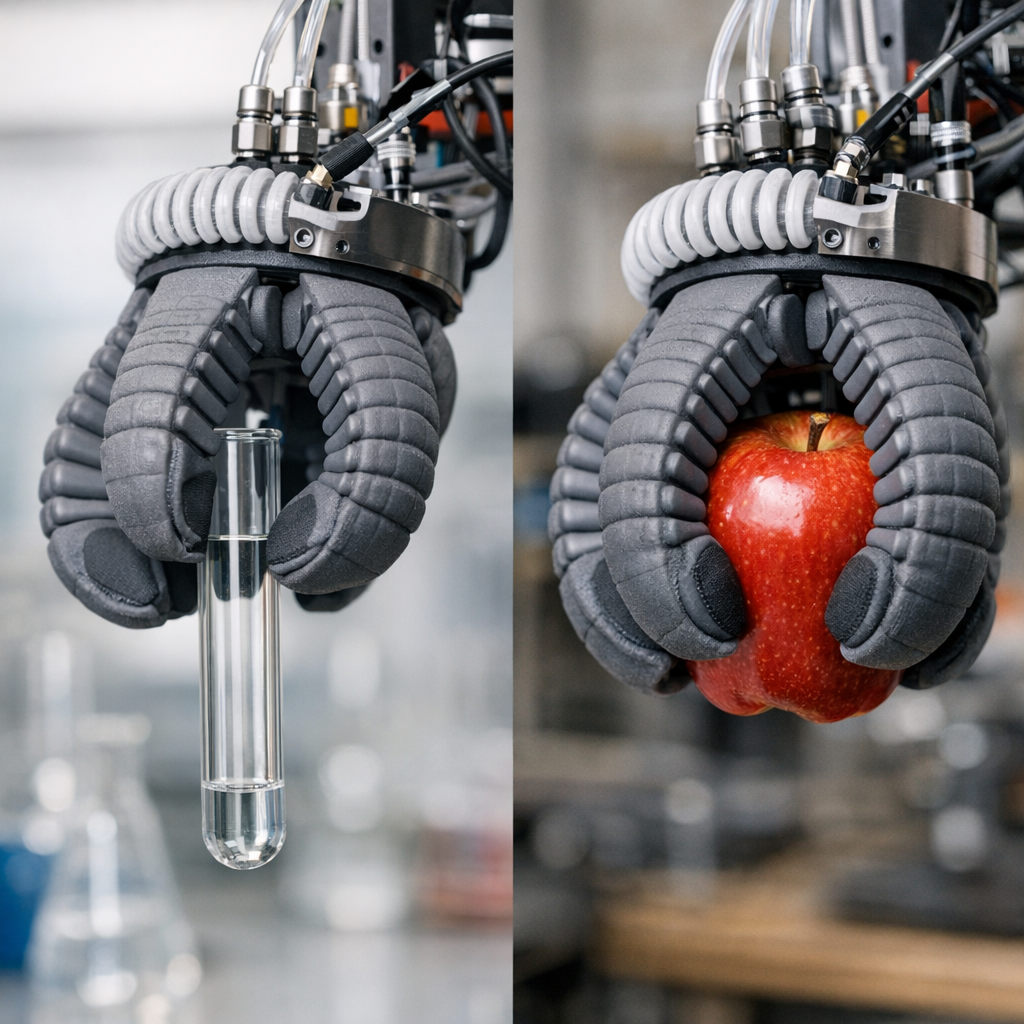
Traditional robotic grippers often struggle to balance precision with force, typically excelling at either fragile handling or heavy lifting, but not both. The ELeTac system addresses this limitation through a soft, adaptable structure that combines flexible materials used in soft robotics with controllable stiffness. Drawing on the muscular hydrostat design of an elephant’s trunk, the gripper can conform to irregular shapes while maintaining enough القوة to securely grasp heavier items.
According to the Tech Xplore report, the device integrates pneumatic actuation with a segmented design that allows for fine control over movement and grip strength. By modulating internal الضغط, the gripper can transition between compliant and rigid states, enabling it to pick up objects as delicate as produce or as robust as tools without requiring separate الأجهزة or complex reconfiguration.
The design also incorporates a multi-contact gripping strategy, allowing the robotic system to distribute force evenly across an object’s surface. This reduces the risk of damage while improving stability, particularly when handling uneven or fragile items. Researchers note that this capability could prove especially valuable in sectors such as agricultural robotics, food processing, and logistics, where automation has historically been constrained by the limitations of conventional grippers.
In addition to industrial uses, the soft robotic approach holds promise for human-centered environments. Because the materials are inherently safer and more forgiving than rigid components, systems like ELeTac could be deployed in settings that require close interaction with people, including healthcare robotics and service robotics.
The work highlighted by Tech Xplore underscores a broader trend in robotics toward systems that emulate biological structures to achieve versatility and resilience. By moving away from rigid механistic designs and toward adaptable, soft architectures, researchers are expanding the range of tasks that robots can perform reliably in real-world conditions.
While further testing and refinement are needed before widespread deployment, the elephant-inspired gripper represents a notable step forward in closing the gap between precision and power in robotic manipulation.