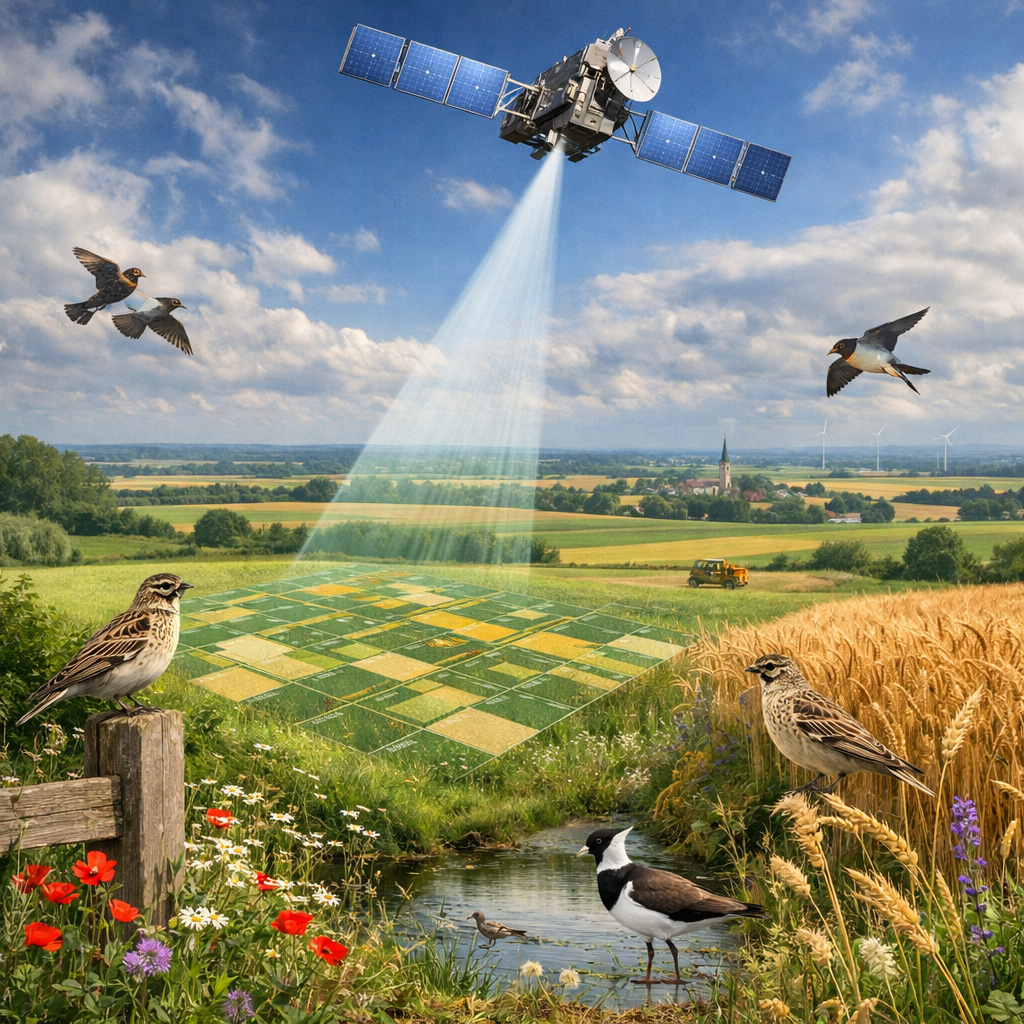
Europe’s farmland birds, long considered among the most visible indicators of environmental health, are in steep decline. A recent article titled “Satellites help chart a future for Europe’s disappearing farmland birds,” published by Innovation News Network, highlights how new satellite-based monitoring techniques are offering scientists and policymakers a clearer picture of the crisis—and potential pathways to reverse it. The original report can be found here: Innovation News Network article.
Across Europe, populations of species such as skylarks, lapwings, and yellowhammers have fallen sharply over recent decades, largely due to intensified agriculture, habitat loss, and climate pressures. These birds depend on traditional farming landscapes that have increasingly given way to large-scale, high-intensity production methods. According to the European Environment Agency’s common bird index, farmland bird populations have shown some of the steepest declines among bird groups. The resulting simplification of habitats has reduced nesting sites, food availability, and seasonal stability.
The Innovation News Network article points to a growing role for satellite data in understanding these dynamics. Advances in Earth observation technologies now allow researchers to monitor land use changes, vegetation cycles, and habitat conditions with unprecedented precision. By combining this data with field observations of bird populations, scientists can begin to map not just where declines are occurring, but why.
Satellite imagery enables continuous, wide-area monitoring that was previously impossible through ground surveys alone. Researchers can detect shifts in crop types, planting schedules, and land management practices that directly affect bird habitats. For example, earlier harvesting times or increased use of monocultures can be linked to reduced breeding success in certain species. Studies supported by programs like Copernicus Sentinel satellites provide crucial datasets for this type of analysis. By correlating these patterns with population data, policymakers gain actionable insight into how agricultural practices influence biodiversity.
The article also underscores the importance of integrating satellite data into conservation planning at both national and European levels. Programs under the European Union’s Common Agricultural Policy have increasingly emphasized environmental stewardship, but measuring outcomes has remained challenging. Satellite-based tools offer a way to track compliance and effectiveness more objectively, helping ensure that subsidies and incentives support biodiversity rather than contribute to its decline.
In addition to policy applications, the technology is improving predictive modeling. By analyzing long-term datasets, researchers can forecast how farmland bird populations may respond to different land-use scenarios or climate trajectories. Initiatives such as the European Bird Census Council’s monitoring programs help provide the long-term data needed for such forecasts. This allows for more targeted interventions, such as identifying priority areas for habitat restoration or adjusting farming practices to better align with ecological needs.
Despite these advances, the situation remains urgent. Farmland birds are often described as “canaries in the coal mine” for wider environmental health, and their decline signals broader ecosystem stress. The adoption of satellite monitoring does not by itself guarantee recovery; it must be paired with meaningful changes in agricultural policy, land management, and conservation funding.
What emerges from the Innovation News Network report is a picture of cautious optimism. While the pressures on Europe’s farmland birds are significant, the ability to observe and understand those pressures at scale represents a critical step forward. With more precise data, stakeholders—from farmers to regulators—are better equipped to balance food production with the preservation of biodiversity.
The challenge now lies in translating this technological capability into sustained action. Without decisive measures, the downward trend is likely to continue. But with coordinated efforts informed by robust data, there remains a chance to stabilize and eventually restore Europe’s iconic farmland bird populations.