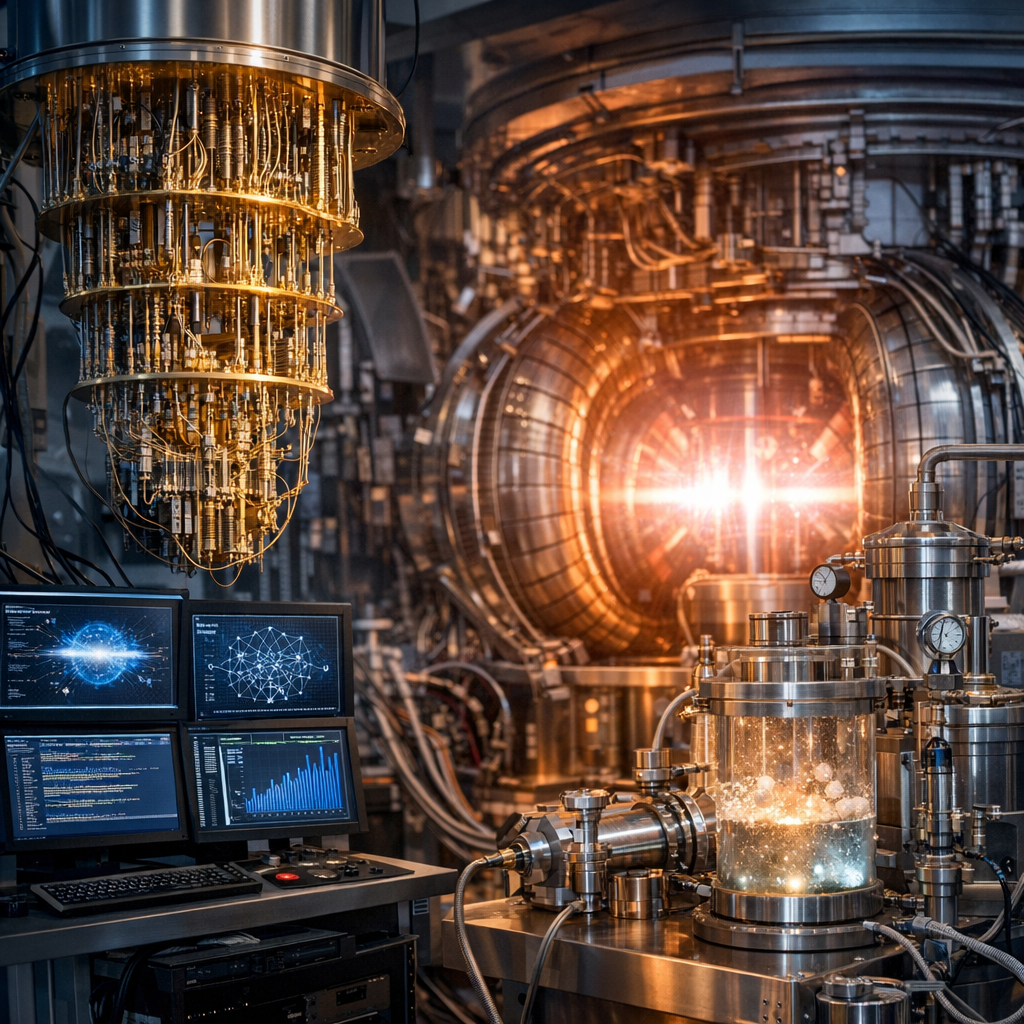
A recent report by Innovation News Network, titled “Quantum computing breakthrough could accelerate tritium production,” highlights a development that may have significant implications for the future of nuclear fusion and clean energy supply chains.
The article details how advances in quantum computing are being applied to one of fusion energy’s most persistent challenges: the efficient production of tritium, a rare hydrogen isotope essential for sustaining fusion reactions. Tritium does not occur naturally in sufficient quantities to support large-scale fusion energy systems, meaning that reliable methods of producing it are critical to the viability of fusion as a commercial energy source.
According to the report, researchers are leveraging quantum computing techniques to model and optimize the behavior of materials used in breeder blankets, the components of fusion reactors designed to generate tritium. These materials, typically containing lithium, undergo nuclear reactions when bombarded by neutrons produced during fusion. The efficiency of this process depends heavily on the underlying atomic interactions, which are exceptionally complex and difficult to simulate using classical computing methods (see ITER overview of fusion fuels and tritium breeding).
Quantum computers, however, offer a way to model these interactions with far greater fidelity. By simulating quantum systems directly, they can provide insights into reaction pathways, material properties, and structural optimizations that were previously out of reach. This could enable scientists to design more efficient materials for tritium production, reducing waste and improving output (as discussed in Nature research on quantum computing applications).
The Innovation News Network article suggests that improved modeling could lead to faster iteration cycles in material design, allowing researchers to identify promising candidates without relying solely on time-consuming and expensive experimental trials. In turn, this could accelerate the development of fusion reactors by addressing one of their key bottlenecks (see U.S. Department of Energy Fusion Energy Sciences).
The implications extend beyond fusion itself. Tritium is also used in certain medical and industrial applications, and global supplies are currently limited. More efficient production methods could ease these constraints, although the primary focus remains on supporting future fusion power plants (as noted by the International Atomic Energy Agency on fusion energy).
While the promise of quantum computing in this area is considerable, the technology is still in a relatively early stage of maturity. Practical, large-scale quantum systems capable of handling the full complexity of nuclear material simulations are not yet widely available. Nevertheless, the progress outlined in the Innovation News Network report indicates that incremental advances are already yielding useful results, particularly in hybrid approaches that combine classical and quantum methods (see IBM Quantum for current platform capabilities).
The broader context is a growing convergence between advanced computing and energy research. As fusion projects move closer to demonstration and commercialization phases, the need for precise modeling and optimization tools is becoming more urgent. Quantum computing, once largely theoretical in its applications, is increasingly being positioned as a practical tool for solving some of the most difficult problems in physics and engineering.
The findings described in “Quantum computing breakthrough could accelerate tritium production” underscore a broader trend: the integration of emerging computational technologies into the energy sector. If these approaches continue to mature, they could play a decisive role in overcoming the technical barriers that have long delayed the realization of fusion as a scalable, carbon-free energy source.