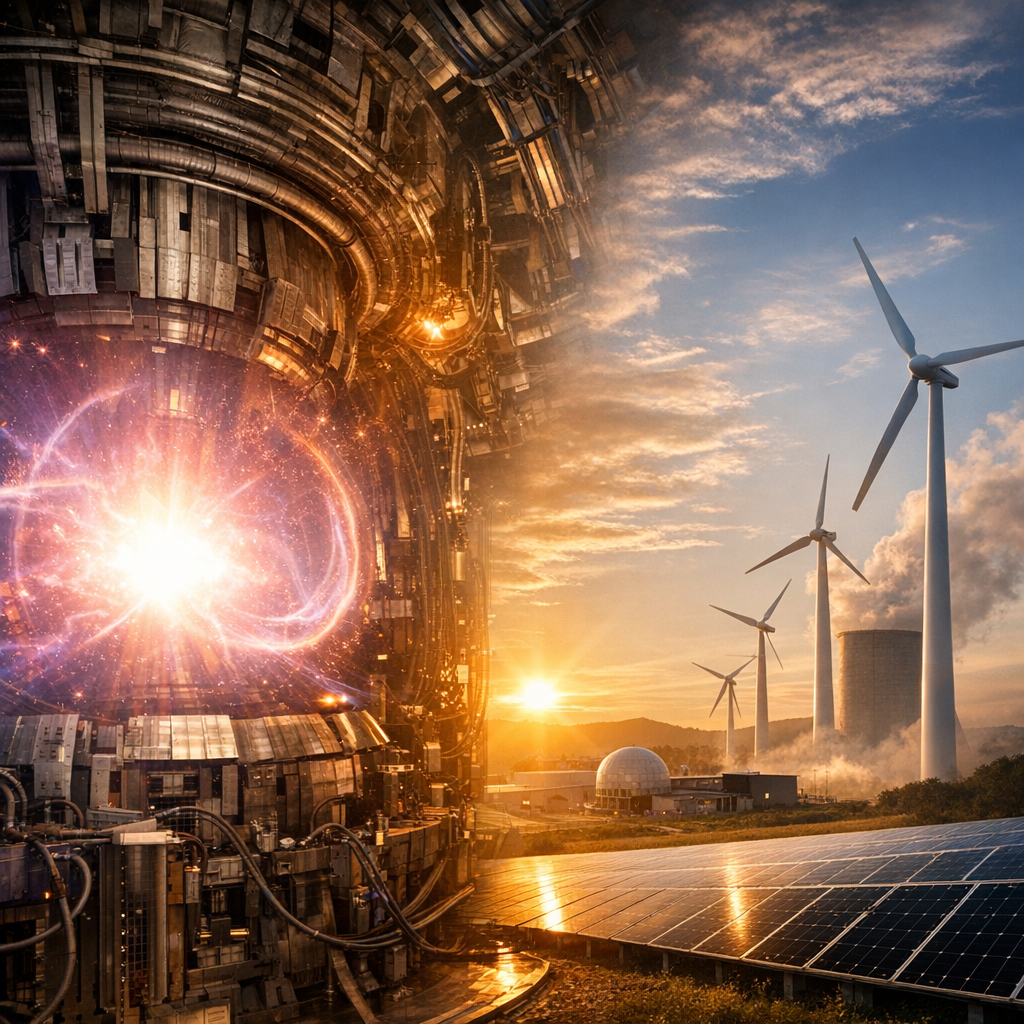
A recent explainer published by Innovation News Network, titled “Fusion energy explained: everything you need to know,” arrives at a moment of renewed optimism and scrutiny surrounding nuclear fusion, a technology long described as the “holy grail” of clean energy. The article outlines the scientific principles, technological hurdles, and policy implications shaping the race to harness fusion power, offering a timely synthesis as governments and private investors accelerate funding in the field.
Fusion energy, unlike conventional nuclear fission, generates power by combining light atomic nuclei—typically isotopes of hydrogen such as deuterium and tritium—into heavier elements, releasing vast amounts of energy in the process. This is the same reaction that powers the sun. As the Innovation News Network article explains, the appeal lies in fusion’s potential to deliver abundant, low-carbon energy with minimal long-lived radioactive waste and no risk of runaway chain reactions, a point also emphasized by the International Atomic Energy Agency.
Yet the gap between theory and practical deployment remains substantial. Achieving fusion requires temperatures exceeding tens of millions of degrees Celsius, conditions that force matter into a plasma state. Containing and stabilizing this plasma without it touching reactor walls has proven one of the most persistent challenges. The article highlights two dominant approaches: magnetic confinement, exemplified by tokamak devices such as the ITER project in France, and inertial confinement, where lasers compress fuel pellets to trigger fusion reactions.
Recent experimental milestones have revived confidence. In the United States, researchers at the National Ignition Facility reported a net energy gain in a controlled fusion experiment, a development widely interpreted as a proof of principle. Meanwhile, private companies are pursuing alternative reactor designs, supported by billions in venture capital. The Innovation News Network piece notes that this influx of private funding marks a shift from decades in which fusion research was almost exclusively the domain of state-backed laboratories, including programs supported by the U.S. Department of Energy’s Fusion Energy Sciences.
Despite these advances, significant engineering barriers remain before fusion can contribute meaningfully to electricity grids. Sustained reactions, efficient energy capture, and materials capable of withstanding extreme neutron bombardment are all unresolved issues. The article underscores that even optimistic timelines place commercial fusion power plants at least a decade away, with some experts cautioning it may take considerably longer.
The policy dimension is equally complex. Governments in Europe, the United States, China, and the United Kingdom are incorporating fusion into long-term energy strategies, balancing investments between established renewables and emerging technologies, with institutions such as the UK Atomic Energy Authority playing a central role. The Innovation News Network article emphasizes that while fusion could eventually complement wind, solar, and fission power, it is not a near-term solution to the climate crisis.
Public perception also plays a role. Fusion’s association with nuclear technology has historically generated skepticism, although proponents argue that its safety profile is fundamentally different from fission. Clear communication, the article suggests, will be essential to building trust as pilot projects move closer to commercialization.
Ultimately, “Fusion energy explained: everything you need to know” presents a measured account of a field at a pivotal juncture. Breakthroughs have shifted fusion from a theoretical ambition toward an engineering reality, yet the pathway to scalable, economically viable power remains uncertain. For now, fusion stands as a promising but unfinished chapter in the global transition to cleaner energy systems, requiring sustained scientific, financial, and political commitment before its potential can be fully realized.