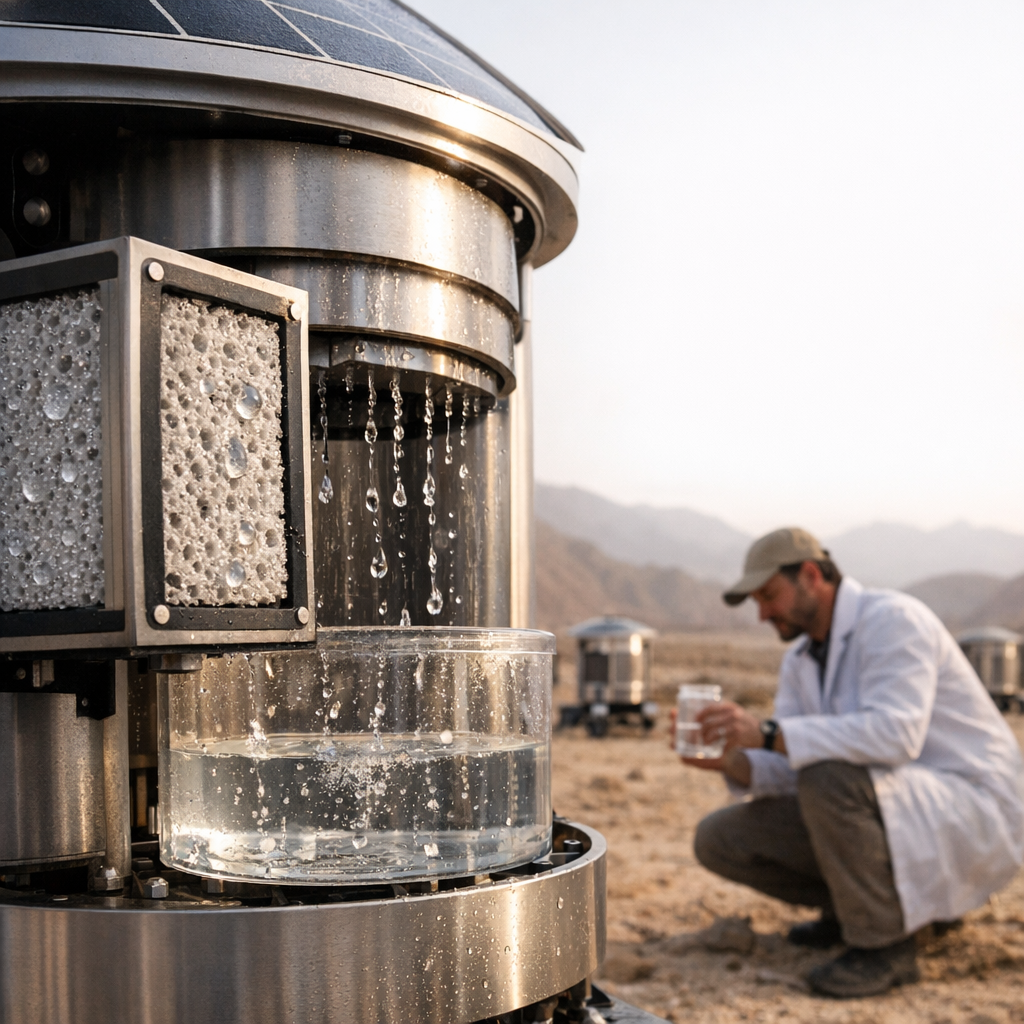
Researchers have developed a novel porous material capable of extracting substantial quantities of water from dry air, according to a report by Tech Xplore in the article titled “New porous material can harvest liters of water daily from dry air.”
The work highlights a growing effort to address global water scarcity through atmospheric water harvesting, a field that seeks to draw moisture directly from the air even in arid environments. The newly engineered material belongs to a class of substances designed with microscopic pores that can capture and release water efficiently under varying environmental conditions, similar to advances seen in metal-organic frameworks for water adsorption.
Unlike earlier systems that often required high humidity levels or significant external energy input, this new material reportedly performs well in relatively dry air. Researchers say the structure’s chemistry and pore architecture enable it to bind water molecules at low humidity and release them with minimal energy, an approach aligned with ongoing research in energy-efficient atmospheric water extraction.
In controlled testing, the material demonstrated the ability to produce liters of water daily, a scale that moves the technology closer to practical use. This represents a meaningful improvement over previous designs that struggled to generate sufficient output for real-world applications such as drinking water supply or agricultural use, a key concern highlighted by the World Health Organization’s global drinking water data.
The system operates through a cyclical process. During cooler or more humid periods, the material absorbs water vapor from the air. When temperatures rise or when mild heating is applied—potentially even from sunlight—the captured moisture is released and condensed into liquid water. The efficiency of this cycle depends on the material’s capacity to absorb water at low relative humidity while releasing it quickly when conditions shift, a principle explored in earlier atmospheric water harvesting systems.
Scientists involved in the research believe the breakthrough lies in fine-tuning the material’s internal structure, allowing for both strong water uptake and easy release. This balance has been a longstanding challenge in atmospheric water harvesting, where materials often excel at one function but not the other.
The implications are significant for regions facing chronic water shortages, particularly those with limited infrastructure. Systems based on such materials could be deployed off-grid, using ambient conditions and minimal energy to provide a steady water supply. This could benefit rural communities, disaster relief operations, and areas where groundwater is scarce or contaminated, as noted in global assessments by the UN Water initiative on water scarcity.
However, researchers caution that further work is needed before large-scale deployment. Questions remain about long-term durability, production costs, and performance across different climates. Scaling up manufacturing while maintaining efficiency will also be a critical hurdle.
Still, the findings reported by Tech Xplore suggest that atmospheric water harvesting is moving from experimental concept toward viable technology. As climate change impacts on water resources and population growth intensify pressure on freshwater supplies, innovations like this porous material could play an increasingly important role in diversifying global water sources.