
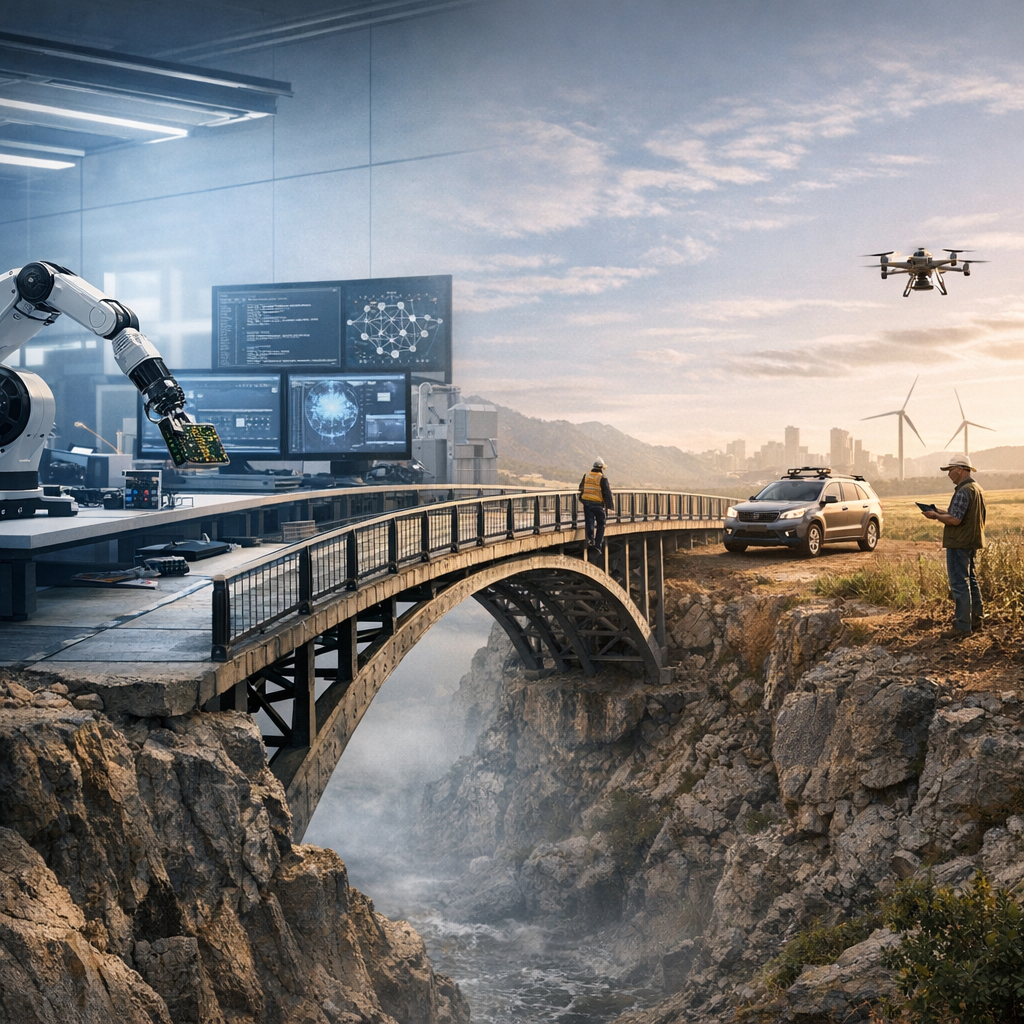
A recent report from MIT News, titled “Helping AI models meet the real world,” examines a growing challenge in artificial intelligence: how to ensure that systems trained in controlled environments can perform reliably in the complexity and unpredictability of real-world settings. The full report is available from MIT News.
The article highlights research efforts at the Massachusetts Institute of Technology aimed at narrowing the gap between laboratory-trained models and real-world deployment. While modern AI systems often achieve impressive results on benchmark datasets, they tend to falter when confronted with conditions that differ even slightly from their training environment. This discrepancy, commonly referred to as the “reality gap” (see sim-to-real transfer), has emerged as a major obstacle as AI increasingly moves from theory to application.
MIT researchers are developing techniques to make AI systems more adaptable and robust when faced with unfamiliar data. One focus is on improving how models handle distribution shifts—situations in which the data encountered in deployment differs from the data used during training (related to dataset shift and domain adaptation). These shifts can arise from changes in lighting for vision systems, variations in human behavior for language models, or unexpected environmental factors in robotics.
According to the MIT News article, a promising direction involves training models to recognize uncertainty and adjust their decisions accordingly. By equipping AI systems with mechanisms to detect when they are operating outside their comfort zone, researchers hope to reduce errors and improve safety. This approach connects to broader work in uncertainty quantification, contrasting with traditional models that often produce confident outputs even when they are incorrect.
Another area of work involves simulation environments designed to better approximate real-world complexity. Researchers are refining these simulations to incorporate variability and noise, allowing models to experience a broader range of scenarios before deployment. The goal is not merely to improve performance in ideal conditions, but to prepare systems for the irregularities and ambiguities that characterize real-world use, a central challenge in sim-to-real transfer research.
The MIT News report also underscores the importance of interdisciplinary collaboration. Bridging the gap between controlled experiments and real-world applications requires insights from fields such as engineering, cognitive science, and ethics. Researchers are increasingly working with domain experts to understand how AI systems behave in practical contexts, from healthcare to autonomous driving.
Ultimately, the challenge described in “Helping AI models meet the real world” reflects a broader shift in artificial intelligence research. The field is moving beyond achieving high accuracy on curated datasets toward building systems that are dependable, transparent, and resilient in everyday settings. As AI tools become more embedded in critical aspects of society, ensuring that they function reliably outside the laboratory is becoming not just a technical priority, but a societal one.
3 thoughts on “Bridging the Reality Gap: Making AI Systems Reliable Beyond the Lab”