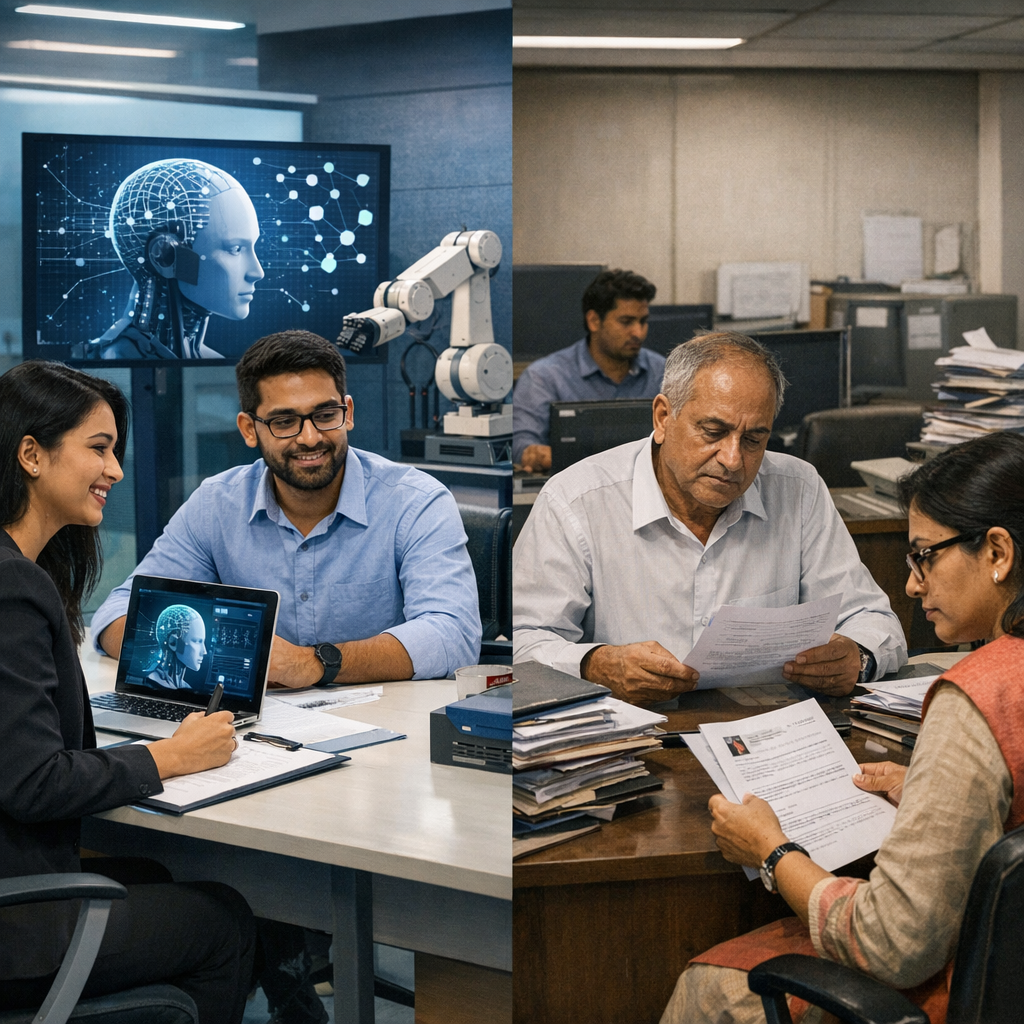
Hiring for artificial intelligence roles in India is accelerating at a pace that outstrips overall recruitment in the broader information technology sector, according to a recent industry analysis highlighted in the Economic Times article titled “AI hiring outpaces overall IT recruitment in India: Report.” The findings point to a structural shift in the country’s technology labour market, where demand for specialised skills in machine learning, data science, and generative AI is reshaping hiring priorities across companies.
The report described by Economic Times indicates that while traditional IT hiring has moderated amid global economic uncertainty and cautious spending by clients, recruitment for AI-focused roles has remained resilient and, in many cases, expanded sharply. This divergence reflects a growing enterprise push to integrate automation, analytics, and AI-driven decision systems into core operations, even as discretionary technology spending slows, a trend also highlighted in studies such as McKinsey’s State of AI report.
Industry data shows that organisations across sectors — including banking, retail, healthcare, and manufacturing — are actively seeking talent capable of deploying AI tools at scale. This demand is not limited to large technology firms. Global capability centres (GCCs), startups, and traditional enterprises are all competing for a relatively limited talent pool, contributing to intensified hiring activity and upward pressure on compensation for skilled professionals, as noted in reports like EY’s research on global capability centres.
Recruitment firms cited in the Economic Times report suggest that companies are increasingly prioritising roles such as AI engineers, data scientists, prompt engineers, and specialists in natural language processing and computer vision. Demand is also rising for professionals who can bridge technical and business functions, translating AI capabilities into practical applications that deliver efficiency gains or new revenue streams, aligning with broader global findings from the Stanford AI Index Report.
At the same time, the broader IT services sector is experiencing a more cautious hiring environment. Major Indian IT employers have slowed fresher intake and moderated lateral hiring in response to weaker global demand and ongoing client budget scrutiny. This has created a bifurcated job market in which conventional roles face slower growth while advanced digital and AI positions expand, echoing workforce trends discussed in the World Economic Forum’s Future of Jobs Report.
The surge in AI hiring is also influencing workforce development strategies. Companies are increasingly investing in upskilling programs to retrain existing employees in AI-related competencies rather than relying solely on external hiring. Training in generative AI tools, data handling, and model deployment has become a priority as firms look to remain competitive while managing costs, a direction supported by initiatives outlined by industry bodies such as NASSCOM.
However, the report underscores a persistent talent gap. Despite the rapid increase in interest and training initiatives, the supply of experienced AI professionals remains constrained, particularly at senior levels. This mismatch is prompting organisations to explore alternative approaches, including partnerships with academic institutions, internal talent mobility programs, and expanded hiring from non-traditional backgrounds.
The Economic Times article suggests that this trend is likely to continue in the near term, as AI adoption deepens across industries. Rather than being a temporary hiring spike, the rise in AI recruitment reflects a longer-term transformation in how technology is developed and applied in business.
As companies recalibrate their workforce strategies, the implications extend beyond hiring numbers. The shift toward AI-focused roles signals a broader redefinition of skills in India’s technology sector, with expertise in automation and advanced analytics increasingly becoming central to future employability.