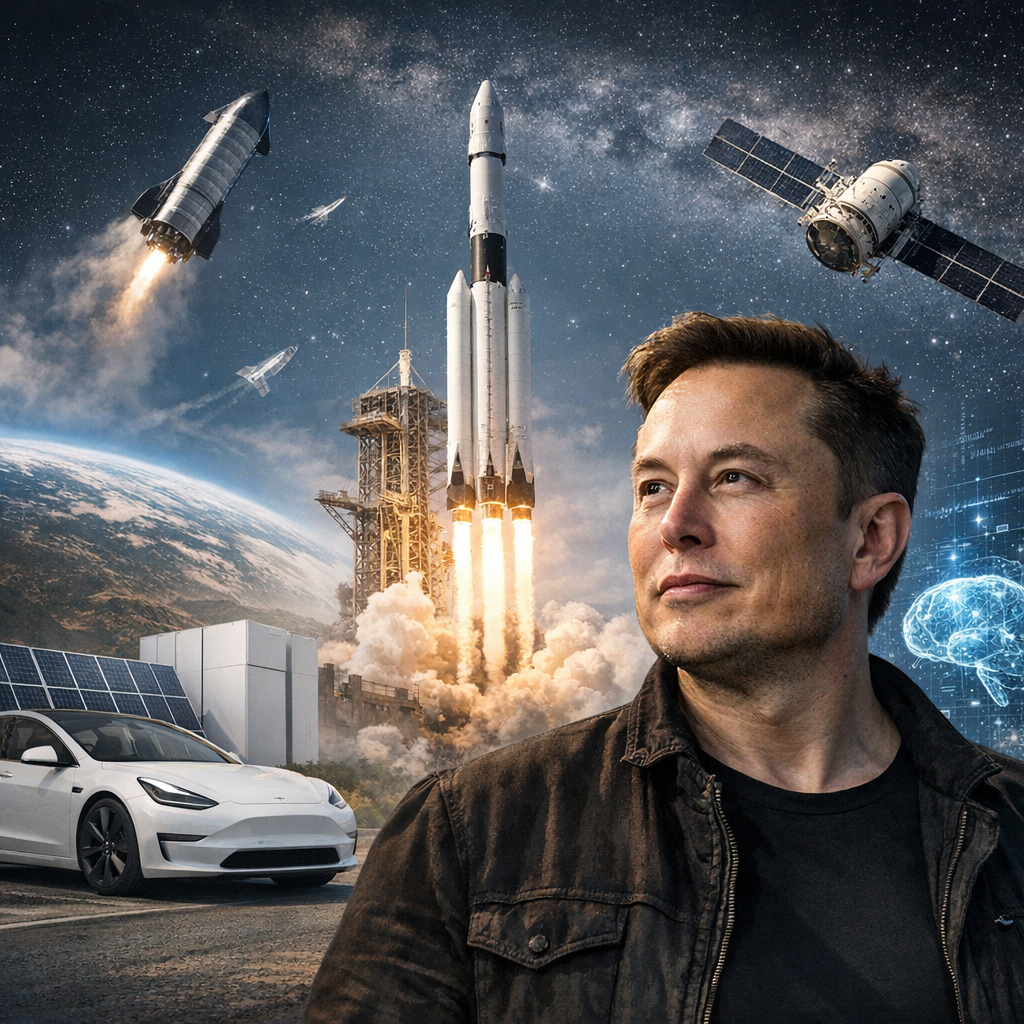
A recent article by The Economic Times, titled “From rockets to brain implants: Here’s a look at Elon Musk’s vast empire,” surveys the breadth of Elon Musk’s business ventures, underscoring how a set of companies that once appeared loosely connected have evolved into a sprawling and increasingly interdependent ecosystem.
At the center of this network remains Tesla, the electric vehicle maker that has driven much of Musk’s public profile and financial influence. While Tesla continues to face intensifying global competition and recurring scrutiny over its autonomous driving claims, it remains a dominant force in the shift toward electrification and energy storage. The company’s efforts extend beyond automobiles into battery systems and grid-scale solutions, positioning it as both a transportation and energy player.
Parallel to Tesla, SpaceX has redefined commercial spaceflight. Through its reusable rocket technology, the company has significantly reduced launch costs and secured contracts with NASA and private clients alike. Its Starlink satellite network, initially conceived as a way to fund deeper space ambitions, has quickly become a major telecommunications service, particularly in underserved or conflict-affected regions. The Economic Times notes that Starlink’s global expansion has given Musk a measure of geopolitical influence that extends beyond traditional corporate boundaries.
Musk’s reach into communications deepened with his acquisition of the social media platform X, formerly Twitter. What began as a controversial takeover has since reshaped the platform’s business model, moderation policies, and strategic direction. Under Musk, X has pursued a transformation into a broader “everything app,” though questions remain about its financial sustainability and user retention amid shifting policies.
Another key component of Musk’s portfolio is Neuralink, a neurotechnology company focused on developing brain-computer interfaces. While still in early stages, Neuralink has attracted attention for its ambition to treat neurological conditions and, eventually, enable direct communication between humans and machines. The Economic Times article highlights both the promise of such technology and the ethical concerns surrounding human trials and long-term implications.
The Boring Company, a comparatively smaller venture, aims to address urban congestion through tunnel-based transportation systems. Though its projects have seen mixed traction, the company represents Musk’s continuing interest in infrastructure solutions that challenge conventional approaches.
What distinguishes Musk’s enterprise, as the Economic Times article suggests, is not merely its scale but the degree of overlap among its components. Advances in artificial intelligence, battery technology, and manufacturing often feed across company lines, creating synergies that amplify their collective impact. At the same time, this concentration of influence raises concerns about governance, accountability, and the risks associated with a single individual holding sway over multiple critical technologies.
As Musk continues to push into sectors ranging from space exploration to neuroscience, the contours of his empire suggest a strategic ambition that extends beyond any single industry. Whether that ambition ultimately delivers cohesive breakthroughs or introduces new complexities will remain a central question for investors, regulators, and the public alike.