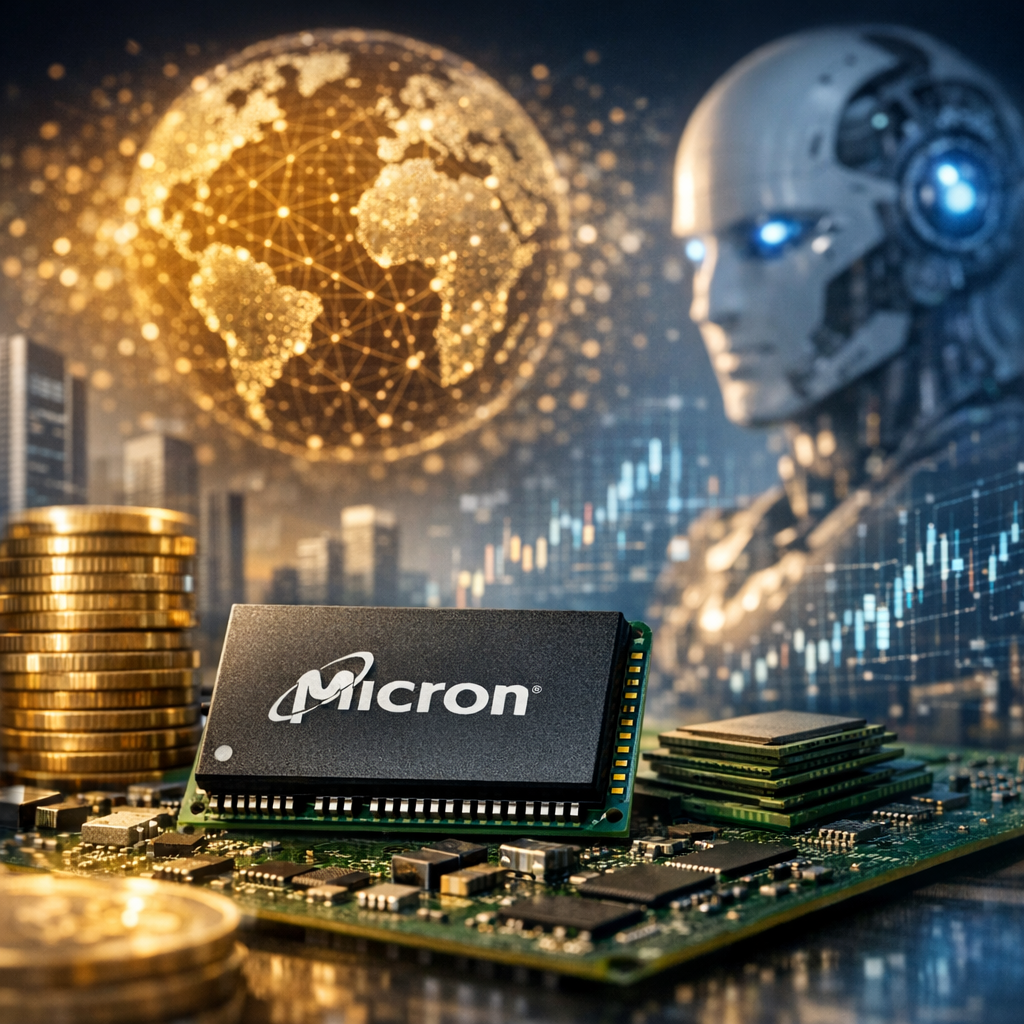
Micron Technology has entered the ranks of the world’s trillion-dollar companies, underscoring the growing investor conviction that memory chips will play a central role in the artificial intelligence boom. The milestone, reported in the article “Micron joins $1 trillion club as AI race powers memory chip boom” published by The Economic Times, reflects a broader shift in how markets are valuing semiconductor firms tied to next-generation computing infrastructure.
The surge in Micron’s valuation comes as demand for high-performance memory, particularly high-bandwidth memory (HBM), accelerates alongside the rapid expansion of AI models and data-intensive workloads. Unlike traditional computing applications, advanced AI systems require vast quantities of fast, efficient memory to process and store information in real time. This has repositioned memory manufacturers from cyclical, commodity-oriented suppliers to strategic enablers of cutting-edge technology.
Investors have responded accordingly. Micron’s stock has risen sharply over the past year, fueled by expectations that AI-driven demand will sustain higher pricing and tighter supply conditions for memory chips. The company has also benefited from improving fundamentals following a prolonged downturn in the semiconductor cycle, during which excess inventory and weak demand weighed heavily on earnings.
The Economic Times article highlights how Micron’s ascent mirrors a broader rally across the semiconductor sector, where companies linked to AI infrastructure—from chip designers to equipment manufacturers—have seen significant valuation gains. Yet Micron’s case is distinct in that memory chips, long viewed as interchangeable and price-sensitive, are now being reconsidered as critical, differentiated components within AI systems.
Industry analysts caution that while the outlook is strong, the memory market’s historical volatility has not disappeared. Capacity expansions, shifts in demand, and geopolitical factors could still introduce instability. However, the current cycle appears structurally different, with AI providing a more durable and scalable source of demand than previous drivers such as personal computers or smartphones.
Micron has moved aggressively to capitalize on this shift, increasing investment in advanced memory technologies and securing supply agreements with major AI hardware producers. Its positioning within the supply chain has made it a key beneficiary of the race among technology companies to build ever more powerful AI systems.
The company’s rise to a trillion-dollar valuation signals a redefinition of what constitutes a core technology player in the modern era. As AI continues to reshape industries, the importance of components that enable speed, efficiency, and scale—particularly memory—has become far more pronounced.
Whether Micron can sustain its newfound status will depend on its ability to navigate both the opportunities and the inherent risks of a rapidly evolving market. For now, its inclusion in the trillion-dollar club stands as a marker of how profoundly AI has altered the semiconductor landscape.