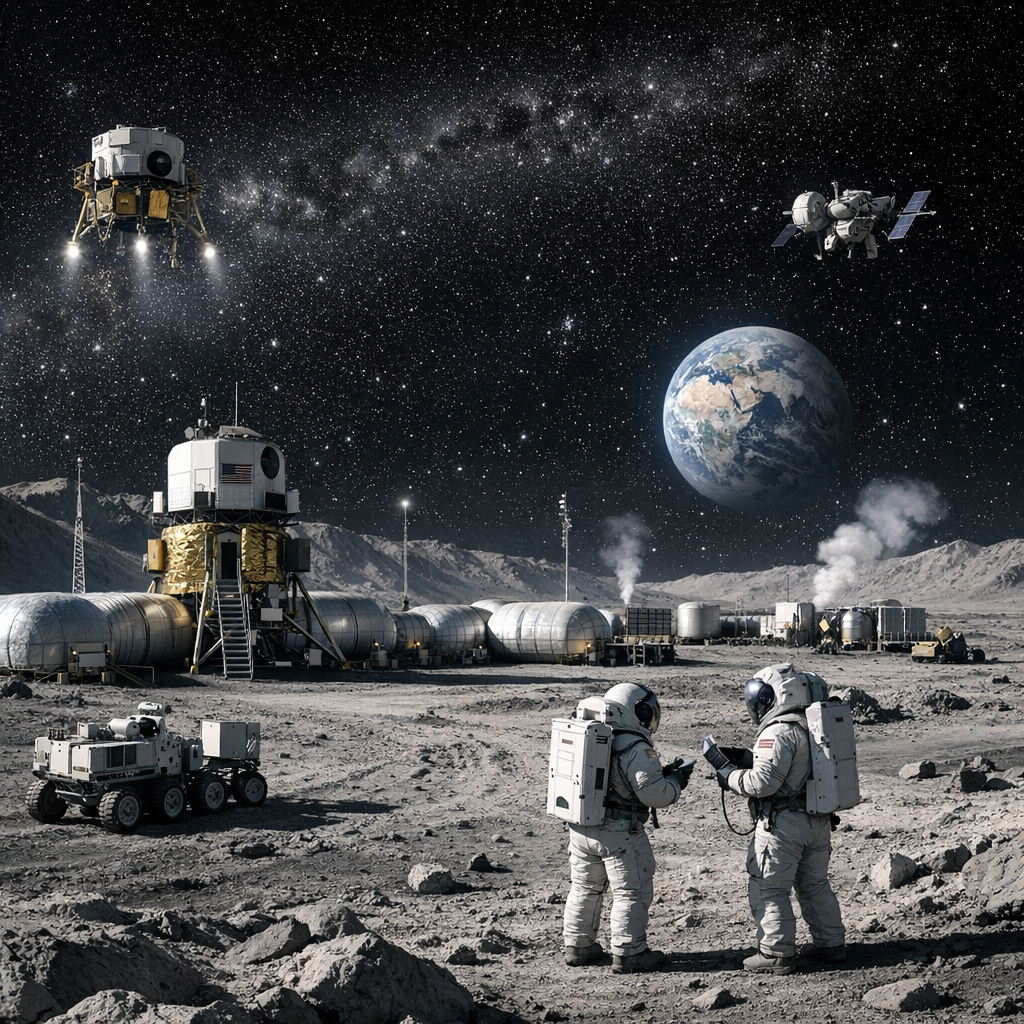
NASA has outlined an initial framework for establishing a long-term human presence on the Moon, marking a significant step in its broader Artemis program aimed at sustained lunar exploration and eventual missions to Mars. The details, reported in the article “NASA reveals first phase of giant Moon base plans” published by Innovation News Network, describe a phased approach that prioritizes infrastructure, logistics, and international collaboration.
According to the report, the first phase focuses on developing foundational systems necessary to support repeated human missions to the lunar surface. Central to this effort is the creation of a reliable transportation network, including the Space Launch System and Orion spacecraft, alongside planned lunar landers capable of delivering cargo and crew. These systems are intended to operate in coordination with the Lunar Gateway, a space station planned for orbit around the Moon that will serve as a staging point for surface operations.
The early design emphasizes modularity and scalability, allowing initial missions to test critical technologies before expanding into more permanent installations. Surface infrastructure will likely include habitats, power systems, and mobility platforms such as rovers. NASA is placing particular emphasis on the Moon’s दक्षिण polar region, where water ice deposits are believed to exist in permanently shadowed craters. These resources could play a pivotal role in supporting human life and producing fuel, reducing reliance on resupply missions from Earth.
The Innovation News Network article highlights that sustainability is a core objective of the project. Rather than short, isolated expeditions, NASA aims to establish a continuous presence supported by robust life support systems and local resource utilization. This includes developing methods to extract oxygen and hydrogen from lunar regolith and ice, as well as advancing technologies for energy generation, potentially through solar arrays positioned to take advantage of near-continuous sunlight at certain polar locations.
International partnerships and commercial collaboration are also central to the strategy. NASA is working with a range of global space agencies and private companies to distribute the technical and financial burden of the endeavor. This collaborative approach reflects lessons learned from the International Space Station, where multinational cooperation proved essential to long-term success.
While the plans remain in early stages, as noted in the Innovation News Network coverage, they signal a shift in how space agencies approach lunar exploration—from brief, symbolic missions to sustained, strategic occupation. The incremental design allows NASA to adapt to technical challenges and budgetary constraints while steadily advancing toward a more permanent foothold on the Moon.
The broader implications of the initiative extend beyond lunar exploration. Establishing a base on the Moon is widely viewed as a critical proving ground for technologies and operational strategies needed for future missions to Mars. By testing life support systems, habitat construction, and in-situ resource utilization in a relatively نزدیک extraterrestrial environment, NASA aims to reduce the risks associated with deeper space travel.
As work progresses, timelines and specific configurations are expected to evolve. However, the first phase outlined in NASA’s plan underscores a clear strategic direction: building the infrastructure necessary to transform the Moon into a sustained hub for human activity in space.