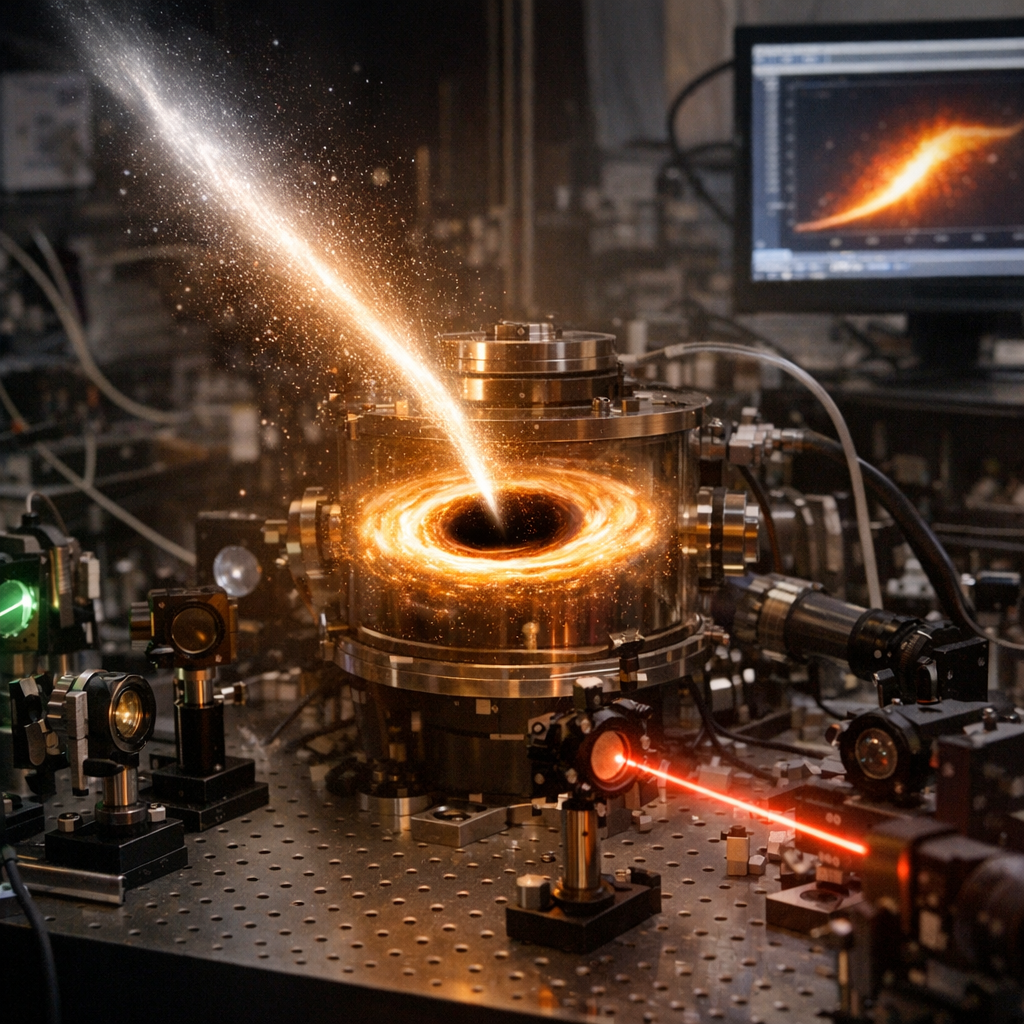
A recent report by Innovation News Network, titled “Hawking radiation breakthrough offers insight into black holes,” highlights a significant step forward in physicists’ long-standing effort to understand one of the most elusive phenomena in the universe. The work brings fresh clarity to the theoretical mechanism proposed by Stephen Hawking in the 1970s, which suggests that black holes are not entirely black but instead emit a faint form of radiation due to quantum effects near their event horizons.
According to the Innovation News Network article, researchers have made progress in recreating conditions analogous to black hole environments within laboratory settings, allowing them to probe the quantum behavior that underpins Hawking radiation. Because actual black holes are extraordinarily distant and their emissions are exceedingly weak, direct observation remains beyond current technological capabilities. As a result, scientists rely on carefully designed analogue systems, sometimes referred to as analogue gravity models, which simulate key properties of black holes using media such as ultracold gases or optical systems.
The breakthrough centers on improved experimental techniques that enable more precise measurements of particle behavior at the boundary where classical and quantum physics intersect, near what is known as the event horizon. In such analogue systems, researchers can observe phenomena that mirror the particle-antiparticle pair production predicted by Hawking. One particle escapes while the other falls into the black hole, effectively leading to a gradual loss of mass and energy from the system. By demonstrating clearer signatures of this process, the latest findings strengthen confidence in the theoretical framework that has guided black hole physics for decades.
Beyond confirming aspects of Hawking’s original proposal, the new research also carries broader implications for fundamental physics. It provides a testing ground for ideas about how gravity interacts with quantum mechanics, a central unresolved question that continues to challenge physicists. Insights gained from these controlled experiments may help bridge the gap between general relativity, which governs large-scale cosmic structures, and quantum theory, which explains subatomic behavior.
The Innovation News Network report underscores that the work is not merely a confirmation of existing theory but also a platform for refining it. By identifying subtle deviations or previously undetectable effects, researchers can explore whether current models are complete or require modification. Such refinements could have implications for understanding black hole evaporation and the longstanding information paradox, as well as the ultimate fate of matter consumed by these cosmic objects.
While practical applications of this research remain distant, the intellectual significance is considerable. The ability to simulate and study black hole phenomena in laboratory environments marks a shift from purely theoretical speculation toward experimentally grounded inquiry. In doing so, it brings physicists closer to resolving questions that sit at the heart of modern science.
As the findings discussed in “Hawking radiation breakthrough offers insight into black holes” suggest, continued advances in experimental design and quantum measurement are likely to deepen our understanding of the universe’s most extreme environments. The work represents a notable convergence of theory and experiment, offering a clearer window into the complex interplay between gravity, quantum mechanics, and the fabric of spacetime.