Researchers are drawing inspiration from one of nature’s most efficient builders—ants—to develop simple robotic systems capable of coordinated excavation, offering new insights into both biology and autonomous engineering.
A recent report published by Tech Xplore, titled “Simple robots like ants can excavate complex structures,” details how scientists have designed minimalist robots that collectively dig and organize material without centralized control. The work highlights how complex group behavior can emerge from straightforward individual rules, a principle long observed in social insects.
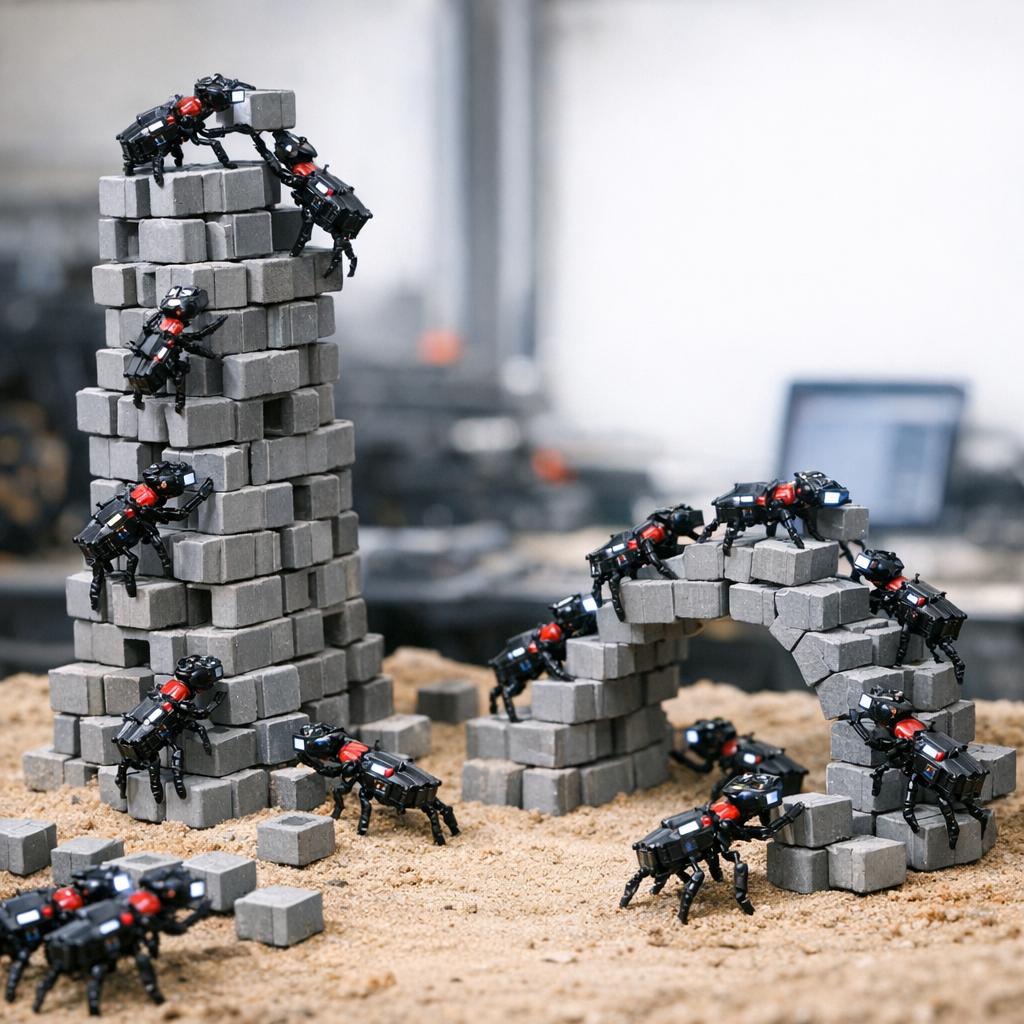
In the study, each robot operates with limited sensing and decision-making capability. Rather than following a pre-programmed blueprint or relying on a leader, the machines respond to local conditions—such as nearby obstacles or the presence of other robots—to determine their actions. Over time, these interactions produce organized excavation patterns resembling tunnels or chambers.
Researchers say this decentralized approach mirrors how ant colonies construct intricate underground nests. Individual ants follow simple behavioral cues, yet the colony as a whole achieves highly structured outcomes. Translating this principle into robotics could reduce the need for expensive sensors, detailed mapping systems, or constant human oversight.
The findings have potential applications in environments where traditional machinery struggles, such as disaster zones, underground exploration, or extraterrestrial construction. Swarms of low-cost robots could, in theory, collaborate to clear debris, create shelters, or prepare terrain without requiring detailed prior information about their surroundings.
Beyond engineering, the research also contributes to a deeper understanding of collective intelligence in biological systems. By replicating ant-like strategies in machines, scientists can test hypotheses about how coordination emerges in nature and how robust such systems are under changing conditions.
The study underscores a shift in robotics toward simplicity and scalability, where large numbers of relatively unsophisticated units can outperform more complex, centralized systems. As the boundary between biology and technology continues to blur, such work points to a future where machines build not through rigid instructions, but through adaptive, cooperative behavior shaped by their immediate environment.