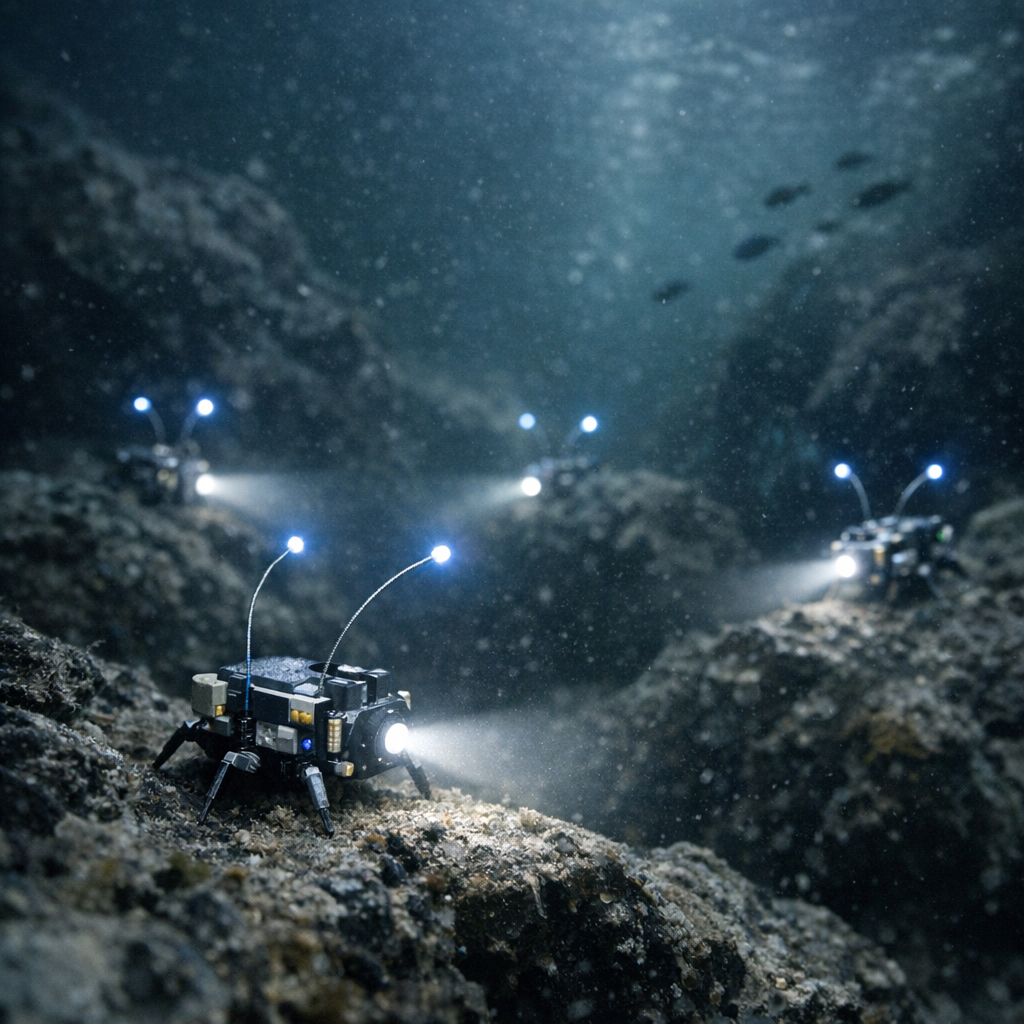
Researchers have unveiled a new class of miniature underwater robots designed to navigate and communicate in environments where conventional systems struggle, according to a report published by TechXplore titled “Tiny underwater antenna robots for dark environments.”
The study details the development of compact robotic devices equipped with antenna-based sensing systems that allow them to operate effectively in low-visibility or completely dark underwater conditions. Unlike traditional underwater robots, which rely heavily on optical cameras or bulky sonar equipment, these machines are built to detect and transmit signals using electromagnetic fields, enabling them to function where light and visibility are severely limited.
The innovation addresses a longstanding challenge in subsea exploration. Deep-sea environments, murky waters, and confined aquatic spaces—such as underwater caves, pipelines, and infrastructure—often render visual navigation systems ineffective. By integrating antenna-based communication directly into the robots’ design, researchers aim to create systems that can maintain connectivity and coordination without relying on line-of-sight signals.
According to the TechXplore report, the robots are extremely small, a design choice that enhances their mobility and allows them to access tight or hazardous environments that would be inaccessible to larger machines. Their antenna systems serve multiple roles, including communication, sensing nearby objects, and potentially mapping their surroundings through signal feedback. This multifunctionality reduces the need for additional hardware, helping keep the robots lightweight and energy efficient.
The research team also emphasized the potential for swarm deployment. Because the robots are compact and relatively simple, they could be deployed in large numbers to collaboratively explore or monitor underwater areas. In such configurations, communication between units becomes critical, and the antenna-based approach offers a way to maintain coordination without relying on acoustic systems, which can be slow and susceptible to interference.
Potential applications extend beyond scientific exploration. The technology could be used for inspecting underwater infrastructure such as oil and gas pipelines, offshore wind installations, and telecommunications cables. Environmental monitoring is another key area, where fleets of these robots could track pollution, study marine ecosystems, or assess damage after natural disasters.
While the concept is still in the research phase, the findings suggest a shift toward more adaptable and resilient underwater robotics. By moving away from vision-dependent systems and toward signal-based sensing and communication, the technology may open new possibilities for operating in some of the most challenging environments on Earth.
The work highlighted by TechXplore underscores a broader trend in robotics research: designing smaller, smarter, and more specialized machines that can operate where traditional tools fall short.