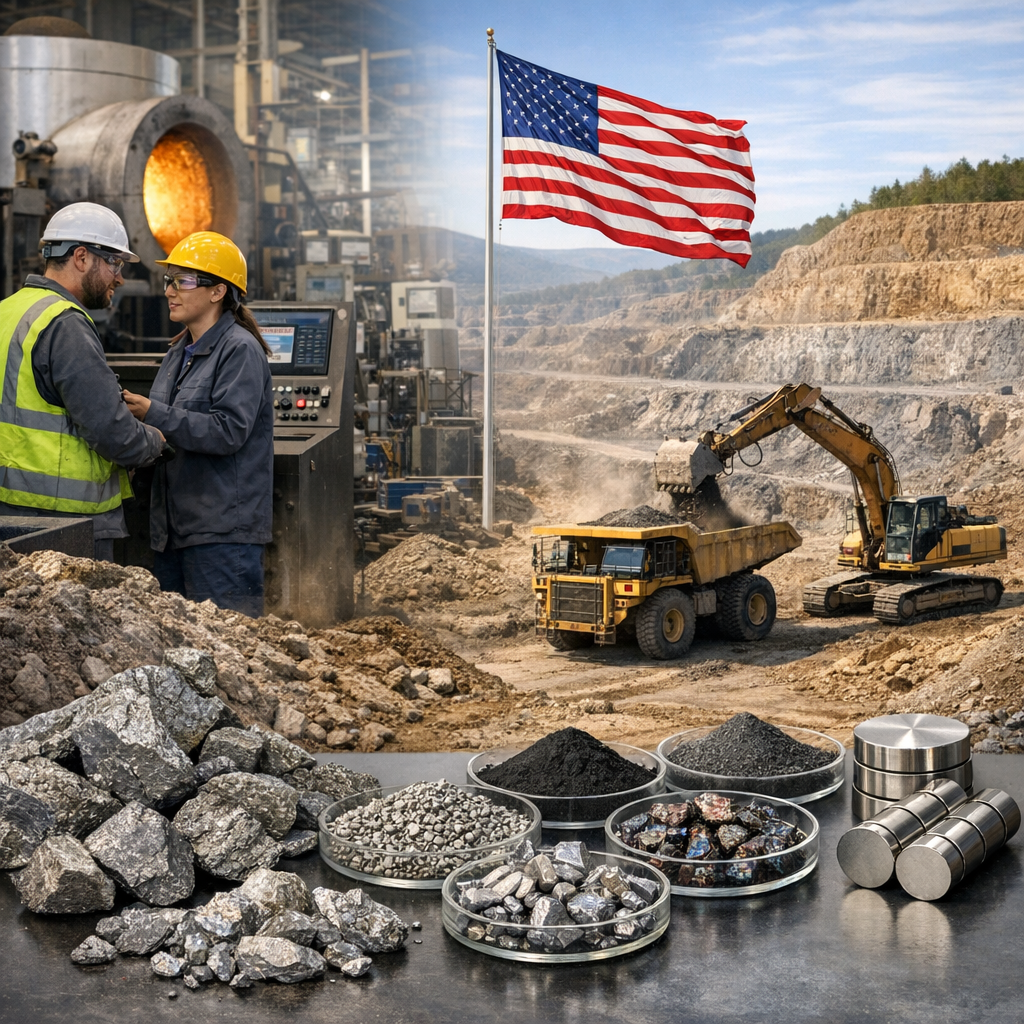
The United States has announced a new tranche of federal funding aimed at reinforcing domestic supply chains for critical minerals, committing $134 million to projects focused on rare earth element production and processing. The move, detailed in the article “US announces $134 million projects that will strengthen domestic supply chains for rare earth elements” published by Innovation News Network, underscores growing concern in Washington over reliance on foreign sources for materials essential to advanced manufacturing, defense systems, and clean energy technologies.
According to the Innovation News Network report, the funding—administered through the U.S. Department of Energy—will support a series of projects designed to expand the country’s capacity to extract, separate, and refine rare earth elements. These materials, which include neodymium, dysprosium, and terbium, are critical for products ranging from electric vehicle motors to wind turbines and precision-guided weapons systems. Despite their importance, much of the global supply chain remains concentrated outside the United States, particularly in China, which dominates both mining and processing.
Federal officials say the investment is intended to mitigate supply risks and stimulate domestic industry in areas that have historically struggled to compete with lower-cost international producers. By supporting both early-stage research and commercial-scale development, the initiative aims to bridge gaps in the supply chain that have left U.S. manufacturers dependent on imports.
The projects backed by the funding are expected to span multiple stages of production, including mineral extraction, advanced separation technologies, and recycling of rare earth materials from end-of-life products. Innovation News Network reports that emphasis will also be placed on environmentally responsible methods, reflecting increasing regulatory and public scrutiny over the ecological impact of mining and processing operations.
The announcement comes amid a broader effort by the U.S. government to classify critical minerals as a strategic priority. Policymakers have warned that supply disruptions—whether from geopolitical tensions or market volatility—could hamper the deployment of clean energy technologies and weaken national security. In recent years, federal agencies have expanded grant programs, tax incentives, and public-private partnerships aimed at reducing these vulnerabilities.
Industry analysts note that while the $134 million commitment represents a meaningful step, building a fully resilient domestic supply chain will require sustained investment over many years. Rare earth processing facilities, in particular, are capital-intensive and technically complex, making it difficult for new entrants to compete without long-term policy support.
At the same time, there is growing recognition that diversification, rather than complete domestic independence, may be a more realistic goal. Alongside domestic projects, the United States has pursued partnerships with allied nations to secure alternative sources of supply, reflecting the global nature of the minerals market.
The funding initiative highlighted by Innovation News Network signals continued momentum in federal efforts to reshape the critical minerals landscape. Whether it will be sufficient to significantly reduce reliance on overseas supply chains remains uncertain, but it marks a clear acknowledgment that rare earth elements will play a central role in the economic and strategic competition of the coming decades.