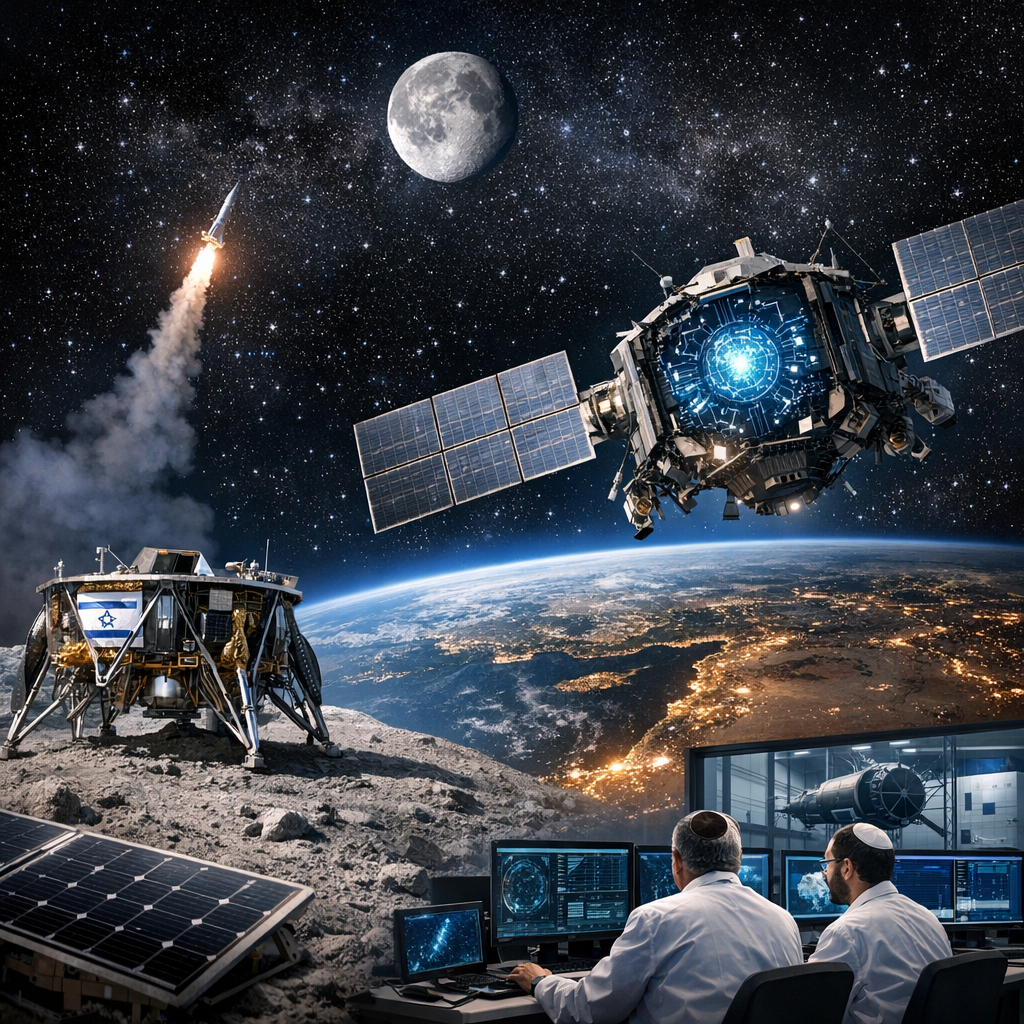
Israel’s emergence as a significant force in space technology is no longer defined by isolated achievements but by a rapidly consolidating ecosystem that blends aerospace engineering, artificial intelligence, and commercial ambition. As outlined in the article “Israel’s Space-Tech Moment: From Beresheet to Space-Based AI,” published by VCCafe, the country’s trajectory reflects a shift from symbolic breakthroughs to sustained industrial and technological momentum.
Much of this evolution can be traced back to the Beresheet mission, Israel’s first attempt to land a spacecraft on the Moon. Although the 2019 mission ended in failure during its final descent, it had an outsized impact on the country’s space sector. It demonstrated that a relatively small, privately led initiative could reach deep space at a fraction of the traditional cost, reshaping perceptions of what was technologically and financially feasible. The mission’s legacy has since become foundational, inspiring both entrepreneurs and investors to pursue new ventures in space technology.
Since then, Israel’s space ecosystem has expanded beyond singular missions into a diverse network of startups and research initiatives. A key area of growth is the integration of artificial intelligence into space-based systems. Companies are increasingly focusing on satellite data analytics, autonomous operations, and onboard AI processing, enabling spacecraft to interpret and act on information in real time without relying heavily on ground control. This capability is particularly valuable in applications such as Earth observation, defense, agriculture, and climate monitoring, where rapid data interpretation can significantly enhance decision-making.
Israel’s strengths in cybersecurity, data science, and miniaturization have translated effectively into this domain. Startups are leveraging these capabilities to build smaller, more efficient satellites and to develop software systems that can analyze vast streams of data generated in orbit. This convergence of AI and space infrastructure marks a shift from hardware-centric space programs to more integrated, software-driven models, similar to trends highlighted in the World Economic Forum’s analysis of AI in space technology.
Government support has also played a role, though the sector remains notably driven by private initiative. The Israel Space Agency and partnerships with international organizations have helped provide a framework for growth, but much of the innovation is emerging from venture-backed companies operating with agility and a commercial mindset. This dynamic mirrors the broader Israeli tech ecosystem, where military expertise and academic research often feed directly into entrepreneurial ventures.
At the same time, challenges remain. The global space industry is becoming increasingly competitive, with major investments from the United States, China, and Europe, as well as a growing number of private players documented in reports like the McKinsey overview of the new space race. Israeli companies must navigate limited domestic funding compared to larger markets and contend with the high costs and risks inherent in space ventures. Nonetheless, the sector’s focus on niche capabilities—particularly in AI-driven analysis and compact satellite systems—offers a pathway to maintaining a competitive edge.
The article published by VCCafe suggests that Israel’s current moment in space technology is less about a single defining achievement and more about the maturation of an ecosystem poised for sustained impact. The transition from Beresheet’s symbolic milestone to a broader integration of space-based AI signals a strategic realignment—one that positions Israel not only as a participant in the global space race but as a contributor to its next phase.
As commercial space activity accelerates worldwide, Israel’s model—combining technical expertise, entrepreneurial agility, and cross-disciplinary innovation—may prove particularly well suited to an era where space is increasingly shaped by data, autonomy, and scalable technologies rather than large-scale government programs alone.