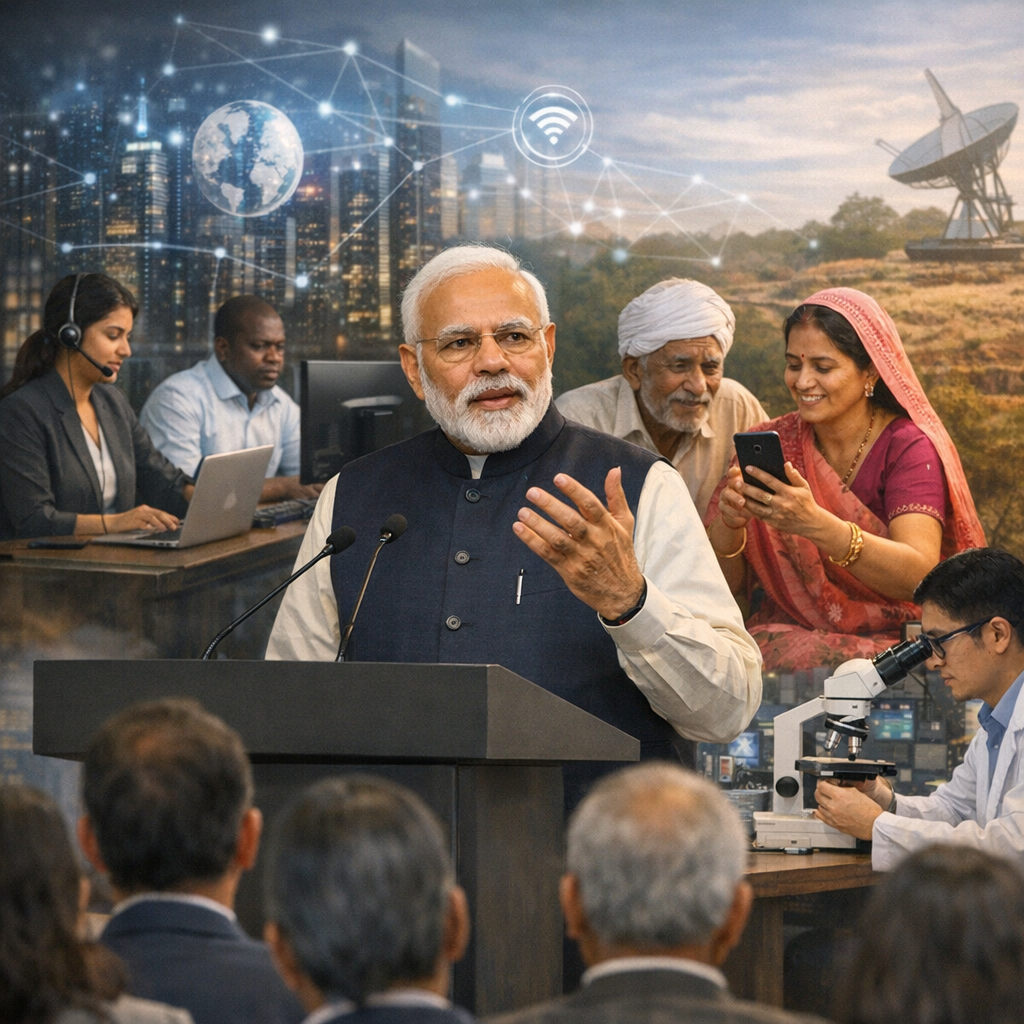
Indian Prime Minister Narendra Modi has underscored the importance of equitable access to technology, arguing that its transformative power can only be fully realized when it is broadly shared across society. His remarks, reported in the Economic Times article, highlight a growing policy emphasis on inclusion as digital innovation accelerates globally.
Speaking in the context of India’s expanding digital ecosystem, Modi stressed that technology must not become the preserve of a privileged few. Instead, he framed it as a public good capable of driving widespread economic growth, improving governance, and enhancing quality of life when made accessible to all segments of society. The prime minister’s comments come as India continues to promote digital public infrastructure, such as Aadhaar, Unified Payments Interface (UPI), and other platforms designed to reach millions of citizens across income levels.
Modi pointed to India’s experience as evidence that large-scale adoption of digital tools can bridge longstanding gaps in financial inclusion and public service delivery. He argued that when technology is embedded in governance systems and made affordable, it can reduce inequality rather than exacerbate it. This approach contrasts with concerns in many parts of the world that rapid technological advancement risks deepening socioeconomic divides, often referred to as the digital divide.
The Economic Times report noted that the prime minister’s remarks align with India’s broader push to position itself as a global technology leader while advocating for responsible and inclusive innovation. This includes efforts to shape international conversations around digital governance, data sharing, and artificial intelligence in ways that prioritize accessibility and public benefit, as seen in discussions around AI policy and governance.
Modi also highlighted the role of collaboration between governments, private enterprises, and innovators in advancing these goals. By fostering an ecosystem that encourages open platforms and scalable solutions, he suggested, countries can ensure that technological progress translates into tangible outcomes for citizens rather than remaining confined to elite sectors. This vision aligns with the broader concept of digital public infrastructure as a foundation for inclusive growth.
His comments come at a time when debates over the societal impact of emerging technologies, particularly artificial intelligence, are intensifying worldwide. Policymakers are grappling with how to balance innovation with safeguards, as well as how to ensure that the benefits of new technologies are distributed fairly.
By framing democratisation as a prerequisite for meaningful progress, Modi placed inclusivity at the center of the technology agenda. The message reflects a broader recognition that the next phase of digital transformation will be judged not only by technological breakthroughs but also by how effectively they are integrated into everyday life for diverse populations.