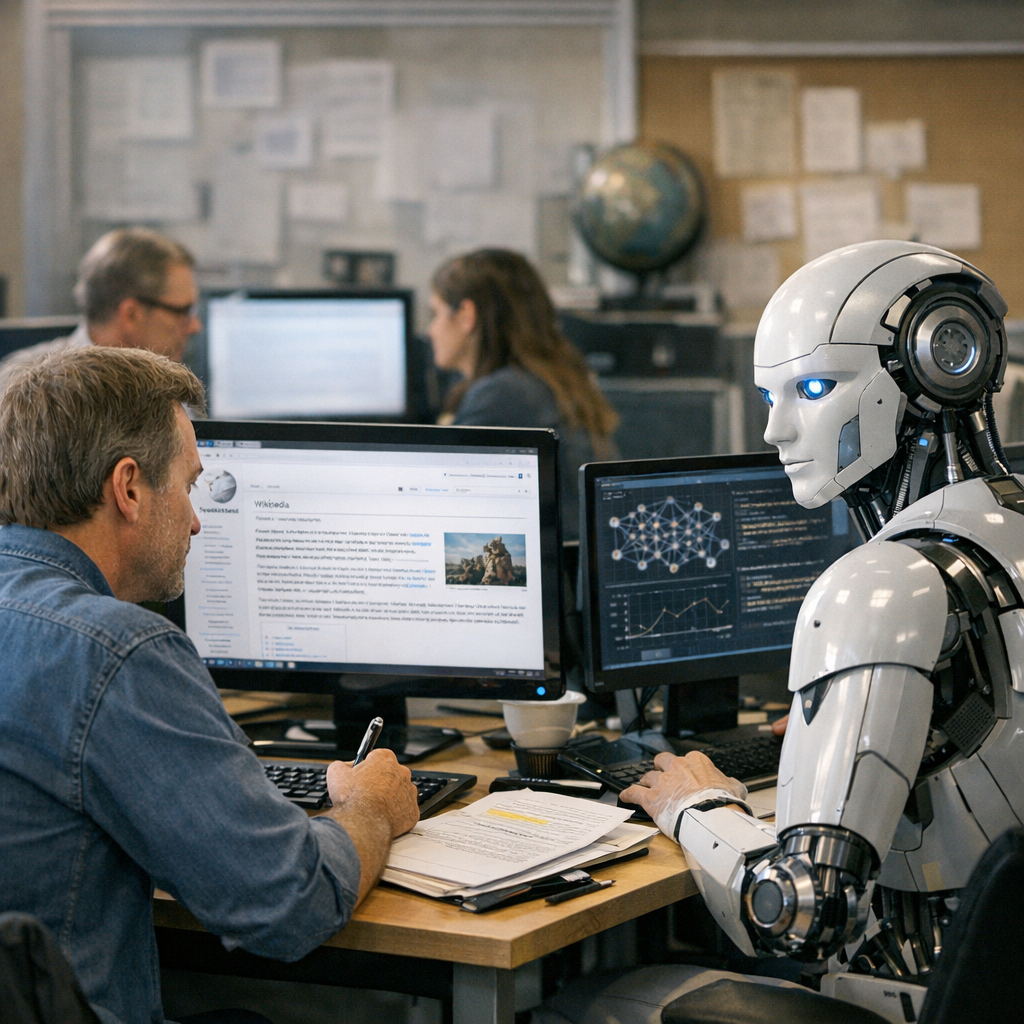
Wikipedia will not rely on artificial intelligence to write or replace its core body of articles, co-founder Jimmy Wales has said, underscoring the platform’s continued commitment to human-led curation despite rapid advances in generative AI.
In remarks reported by Tech Xplore in its article “Wikipedia won’t use AI to write articles, cofounder says”, Wales emphasized that the online encyclopedia’s credibility depends on verifiable sourcing, editorial judgment, and community oversight—qualities he argued current AI systems cannot reliably replicate. While acknowledging that artificial intelligence tools may assist with certain tasks, he drew a clear boundary around their role in producing encyclopedic content.
Wales’ comments come as media organizations, tech companies, and content platforms experiment with integrating AI systems capable of generating large volumes of text. Those systems, while increasingly sophisticated, have been widely criticized for fabricating information or presenting inaccuracies with confidence, raising concerns about their use in knowledge repositories.
According to the Tech Xplore report, Wales pointed to the risk of “hallucinations”, a known issue in which AI models generate plausible but false statements. Such errors are especially problematic for a platform like Wikipedia, which has built its reputation on citation-backed information and a transparent editorial process. Allowing AI to author primary content could undermine trust in the site, he suggested.
Instead, Wikipedia is exploring limited, supportive applications of artificial intelligence. These include tools designed to help volunteer editors streamline repetitive work, detect vandalism, or improve readability. Any deployment, Wales indicated, would be carefully controlled and subject to community input, maintaining the platform’s longstanding governance model guided by principles like verifiability.
Wikipedia’s approach contrasts with a broader trend in the tech industry, where companies are rapidly integrating generative AI into search engines, writing tools, and customer service systems. Proponents argue that such tools can boost productivity and expand access to information, while critics warn they risk amplifying misinformation if not rigorously managed.
Wales’ stance reflects a cautious philosophy shaped by Wikipedia’s history. Since its founding in 2001, the platform has relied on a global network of volunteer contributors who adhere to strict policies on sourcing, neutrality, and verifiability. That model, while sometimes criticized as inconsistent or slow, has enabled Wikipedia to become one of the most widely used and trusted reference sites online.
By reaffirming the central role of human editors, Wales signaled that Wikipedia intends to prioritize accuracy and accountability over speed or scale as AI capabilities evolve. The platform, he suggested, will adapt to new technologies, but not at the cost of the principles that underpin its credibility.