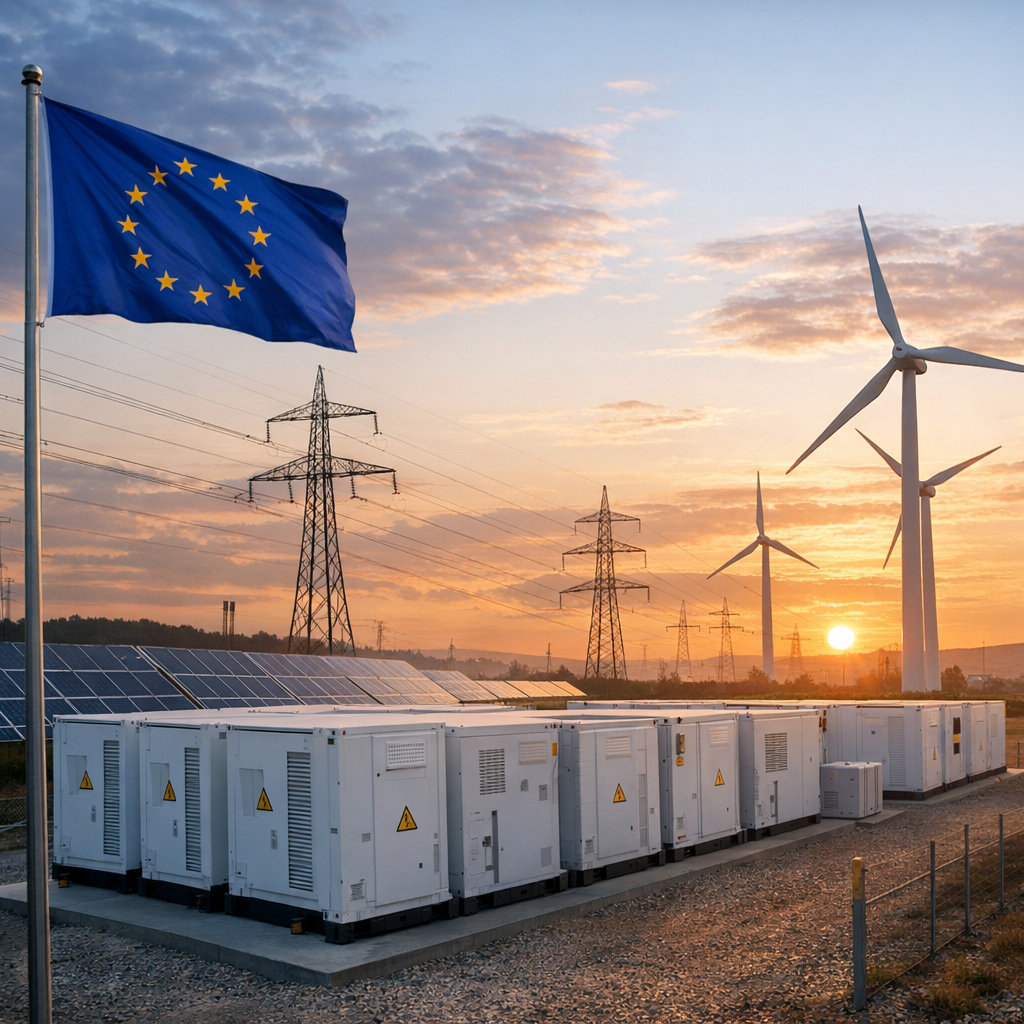
A tripartite agreement aimed at rapidly scaling up Europe’s energy storage capacity marks a significant step in the European Union’s broader transition to a more resilient, low-carbon energy system. As reported in the article “EU energy storage tripartite agreement to deliver 35GW by 2028” published by Innovation News Network, the initiative brings together key industry stakeholders in a coordinated push to deploy 35 gigawatts of energy storage capacity across the bloc within the next four years.
The agreement reflects growing recognition among policymakers, grid operators, and private sector actors that energy storage is essential to managing the intermittency of renewable energy sources such as wind and solar. While the EU has made substantial progress in expanding renewable generation, the lack of sufficient storage infrastructure continues to pose challenges for grid stability, price volatility, and security of supply. According to the International Energy Agency’s analysis of electricity storage, storage systems play a critical role in balancing supply and demand in increasingly renewable-heavy grids.
Under the terms outlined in the Innovation News Network report, the tripartite framework is designed to align regulatory support, investment incentives, and industrial capacity. By bringing together public authorities, developers, and technology providers, the initiative seeks to accelerate project deployment while addressing long-standing bottlenecks, including permitting delays, fragmented market rules, and limited access to financing. The European Commission has similarly emphasized the importance of coordinated energy storage policy to support decarbonization.
The 35GW target represents a notable increase compared to current installed storage capacity in the EU, signaling the scale of ambition required to meet climate and energy security objectives simultaneously. Analysts see this level of expansion as critical not only for integrating higher shares of renewables, but also for reducing reliance on fossil fuel-based backup generation, particularly in periods of peak demand or low renewable output. Broader renewable energy forecasts reinforce the need for parallel growth in storage capacity.
The agreement also comes at a time of heightened geopolitical awareness around energy resilience. Recent disruptions in global energy markets have underscored the importance of domestic infrastructure that can buffer supply shocks. Energy storage systems, including batteries and other emerging technologies, are increasingly viewed as strategic assets capable of enhancing autonomy while supporting decarbonization goals. The IEA’s work on grid-scale storage highlights how such systems can strengthen energy security.
However, the success of the initiative will depend heavily on the consistency and clarity of regulatory frameworks across member states. Industry participants have repeatedly pointed to the need for harmonized rules governing market participation, revenue streams, and grid access. Without such alignment, there is a risk that deployment could remain uneven, undermining the collective target.
Financing also remains a central challenge. Although investor interest in energy storage has grown significantly, large-scale deployment requires stable policy signals and long-term revenue certainty. The tripartite agreement is expected to address these concerns by promoting mechanisms that de-risk investment, including capacity markets, contracts for difference, and other support schemes.
In addition to utility-scale projects, the broader ecosystem of distributed storage, including residential and commercial systems, is likely to play an increasingly important role. Aggregated storage resources can contribute to grid flexibility while empowering consumers to participate more actively in energy markets, further advancing the EU’s decentralization agenda.
The timeline set out in the agreement is ambitious, particularly given the complexities of supply chains, workforce capacity, and permitting processes. Yet proponents argue that such urgency is necessary to keep pace with the EU’s climate targets and to avoid locking in fossil-based infrastructure as a fallback solution.
As detailed in Innovation News Network’s coverage, the tripartite approach signals a shift toward more integrated and cooperative policymaking in the energy sector. By aligning stakeholders around a common objective, the EU is attempting to move beyond fragmented efforts and toward a coordinated strategy capable of delivering system-wide transformation.
Whether the 35GW target is ultimately achieved will depend on the effectiveness of implementation in the coming years. What is clear, however, is that energy storage is no longer a peripheral concern in Europe’s energy transition, but a central pillar of its long-term strategy.