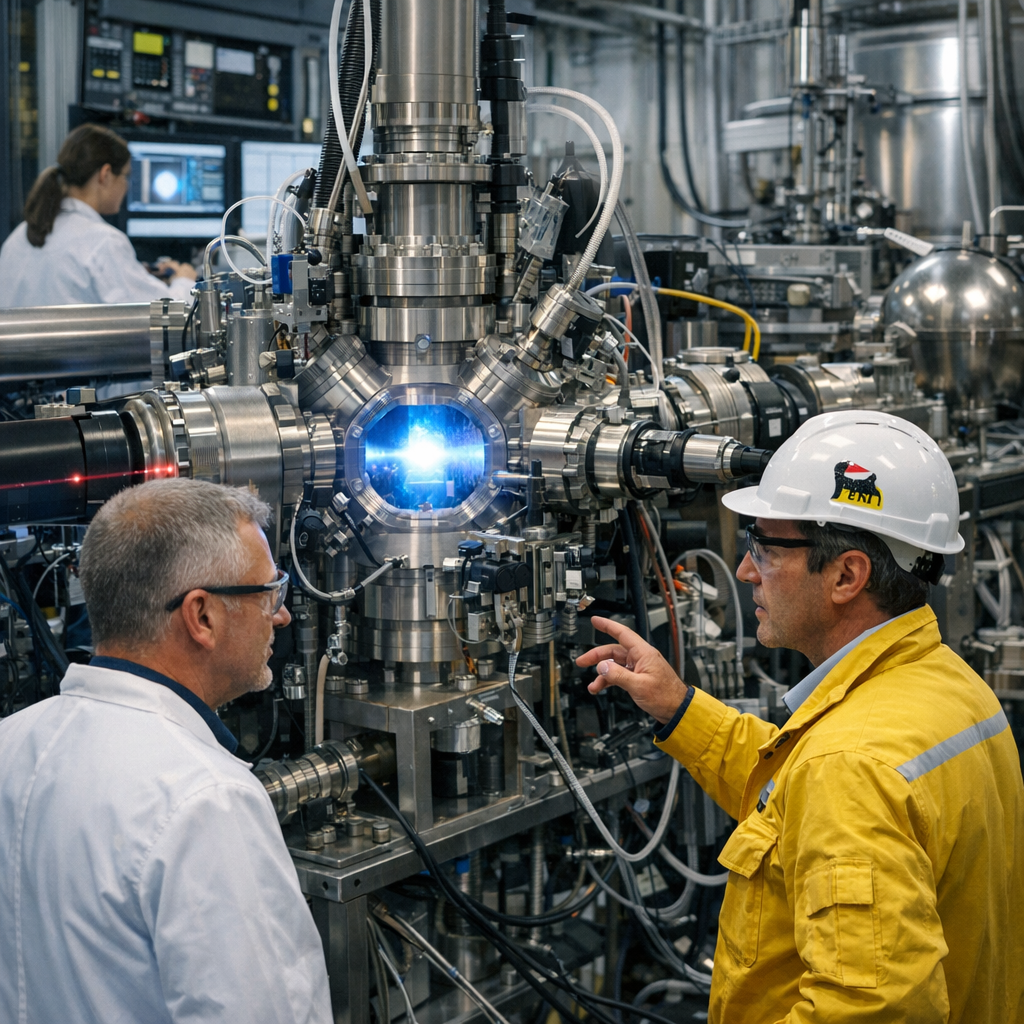
The United Kingdom Atomic Energy Authority (UKAEA) and Italian energy company Eni have announced the launch of a new initiative aimed at advancing the fusion fuel cycle, marking another step toward making nuclear fusion a viable source of clean energy. The collaboration, known as RH³OVA, seeks to tackle one of the central technical challenges in fusion development: ensuring a sustainable supply and efficient management of fusion fuel.
As reported in the article “UKAEA and Eni launch RH3OVA to accelerate the fusion fuel cycle” published by Innovation News Network, the project will focus on developing innovative solutions for handling tritium, a rare and radioactive isotope of hydrogen that is critical for most fusion reactions. The scarcity and complexity of tritium processing have long been considered major obstacles to commercial fusion power, and the RH³OVA initiative is designed to address these issues through targeted research and engineering.
The partnership brings together UKAEA’s longstanding expertise in fusion research with Eni’s industrial capabilities and experience in large-scale energy systems. By combining scientific knowledge with industrial application, the two organizations aim to accelerate the translation of laboratory advances into practical technologies that can be deployed in future fusion power plants.
Central to the RH³OVA program is the development of advanced systems for tritium breeding, extraction, and recycling. Fusion reactors are expected to generate their own tritium by using lithium-containing materials, but this process requires highly efficient and reliable technologies to ensure a continuous fuel cycle. Improving these systems is essential not only for the economic viability of fusion but also for meeting strict safety and regulatory requirements.
The initiative also reflects growing international momentum behind fusion energy, as governments and private companies increase investment in the field. While significant scientific milestones have been achieved in recent years, including breakthroughs in plasma confinement and fusion gain, the challenge of building an integrated, self-sustaining fusion fuel cycle remains unresolved. Projects like RH³OVA are intended to close that gap by focusing on the engineering and materials challenges that lie between experimental success and commercial deployment.
UKAEA and Eni have emphasized that collaboration across sectors will be critical to overcoming these hurdles. By engaging both research institutions and industry partners, RH³OVA aims to create a framework that can support rapid innovation while maintaining the rigorous safety standards required for nuclear technologies.
If successful, the work could have implications far beyond the immediate partnership. Establishing a reliable fusion fuel cycle would represent a major خطوة toward making fusion a practical and scalable energy source, offering the promise of abundant, low-carbon power with minimal long-lived radioactive waste. While commercial fusion remains a long-term goal, initiatives such as RH³OVA underscore the increasing focus on the practical challenges that must be solved to bring this technology out of the laboratory and into the global energy mix.