A European research effort has taken a significant step toward restoring movement in people with paralysis, offering new evidence that damaged communication between the brain and body can, under certain conditions, be re-established. The findings, reported in the article “Reconnecting body and brain: Europe’s breakthrough in reversing paralysis” published by Innovation News Network, highlight a convergence of neuroscience, bioengineering, and rehabilitation that is reshaping expectations about recovery after spinal cord injury.
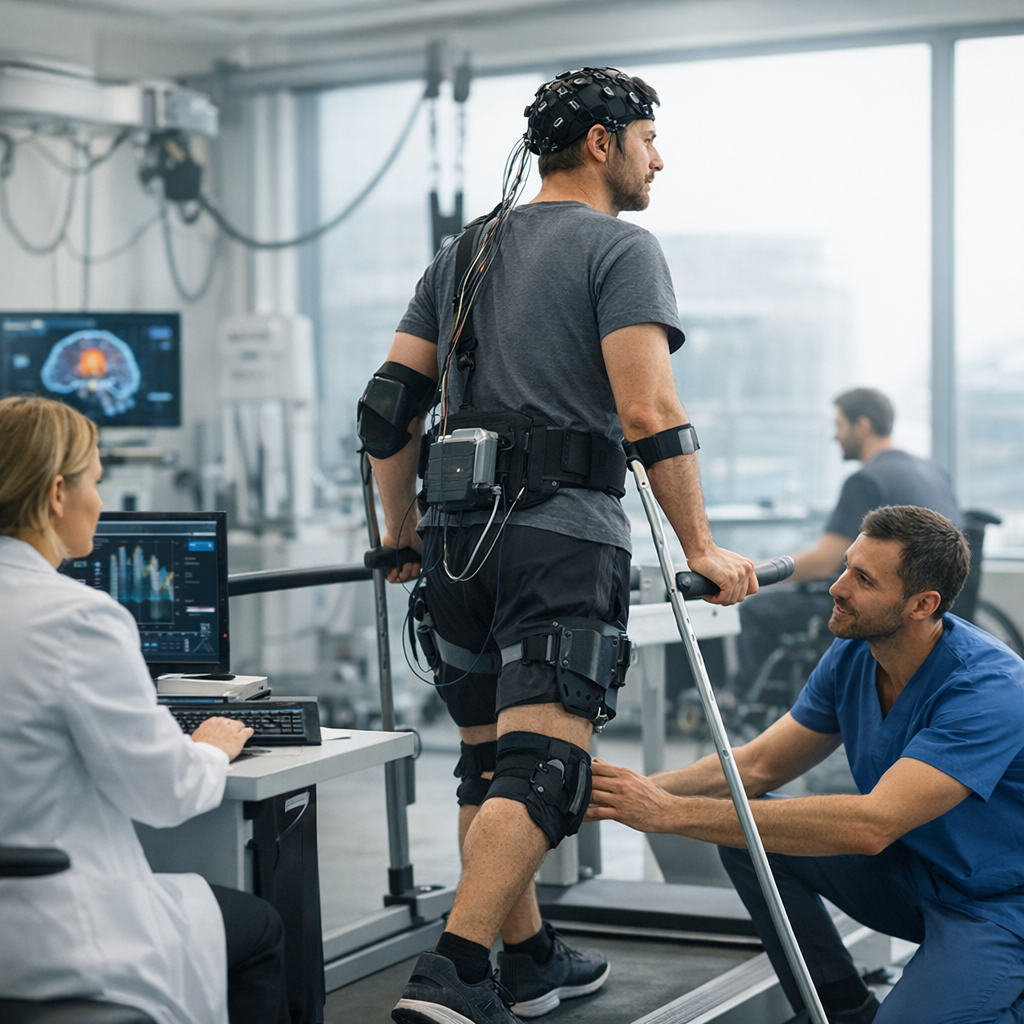
At the core of the work is the concept of reactivating dormant neural pathways rather than attempting to fully repair severed ones. Researchers are developing technologies that allow electrical signals to bypass damaged sections of the spinal cord, effectively restoring a line of communication between the brain and the limbs. These systems typically combine implantable devices with external sensors and software capable of decoding neural intent in real time, similar to advances in brain-computer interfaces.
The approach reflects a broader shift in neuroscience away from the long-standing assumption that paralysis caused by spinal cord injury is largely irreversible. Instead, scientists are increasingly focused on neuroplasticity—the brain’s capacity to adapt and reorganize—as well as the residual function that may persist even after severe injury. By stimulating targeted regions of the spinal cord and coordinating that stimulation with voluntary intent, patients have demonstrated the ability to regain controlled movements, including standing and walking with assistance.
The European initiative described by Innovation News Network brings together clinicians, engineers, and data specialists to refine these interventions and make them more accessible. A key element is the integration of artificial intelligence, which helps translate brain signals into precise stimulation patterns. Breakthroughs such as the brain–spine interface reported in Nature demonstrate how AI-driven decoding can enable more natural and responsive movement, reducing the mechanical and often cumbersome nature of earlier assistive technologies.
Clinical results so far, while limited to small groups of patients, are encouraging. Participants who had previously been unable to move their lower limbs have shown measurable improvement after undergoing treatment and rehabilitation using these systems. Research teams, including those at institutions like EPFL, report that in some cases, regained mobility has persisted even when the stimulation devices were temporarily turned off, suggesting that the therapy may promote longer-term neural recovery rather than merely providing a temporary workaround.
Despite these advances, significant challenges remain. The procedures involved are complex and resource-intensive, requiring surgical implantation and highly specialized follow-up care. Researchers are also working to determine how broadly the treatment can be applied, as outcomes may vary depending on the severity and location of the injury, as well as the patient’s overall health and rehabilitation history.
Ethical and logistical considerations are also coming into sharper focus. Questions around cost, accessibility, and long-term support will be central if the technology moves beyond experimental settings. Ensuring that such treatments do not exacerbate existing healthcare inequalities is likely to be a key concern for policymakers and medical institutions across Europe and beyond.
Nevertheless, the progress outlined in Innovation News Network’s coverage underscores a growing sense that paralysis may no longer be viewed as a fixed condition. While a universal cure remains out of reach, the ability to restore even partial movement represents a profound shift in both scientific understanding and patient outcomes.
As research continues, the convergence of neural engineering and rehabilitation medicine is expected to accelerate, potentially transforming how spinal cord injuries are treated. For now, the work serves as a compelling demonstration that reconnecting the brain and body, once considered impossible, is increasingly within reach.