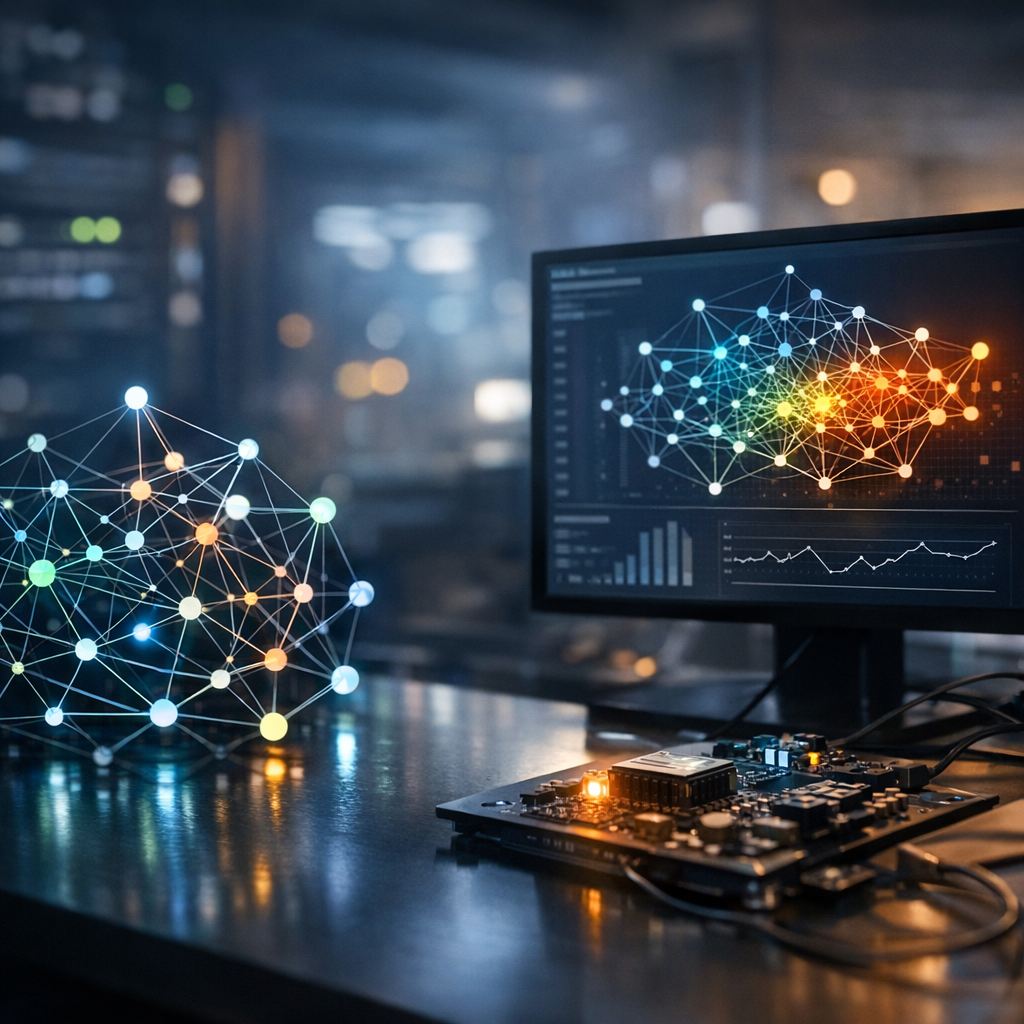
A newly proposed approach to graph-based artificial intelligence is showing promise in addressing one of the field’s most persistent challenges: improving model accuracy without sacrificing efficiency. In an article titled “HarmonyGNN boosts graph AI accuracy,” published by TechXplore, researchers describe a framework designed to better capture complex relationships within graph-structured data, a cornerstone of modern AI applications ranging from social networks to molecular analysis.
Graph neural networks (GNNs) are widely used to model systems where entities are interconnected, but they often struggle to balance local and global information. Traditional methods can either overemphasize nearby connections or dilute important structural signals when trying to aggregate data across an entire network. This trade-off has limited their performance in tasks where subtle relational patterns are critical.
The HarmonyGNN approach aims to resolve this tension by introducing a mechanism that aligns multiple layers of information more effectively. Instead of relying on a single type of aggregation, the model integrates diverse representations of node relationships, allowing it to preserve fine-grained details while still capturing broader structural context. According to the TechXplore report, this “harmonizing” process enables the system to avoid common pitfalls such as over-smoothing, where distinctions between nodes become blurred as information is repeatedly combined.
Early results suggest the method delivers notable gains in predictive accuracy across benchmark datasets commonly used to evaluate graph AI systems. The improvements appear particularly significant in scenarios involving complex or noisy data, where conventional GNNs often lose precision. Researchers attribute these gains not only to the model’s architecture but also to its ability to maintain stability during training, a frequent source of difficulty in deep graph models.
Beyond accuracy, the researchers emphasize computational efficiency. While more sophisticated models can sometimes achieve better results, they often require substantially greater processing power. HarmonyGNN is designed to strike a more practical balance, offering performance improvements without a proportional increase in computational cost. This could make it more accessible for real-world deployment, particularly in resource-constrained environments.
The implications extend across multiple domains. In drug discovery, for instance, more accurate graph models can improve the prediction of molecular interactions. In recommendation systems and fraud detection, enhanced relational understanding can lead to more reliable insights. As graph-based AI continues to expand into new areas, methods that improve both accuracy and efficiency are likely to play a central role.
The work highlighted by TechXplore underscores the rapid pace of innovation in graph machine learning. While further validation and real-world testing are needed, HarmonyGNN represents a step toward more robust and scalable AI systems capable of handling the intricate networks that underpin many modern technologies.