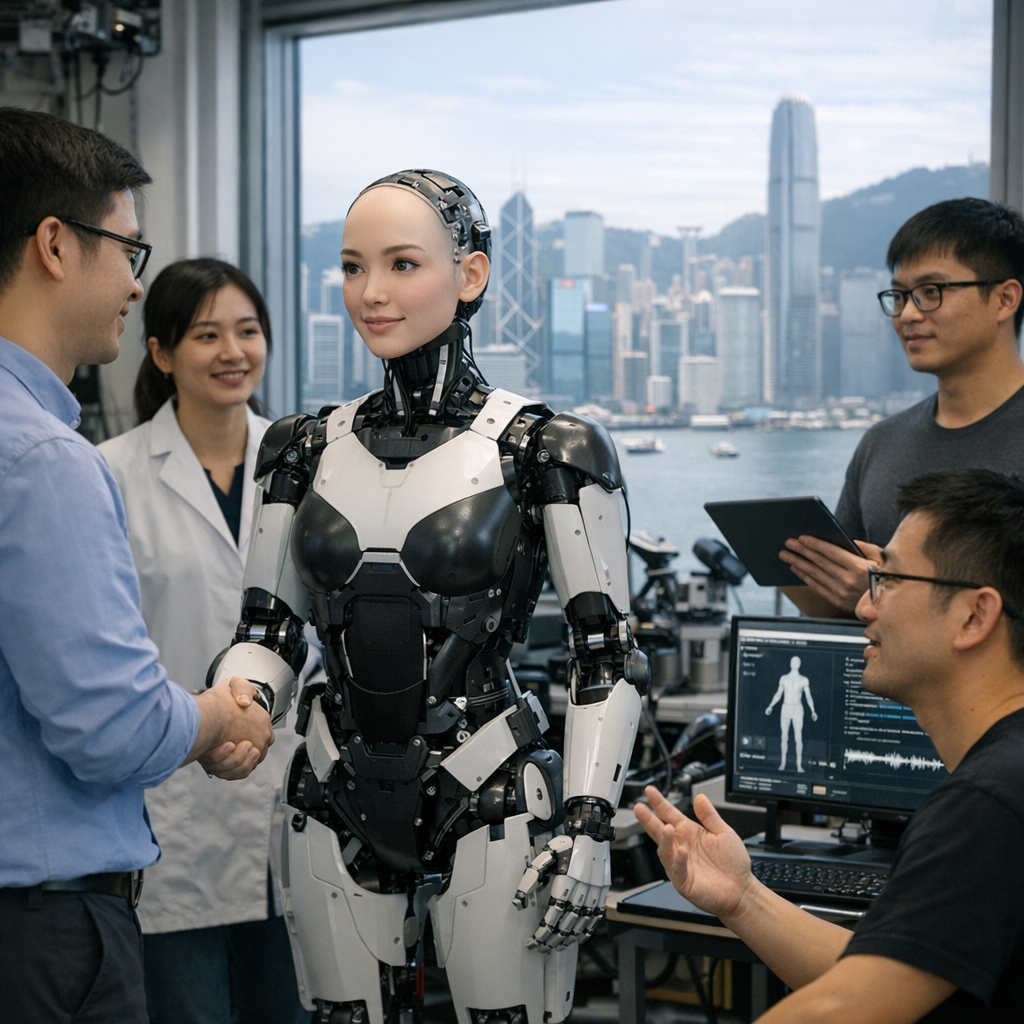
A team of researchers in Hong Kong has developed a new approach to improving how humanoid robots understand and use language, marking a step forward in making machines more adaptable in real-world environments. The work, detailed in the Tech Xplore article “Humanoid robots gain language skills from Hong Kong research,” focuses on enhancing robots’ ability to interpret human instructions with greater flexibility and contextual awareness.
The researchers’ system departs from rigid, predefined command structures that have long constrained robot behavior. Instead, it allows humanoid machines to process natural language in a way that better reflects how people actually speak, including ambiguous phrasing and varying sentence structures. By integrating language models with embodied action systems, the robots can link verbal instructions to physical tasks more effectively.
A key element of the research is the use of multimodal learning, in which robots simultaneously process linguistic input and sensory data such as vision and spatial awareness. This enables them to ground words in physical context—for example, recognizing objects, understanding spatial relationships, and adjusting actions in response to environmental changes. The result is a system that can handle more dynamic and less predictable scenarios than earlier models.
The team also focused on improving generalization, allowing robots to apply learned language concepts to new, unseen situations. Rather than memorizing fixed responses, the robots develop a more flexible understanding of tasks, which is critical for deployment in homes, workplaces, and public settings where variability is the norm.
While the technology remains in a research phase, its implications are significant. More capable language understanding could make humanoid robots more useful as assistants in settings ranging from elder care to logistics, where interpreting natural human communication is essential. However, challenges remain, including ensuring reliability, safety, and the ability to operate effectively outside controlled environments.
As highlighted in Tech Xplore’s coverage, the Hong Kong team’s work underscores a broader shift in robotics toward integrating advanced language models with physical intelligence. This convergence is increasingly seen as necessary for creating machines that can interact with humans in intuitive and meaningful ways, rather than relying on narrowly defined commands.