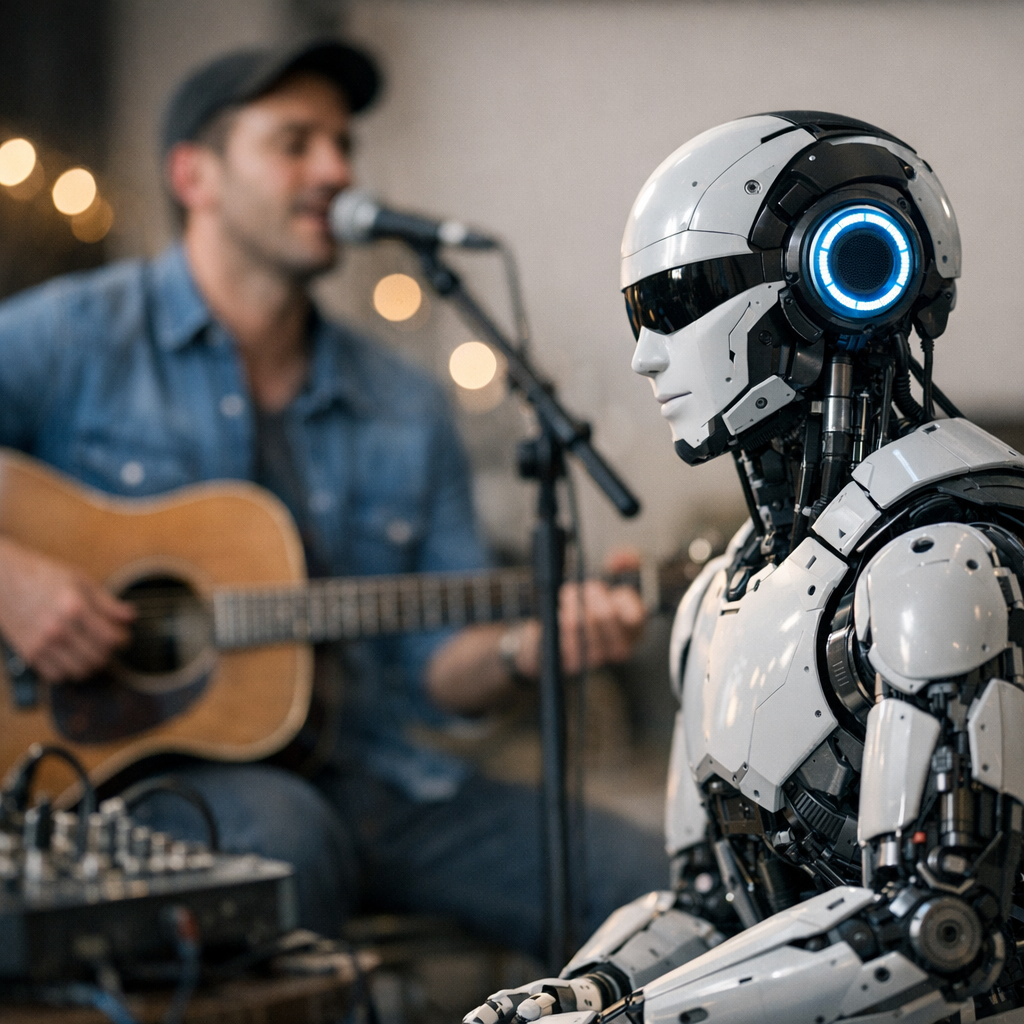
A team of researchers has developed a robotic system capable of playing music by ear, marking a step forward in efforts to make machines more adaptive and expressive in creative tasks. The work, described in the Tech Xplore article “Robot can play music by ear—opening new possibilities,” explores how artificial intelligence and robotics can move beyond rigid programming to respond dynamically to sound.
Unlike traditional music-playing robots, which rely on pre-coded scores or fixed inputs, the new system listens to audio and reproduces it in real time. Using advanced machine learning techniques, the robot analyzes pitch, timing and dynamics, translating auditory input into physical movements. This allows it to imitate melodies on instruments without prior knowledge of the piece—an ability that researchers say could reshape how robots interact with human environments.
At the core of the system is a neural network trained on a wide range of musical data. By learning the relationships between sound patterns and corresponding motor actions, the robot can generate appropriate responses when exposed to unfamiliar music. This represents a shift toward more flexible robotic behavior, where machines interpret and react rather than simply execute predefined commands.
Researchers involved in the project emphasize that the implications extend beyond music. The same underlying approach—combining perception and action through learning—could be applied to areas such as speech imitation, collaborative manufacturing, and assistive technologies. A robot that can adapt to new sensory input in real time could operate more effectively alongside humans, particularly in unpredictable or unstructured settings.
The project also touches on longstanding challenges in robotics, especially the difficulty of translating sensory data into fluid physical motion. Musical performance, with its requirement for precise timing and nuanced control, provides a demanding test case. By demonstrating success in this domain, the researchers argue that similar systems could be adapted for other complex tasks requiring coordination and responsiveness.
Still, significant limitations remain. The robot’s performance is not yet on par with skilled human musicians, and questions about generalization persist. While it can reproduce melodies it hears, its ability to interpret style, emotion or improvisation is still rudimentary. Researchers acknowledge that bridging this gap will require further advances in both machine learning models and robotic hardware.
The development comes amid growing interest in creative AI, where machines are increasingly capable of producing art, music and written content. However, the emphasis in this project is less on replacing human creativity and more on enhancing interaction. By enabling robots to respond to human-generated stimuli in real time, the technology opens the door to more collaborative forms of creativity.
As highlighted in Tech Xplore’s coverage, the system represents an early but notable step toward robots that can engage with the world in more intuitive ways. Whether in artistic contexts or practical applications, the ability to “play by ear” may prove to be a valuable benchmark in the ongoing effort to build machines that are not only intelligent, but also adaptable.