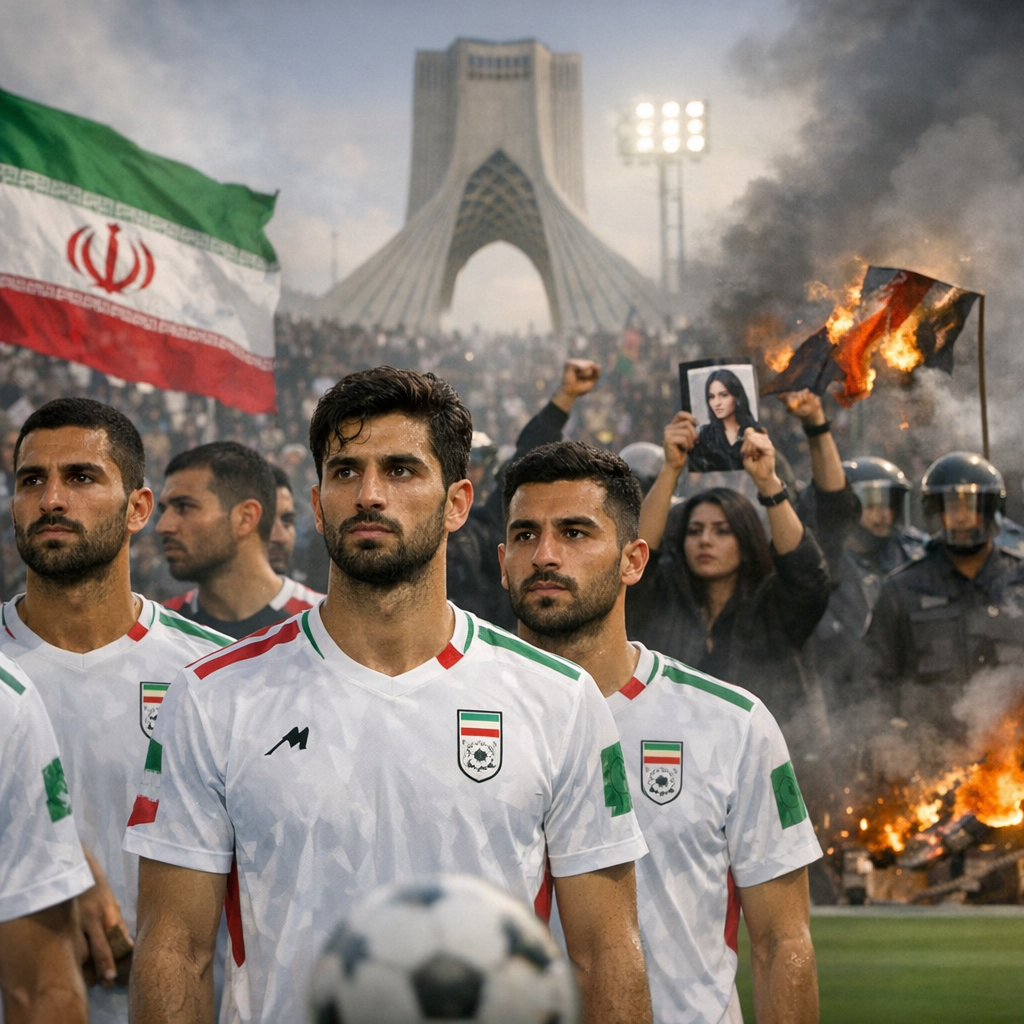
As global sporting events increasingly intersect with political tensions, Iran’s participation in international football has again become a focal point for both national identity and dissent. A recent report in Wired, titled “Why Iran’s World Cup Team Is Caught in a Political Crossfire”, examines how the country’s national team has been drawn into a broader struggle over legitimacy, protest, and global perception.
The article highlights how major tournaments such as the FIFA World Cup are rarely insulated from domestic realities, particularly in countries experiencing political unrest. For Iran, where widespread protests have erupted in recent years over issues ranging from civil liberties to economic hardship, as documented by Amnesty International, the national team has become an inadvertent symbol of a nation divided.
Players have faced intense scrutiny both at home and abroad. Decisions as seemingly simple as whether to sing the national anthem or how to comport themselves during matches have taken on heightened significance, as noted in coverage by BBC News. These actions are interpreted not just as personal choices, but as signals of loyalty or dissent, placing athletes under pressures that extend far beyond the football pitch.
Wired’s reporting underscores how governments often view international sports as an opportunity to project unity and strength. Iran is no exception. State authorities have historically leveraged appearances in global tournaments to reinforce narratives of national pride and resilience. Yet this strategy faces increasing complications when segments of the population view such displays as disconnected from their lived experiences, a dynamic explored by Human Rights Watch.
The Iranian team’s participation has also been closely followed by the diaspora and international observers, many of whom see the players as representatives of a society in flux. Social media has amplified these dynamics, turning moments during matches into global political statements within seconds, as reported by Reuters. This has intensified the stakes for athletes, who must navigate not only domestic expectations but also a transnational audience with divergent perspectives.
At the same time, Wired’s article points out that athletes themselves are not monolithic in their views. Some may seek to avoid political expression altogether, focusing on their professional responsibilities, while others may feel compelled to signal solidarity with protest movements. The lack of clear boundaries between sport and politics has made neutrality increasingly difficult to maintain.
The situation reflects a broader global trend in which sporting events are becoming arenas for contested narratives. Governments, activists, and fans alike project their own interpretations onto athletes and teams. In Iran’s case, the convergence of political unrest and international competition has created an especially fraught environment.
Ultimately, the Wired report illustrates how the World Cup, often framed as a celebration of unity and competition, can instead mirror the divisions of the societies it represents. For Iran’s national team, the tournament has become more than a sporting challenge; it is a stage where questions of identity, legitimacy, and resistance are played out under the scrutiny of a global audience.