
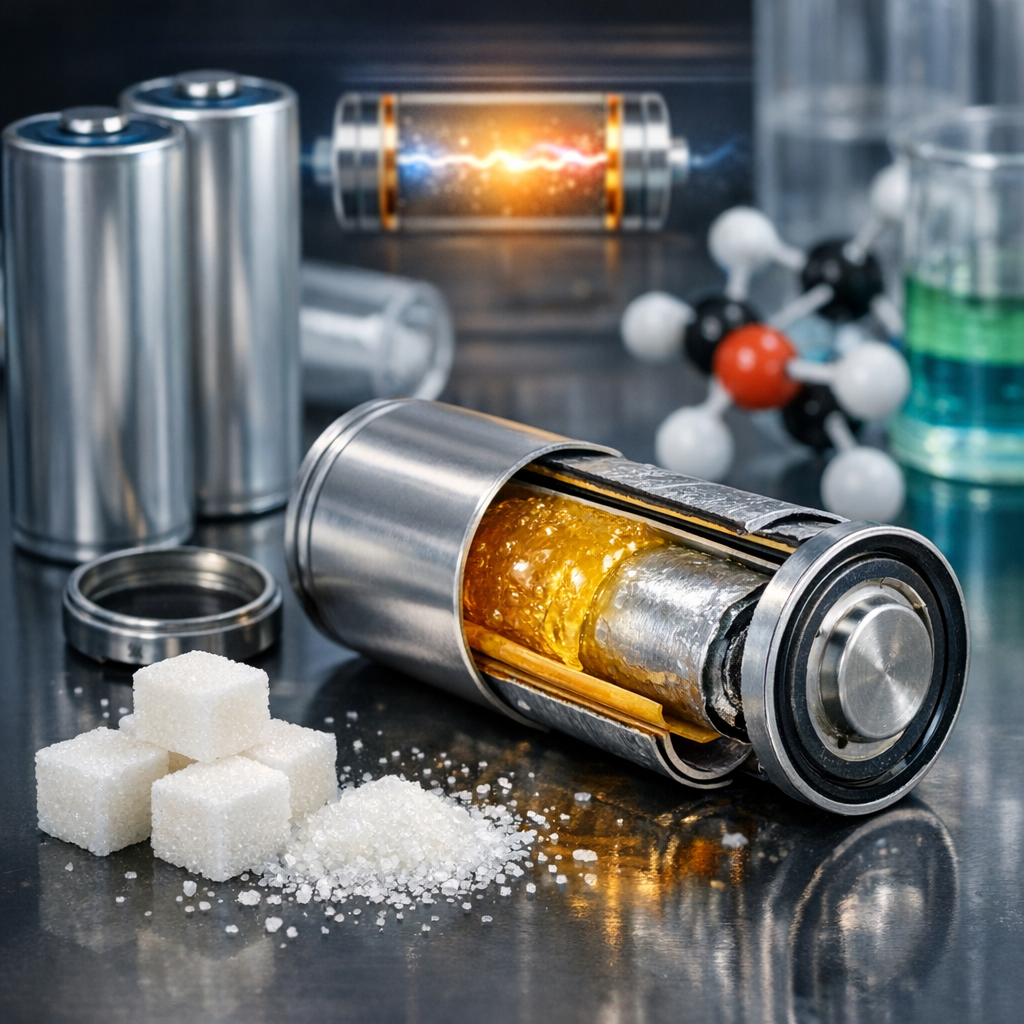
Researchers have developed a new approach that could make lithium-metal batteries both safer and longer-lasting, according to a report published by TechXplore titled “A sweet solution for safer, longer-lasting lithium metal batteries.” The work focuses on addressing one of the most persistent challenges in next-generation energy storage: stabilizing lithium-metal batteries without sacrificing performance.
Lithium-metal batteries have long been considered a promising successor to today’s lithium-ion systems because they can store significantly more energy. However, their widespread use has been limited by safety risks and rapid degradation. Chief among these issues is the formation of dendrites—needle-like lithium structures that can grow during charging, pierce internal battery components, and cause short circuits or even fires.
The research highlighted by TechXplore explores the use of organic compounds derived from sugar-like molecules to improve electrolyte stability. These compounds appear to help form a more uniform and protective layer at the interface between the lithium metal and the electrolyte. This layer, often referred to as the solid-electrolyte interphase, plays a critical role in battery longevity and safety.
By promoting a more stable interphase, the new method reduces the uneven deposition of lithium that leads to dendrite formation. Early testing suggests that batteries using this approach can maintain performance over more charge-discharge cycles compared with conventional lithium-metal designs. Equally important, the modified electrolyte appears to reduce the likelihood of internal short circuits, addressing a major barrier to commercialization.
The choice of sugar-derived materials is also notable for its potential environmental and economic advantages. Such compounds are typically more abundant and less toxic than many synthetic additives currently used in battery research. According to the U.S. Environmental Protection Agency’s green chemistry principles, using safer and more sustainable materials is a key priority in developing future technologies. While the study does not suggest immediate large-scale adoption, it points to a pathway for developing safer chemistries using relatively accessible materials.
Despite these advances, challenges remain before lithium-metal batteries can be deployed broadly. Scaling laboratory results to industrial production, ensuring consistent manufacturing quality, and integrating the new materials into existing battery architectures will require further work. Researchers also must demonstrate long-term reliability under real-world conditions, including variations in temperature and charge rates.
The findings reported by TechXplore contribute to a growing body of research aimed at overcoming the limitations of lithium-metal technology. If such approaches continue to show promise, they could accelerate the development of high-energy batteries for electric vehicles, portable electronics, and grid storage—applications where improved capacity and safety are increasingly in demand.
For now, the study represents a step toward resolving a longstanding trade-off in battery science: achieving higher energy density without compromising stability.


One thought on “Sugar-Derived Electrolyte Breakthrough Boosts Safety and Lifespan of Lithium-Metal Batteries”