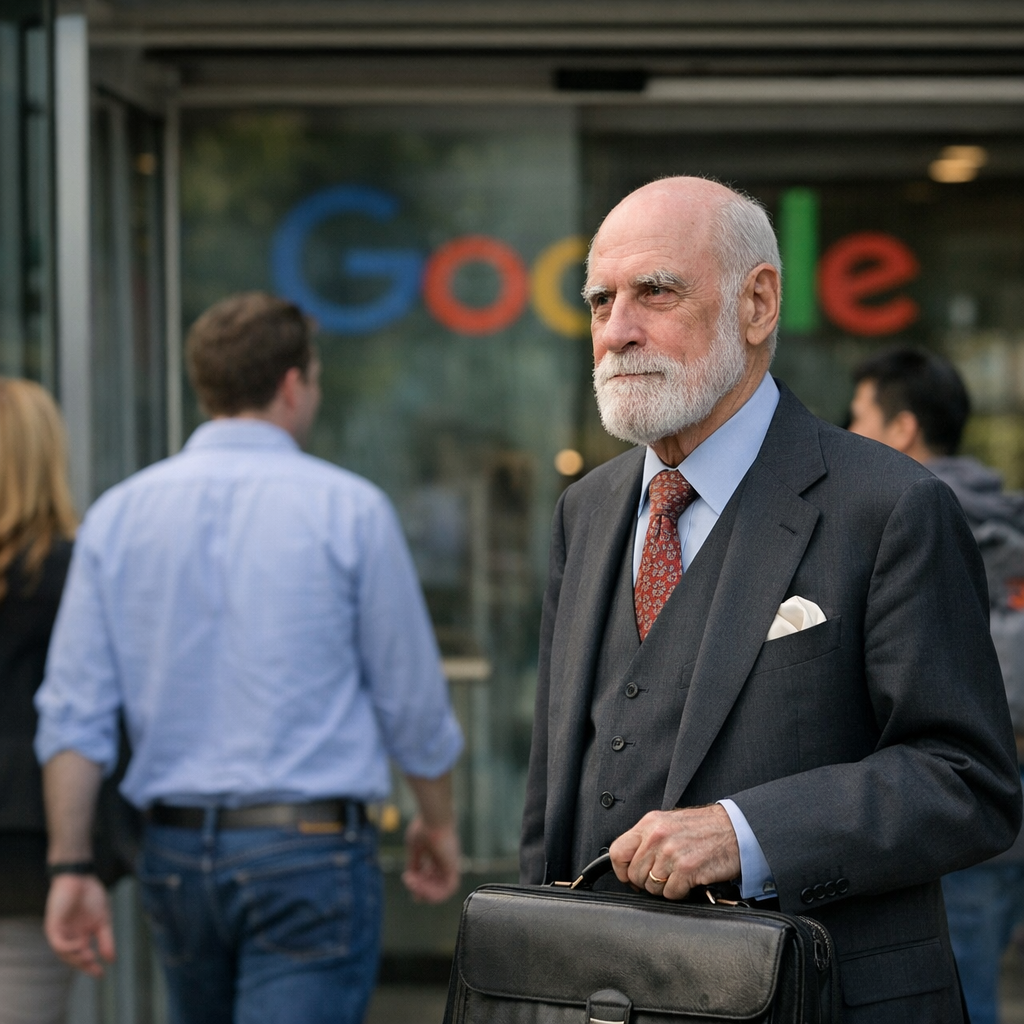
Vinton Cerf, widely recognized as one of the principal architects of the modern internet, is stepping down from his role at Google, marking the end of a significant chapter in both the company’s history and the broader evolution of digital communications. The development was first reported by StartupNews.fyi in its article titled “Vinton Cerf, Father of Internet, Retires From Google” (original source).
Cerf joined Google in 2005 as its Chief Internet Evangelist, a role that reflected both his technical authority and his broader mission to advocate for an open, interoperable internet. Over nearly two decades at the company, he became one of its most visible ambassadors on issues ranging from internet governance and infrastructure resilience to digital preservation and interplanetary networking. More about Cerf’s background can be found on his biographical profile.
Before his tenure at Google, Cerf co-designed the TCP/IP protocols alongside Robert Kahn in the 1970s, laying the technical foundation for the global internet. His work earned him numerous accolades, including the Turing Award and the Presidential Medal of Freedom, and cemented his reputation as a central figure in the development of modern computing and communications.
At Google, Cerf’s responsibilities extended beyond symbolic leadership. He played a key role in shaping the company’s thinking on internet standards, accessibility, and long-term data stewardship. He was also closely involved in efforts to address future challenges such as maintaining the usability of digital information over centuries, as well as advancing concepts related to space-based communication networks.
StartupNews.fyi reports that Cerf’s retirement comes at a time when the internet faces growing pressures, including regulatory fragmentation, cybersecurity threats, and debates over the concentration of power among major technology companies. His departure removes one of the industry’s most influential and historically grounded voices from an active corporate role, though he is expected to remain engaged in advisory and advocacy capacities.
Cerf has long warned about the risks of digital obsolescence and the fragility of data dependent on rapidly changing hardware and software environments. His concept of “digital vellum,” aimed at preserving information in formats that can be reliably accessed far into the future, has gained increasing relevance as governments and institutions grapple with long-term archival challenges.
Industry observers note that Cerf’s exit also underscores a generational shift within the technology sector. Many of the individuals who helped build the foundational architecture of the internet are stepping back from day-to-day roles, leaving stewardship of its future to leaders shaped by a very different technological landscape—one dominated by artificial intelligence, platform economies, and geopolitical competition over digital infrastructure.
While Cerf’s departure from Google marks the end of a formal role, his influence on the internet’s past and future is unlikely to diminish. His career has been defined not only by technical innovation but also by a sustained commitment to keeping the internet open, accessible, and resilient. As the digital ecosystem grows more complex and contested, those principles remain central to ongoing debates about how the network should evolve.
As noted in the StartupNews.fyi report, Cerf’s retirement is less a conclusion than a transition, with his ideas and legacy continuing to shape discussions about the internet’s direction in the years ahead.