Endava has unveiled a framework for orchestrating networks of artificial intelligence agents designed to automate and accelerate software delivery, signaling a broader shift in how enterprises approach development lifecycles. The initiative, detailed in the Developer-Tech article “Endava builds AI agent network to automate software delivery”, reflects growing industry momentum toward agent-based systems that can collaborate across complex engineering workflows with minimal human intervention.
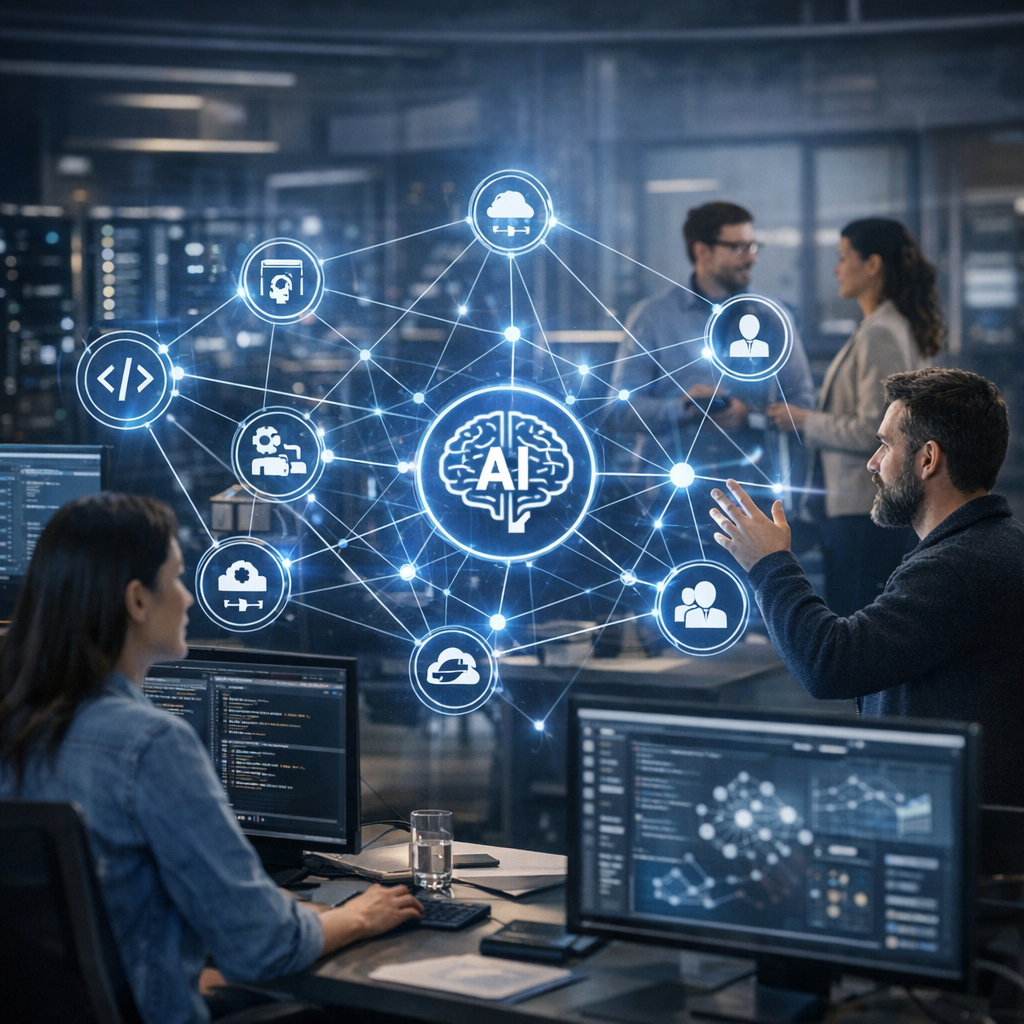
According to the report published by Developer-Tech, Endava’s approach centers on deploying interconnected AI agents that can independently handle discrete tasks such as requirements analysis, code generation, testing, and deployment. Rather than relying on a single monolithic model, the company’s architecture distributes responsibilities across specialized agents that communicate with one another, enabling a more modular and adaptive system. This design aims to mirror how human development teams operate, while significantly reducing the time required to move from concept to production.
The company positions its agent network as a response to persistent bottlenecks in software delivery, particularly in enterprises managing large-scale, legacy-heavy systems. By automating repetitive or time-intensive tasks, Endava expects organizations to reallocate human expertise toward strategic and creative work. The Developer-Tech report notes that these AI agents can also continuously learn from project data, improving performance over time and potentially reducing error rates in critical areas such as testing and integration.
Endava’s initiative arrives amid intensified competition among technology firms seeking to operationalize generative AI beyond experimental use cases. While many organizations have experimented with code-generation tools, scaling those capabilities across entire development pipelines has proven more complex. The agent-based model attempts to address this by coordinating multiple AI systems with defined roles, rather than relying on a single system to manage every stage of development.
However, the move also raises questions around governance, reliability, and transparency. As AI agents take on greater autonomy, organizations will need robust oversight mechanisms to ensure that outputs meet security, compliance, and quality standards. The Developer-Tech article highlights that human oversight remains a central component of Endava’s framework, particularly in high-risk or mission-critical applications.
Industry analysts suggest that agent networks could become a cornerstone of next-generation software engineering, particularly as enterprises seek to deliver updates more rapidly without increasing headcount. Endava’s model reflects a broader transition toward AI-augmented engineering teams, where human developers supervise and guide systems that handle much of the operational workload.
While still in its early stages, Endava’s AI agent network underscores a significant evolution in enterprise software development. If successful, it may help redefine how organizations structure teams, manage workflows, and measure productivity in an increasingly automated digital landscape.