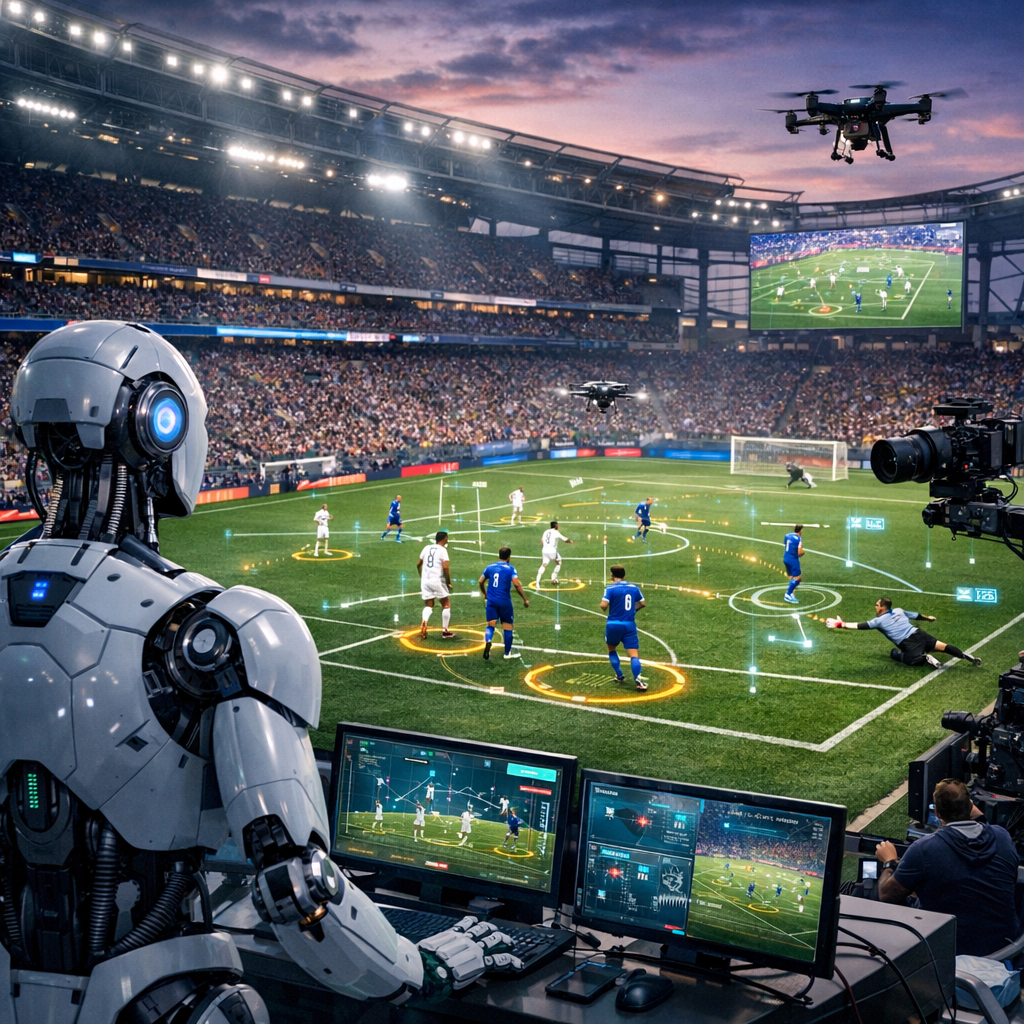
Artificial intelligence is taking on an increasingly visible role at major global sporting events, and this year’s World Cup is emerging as a key showcase. In its recent report, “Artificial Intelligence Sneaks Into the World Cup Thanks to Google Gemini”, Wired detailed how Google is embedding its Gemini AI systems into the tournament’s digital infrastructure, signaling a broader shift in how fans experience live sports.
At the center of this effort is Google’s push to integrate generative AI technologies like Gemini into real-time sports consumption. Through partnerships tied to broadcasting, search, and mobile platforms, Gemini is being positioned as a behind-the-scenes assistant that can surface statistics, generate summaries, and answer complex user queries about matches as they unfold. Rather than serving as a standalone product, the technology is woven into tools that millions of viewers already use, including Google Search and Android devices.
The changes are subtle but consequential. Fans searching for match results or player information are increasingly met with AI-generated responses that synthesize live data, historical context, and predictive insights. During matches, users can request tactical breakdowns, player comparisons, or even explanations of key plays in near real time. This marks a departure from traditional sports coverage, where analysis is mediated by commentators and delayed by production cycles.
Wired’s reporting emphasizes that Google’s approach is designed to normalize AI assistance rather than spotlight it. By embedding Gemini into familiar interfaces, the company is effectively introducing generative AI to a global audience without requiring users to adopt new behaviors or platforms. The FIFA World Cup, with its vast and diverse viewership, offers an ideal proving ground for this strategy.
The move also reflects intensifying competition among technology companies to define the future of AI-enhanced media. Real-time sports, with their massive data streams and engaged audiences, represent a particularly valuable domain. Success in this space could shape user expectations for AI across other forms of live content, including news and entertainment, as explored in broader discussions of AI adoption trends.
However, the integration of AI into live sports raises questions about accuracy and editorial trust. Automated summaries and instant analysis rely on complex models that may not always interpret events correctly, particularly in fast-moving or ambiguous situations. While Google has emphasized safeguards and ongoing refinement, the risk of errors being disseminated at scale remains a concern, echoing wider debates about AI reliability and trust.
There is also the issue of authorship and the role of human expertise. As AI-generated insights become more sophisticated, the line between machine-assisted information and traditional sports journalism could blur. Commentators and analysts may find their roles evolving, as audiences increasingly turn to AI for personalized, on-demand explanations.
Despite these uncertainties, the trajectory appears clear. As outlined in Wired’s “Artificial Intelligence Sneaks Into the World Cup Thanks to Google Gemini,” the current tournament is less a final product than an early demonstration of how AI could reshape the sports viewing experience. What begins as a convenience feature may soon become an expectation, altering how fans interact with the games they follow.
In that sense, the World Cup is not only a global sporting event but also a testing ground for a new kind of media ecosystem—one in which artificial intelligence operates quietly alongside the action, interpreting, summarizing, and contextualizing it in real time.