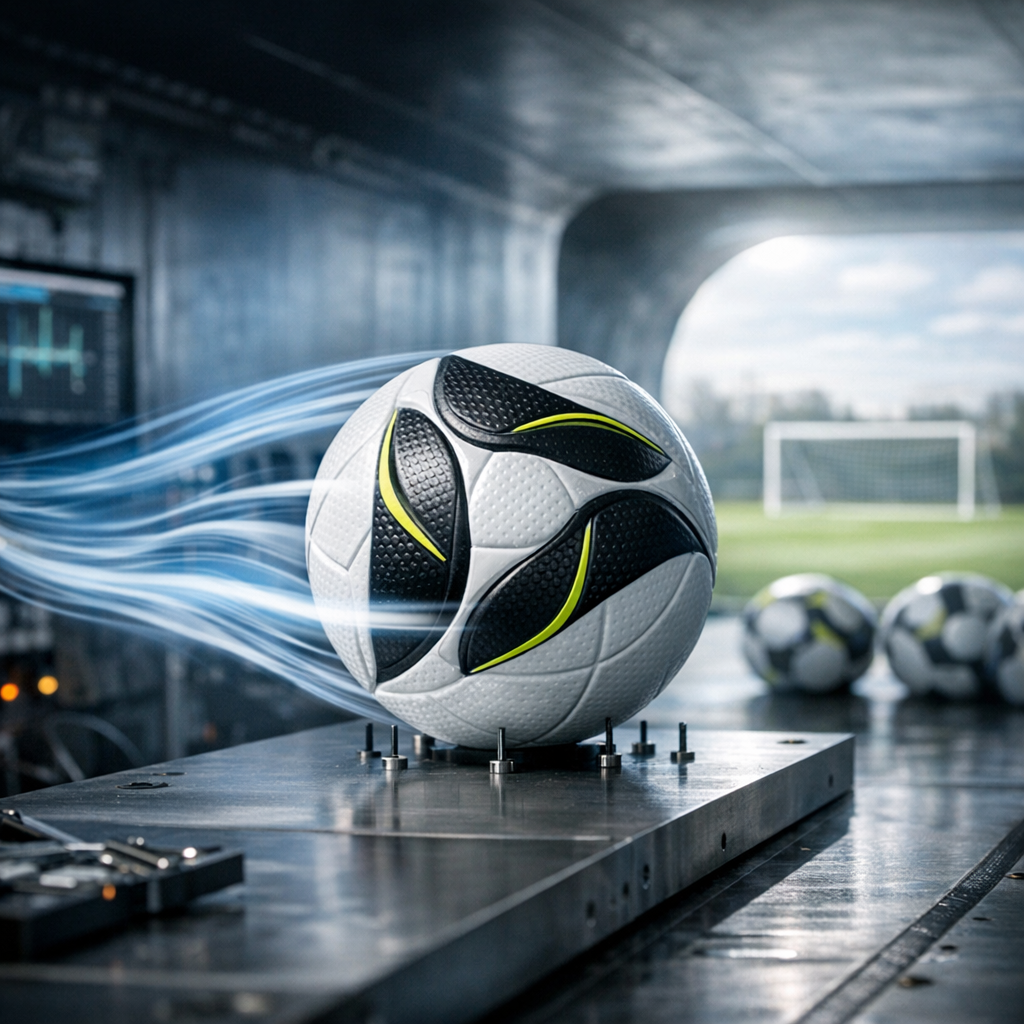
A new World Cup ball design is prompting questions about the limits of traditional aerodynamics, as engineers and players alike assess how subtle shifts in geometry can reshape the behavior of a familiar object in flight.
In “The World Cup’s ‘Trionda’ Ball Challenges Traditional Aerodynamics,” published by Wired, the focus turns to how recent advances in panel construction and surface texturing are complicating long-standing assumptions about how soccer balls move through air. The article explores the emergence of a new configuration—referred to as the “Trionda” design—that departs from classic panel arrangements and introduces unconventional aerodynamic properties.
For decades, soccer ball engineering has balanced predictability with performance. Earlier designs, with their stitched panels and relatively rough surfaces, produced airflow patterns that were comparatively stable and well understood, reflecting basic principles of aerodynamics. More recent iterations have reduced seams and altered textures to improve speed and accuracy, sometimes with unintended consequences. Players have periodically complained about “knuckling” effects—erratic deviations in a ball’s path—especially at high velocities, a phenomenon similar to what is described in studies of the knuckleball effect.
The Trionda approach appears to intensify these dynamics. By rethinking panel geometry and surface topology, designers are effectively reshaping how air clings to and separates from the ball in flight. According to the Wired report, even small changes in seam depth, curvature, and distribution can significantly affect turbulence, altering lift and drag in ways that are difficult to model with conventional equations tied to concepts like the Reynolds number.
Researchers cited in the article suggest that the new design occupies a delicate aerodynamic regime, one where airflow can shift rapidly between smooth and turbulent states. This transitional behavior is what produces the unpredictable swerves that goalkeepers and defenders find challenging. While such effects are not entirely new, the Trionda ball appears to magnify them, particularly under certain speeds and spin conditions.
The implications extend beyond player experience. The evolving design underscores a broader challenge in sports engineering: the gap between controlled laboratory testing and the variability of real-world play. Wind tunnel experiments can approximate airflow under steady conditions, but they struggle to replicate the complex, constantly changing forces present in a live match. As Wired notes, this makes it difficult to anticipate exactly how a new ball will perform once it reaches the field.
There is also an ongoing debate about fairness and standardization. Governing bodies aim to ensure consistency across competitions, yet innovation in equipment continues to push boundaries. Organizations like FIFA set regulations, but each redesign introduces a new set of variables, raising questions about whether technological advances are subtly reshaping the nature of the sport.
At the same time, manufacturers argue that such experimentation is essential. Incremental changes in materials science, fabrication, and computational modeling enable designers to refine performance in ways that were previously impossible. The Trionda concept, as described in Wired, reflects a willingness to challenge orthodoxy and explore the edges of aerodynamic understanding.
Ultimately, the reaction on the pitch may prove decisive. If players adapt quickly, the design could be seen as a natural evolution. If not, it may join a history of controversial balls that briefly disrupted elite competition.
What remains clear is that even a seemingly simple object—a sphere propelled across a field—continues to reveal new layers of complexity. The Trionda ball, as Wired’s reporting suggests, is less a finished solution than an ongoing experiment in how design, physics, and sport intersect.