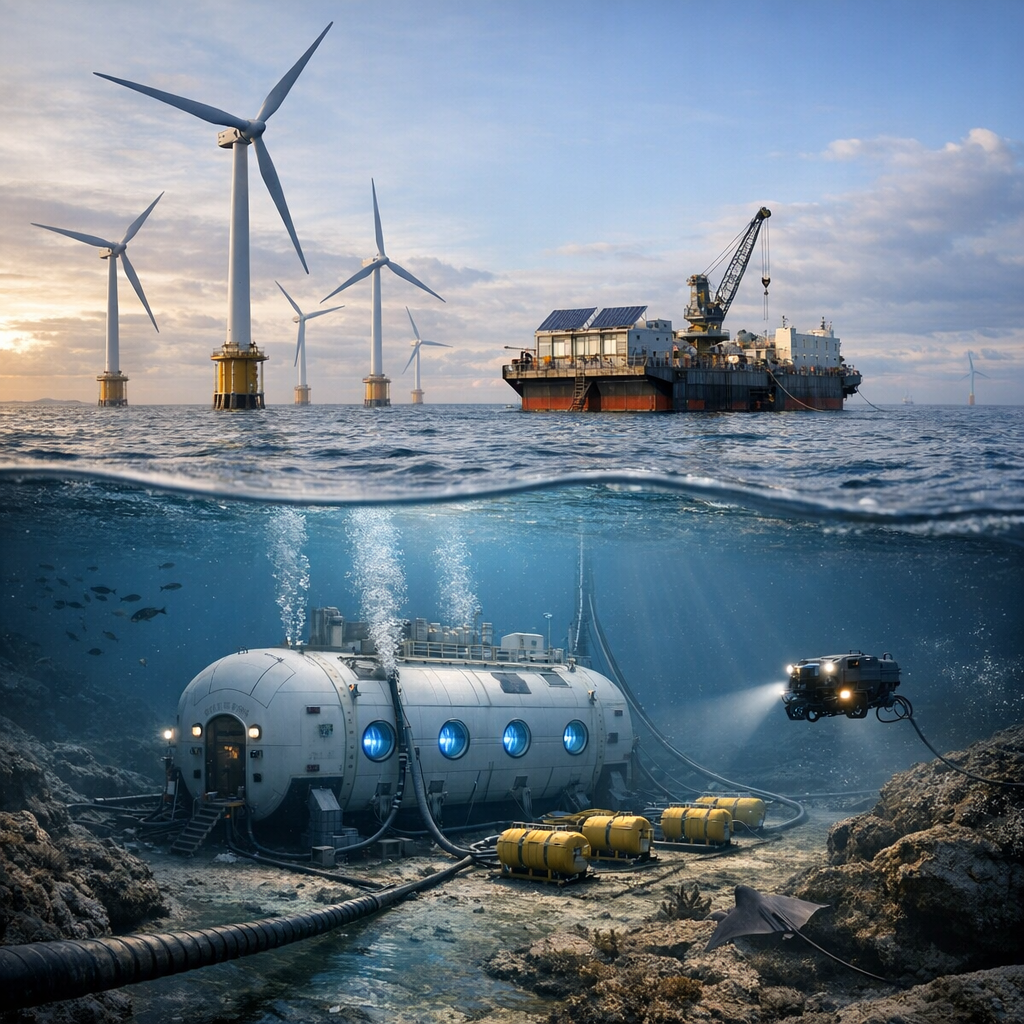
China has begun operating what it describes as the world’s first commercially deployed underwater data center powered by offshore wind energy, a project that reflects the country’s growing interest in alternative approaches to the energy-intensive demands of artificial intelligence and cloud computing.
The development, reported in a recent Wired article titled “China Opens World’s First Wind-Powered Underwater Data Center”, pairs submerged server infrastructure with a nearby wind farm, aiming to reduce both the carbon footprint and cooling costs that have become central challenges for global data centers. As computing workloads surge—driven in large part by AI training and inference—operators are under increasing pressure to find scalable, energy-efficient solutions.
Unlike conventional facilities, which rely heavily on land-based cooling systems and often consume significant freshwater and electricity, the Chinese system places sealed data center modules on the seabed. The surrounding ocean provides natural cooling, allowing servers to operate without the large air-conditioning systems typical of terrestrial installations. Electricity is supplied by offshore wind turbines, linking two emerging sectors in an effort to create a more sustainable computing model. (See: IEA report on data center energy use.)
According to Wired, the project builds on earlier experiments with underwater data centers, including initiatives by U.S. technology companies such as Microsoft, which tested similar concepts but did not proceed to full-scale commercial deployment (see Microsoft’s Project Natick). China’s approach appears to go further by integrating renewable power directly into the design, rather than simply using underwater placement as a cooling mechanism.
Advocates of the model argue that submerging data centers can significantly reduce energy consumption, operational noise, and land use conflicts. Coastal regions, where demand for computing capacity is often highest, may benefit from having infrastructure located offshore rather than competing for space in densely populated urban areas. The proximity to offshore wind generation also helps mitigate transmission losses and aligns supply with demand (see Global Wind Energy Council on offshore wind).
However, the approach raises technical and environmental questions. Long-term maintenance of submerged equipment remains complex, as does ensuring the integrity of sealed server units under high pressure and corrosive conditions. Repairs typically require bringing modules back to the surface, potentially increasing downtime. Environmental concerns have also been raised about the impact of underwater installations on marine ecosystems, although developers argue that carefully designed enclosures and monitoring can minimize disruption (see NOAA resources on marine environments).
The project comes at a time when China is significantly expanding its renewable energy capacity while simultaneously investing heavily in digital infrastructure (see International Renewable Energy Agency overview of China). The combination of offshore wind and subsea data storage signals an effort to address two strategic priorities with a single integrated system. It also reflects broader global experimentation with unconventional data center designs as the industry grapples with rising energy consumption.
Whether the model proves economically viable at scale remains uncertain. Much will depend on durability, maintenance costs, and the ability to standardize deployment. Still, as Wired notes, the initiative positions China at the forefront of a niche but increasingly relevant segment of infrastructure innovation, one that could reshape how and where the world’s data is processed in the coming decades.