A recent report highlights a growing effort to tackle the environmental footprint of data centers by pairing them with underground carbon storage technologies, signaling a potential shift in how the digital economy manages its emissions. The article, titled “Data center emissions could be curbed with underground carbon storage,” published by Tech Xplore, examines how emerging carbon capture and storage (CCS) strategies could meaningfully reduce the climate impact of rapidly expanding data infrastructure.
Data centers, which underpin cloud computing, artificial intelligence, and global communications, are among the fastest-growing sources of electricity demand worldwide. According to the International Energy Agency, their energy use has been rising steadily alongside digitalization trends. While major technology firms have invested heavily in renewable energy procurement, their operations still generate substantial indirect emissions, particularly in regions where grids remain carbon-intensive. The Tech Xplore report points to new research suggesting that co-locating data centers with carbon storage sites could offer a more direct path to reducing net emissions.
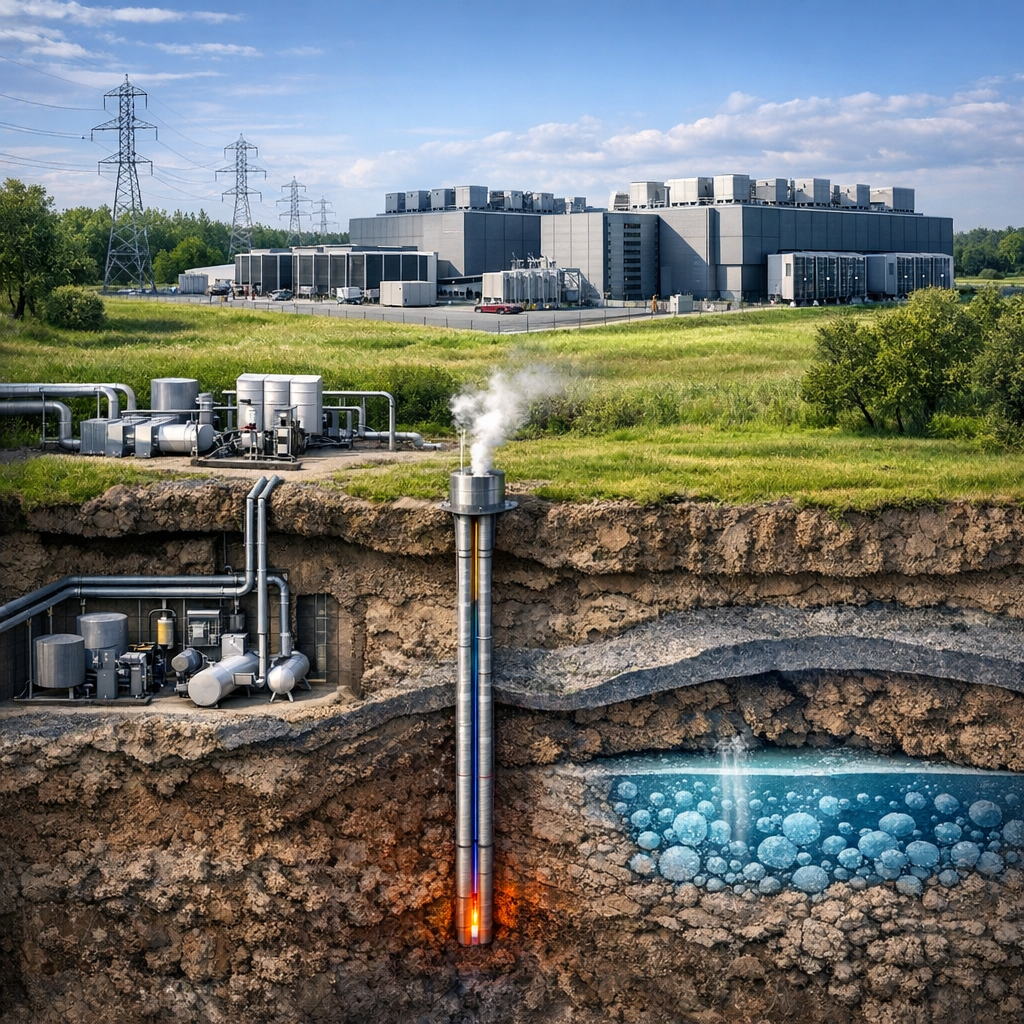
The concept involves capturing carbon dioxide produced either on-site or from nearby industrial processes and injecting it deep underground into geological formations capable of securely storing greenhouse gases over long periods. The U.S. Department of Energy describes CCS as a key technology for mitigating emissions from hard-to-abate sectors. By integrating these systems into the planning and construction of data centers, operators could offset a portion of their carbon output more reliably than through renewable energy credits alone.
Researchers cited in the article argue that this approach could be especially effective in areas with suitable subsurface geology, such as depleted oil and gas reservoirs or deep saline aquifers. The IPCC has identified such formations as viable long-term storage options. In such cases, carbon captured from power generation or backup systems supporting data centers could be permanently sequestered, reducing lifecycle emissions associated with digital services.
However, the proposal is not without challenges. The development of CCS infrastructure remains capital-intensive, and regulatory frameworks governing long-term storage liability are still evolving. The Global CCS Institute notes that scaling deployment will require significant investment and policy support. Additionally, critics have cautioned that reliance on carbon storage should not distract from efforts to improve energy efficiency or accelerate the transition to fully renewable power sources.
The Tech Xplore report also notes that collaboration between technology companies, energy providers, and policymakers will be essential to make such systems viable at scale. Integrating data center construction with regional carbon management strategies could require significant coordination, as well as public acceptance of underground storage projects, an issue explored by the Nature Climate Change journal.
Despite these hurdles, proponents see the convergence of data infrastructure and carbon storage as a pragmatic response to the realities of growing digital demand. As artificial intelligence and cloud services continue to expand, the industry faces mounting pressure to demonstrate credible pathways to net-zero emissions. Underground carbon storage, while still developing, may become a key component of that strategy if technical, economic, and regulatory barriers can be addressed.