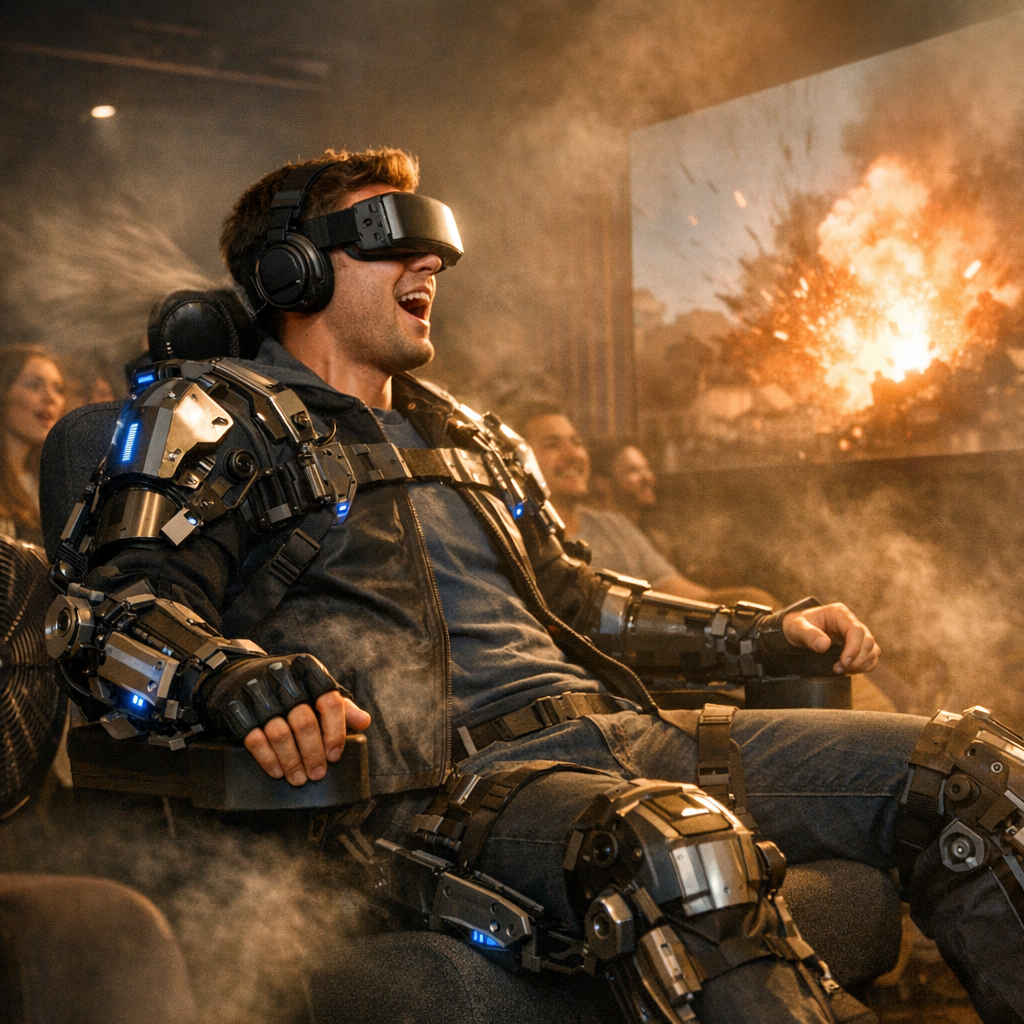
Researchers have developed a wearable robotic system capable of responding to cinematic cues in real time, an innovation that blurs the boundaries between passive media consumption and physically immersive experience. The work, described in the TechXplore article titled “Horror movie cue triggers wearable robot”, points to new directions in entertainment technology and human–machine interaction.
The system is designed to detect specific audiovisual signals embedded in films—particularly those commonly used in horror cinema to build tension or signal impending action—and translate them into physical feedback delivered through a lightweight wearable device. By synchronizing mechanical responses with moments of suspense, the technology aims to heighten emotional engagement and create a more embodied viewing experience.
According to the report, the wearable apparatus incorporates sensors and actuators that allow it to react almost instantaneously to cues such as changes in sound intensity, musical stings, or scene transitions. When a triggering signal is detected, the device can produce movements or tactile sensations that mirror the rhythm or emotional tone of the scene. In a horror context, this might mean sudden taps, pressure, or motion aligned with jump scares or moments of heightened anxiety.
The underlying concept builds on a broader trend in immersive media, where developers seek to extend storytelling beyond visual and auditory channels. While virtual reality and augmented reality have received most of the attention, wearable robotics offer a different pathway, one that augments conventional screen-based experiences rather than replacing them. By layering physical feedback onto existing films, creators can potentially transform how audiences perceive familiar genres.
Researchers involved in the project emphasize that the system is not limited to horror films. Although the initial demonstrations focus on suspense and surprise—genres well suited to testing rapid, reactive feedback—the technology could be adapted for action, drama, or even educational content. For example, subtle tactile cues might reinforce narrative beats, guide attention, or convey information in ways that complement the on-screen story.
At the same time, the development raises questions about user comfort and the psychological effects of intensified sensory input. Horror films are already designed to provoke strong emotional responses, and adding a physical dimension could amplify those reactions in ways that are not universally desirable. Designers will need to consider personalization and adjustable intensity to ensure that users remain in control of their experience.
The TechXplore article highlights that the system is still in a research phase, with ongoing work focused on refining cue detection and improving the responsiveness and ergonomics of the wearable components. Challenges include ensuring accurate synchronization across different types of media and minimizing latency so that physical feedback feels natural rather than disruptive.
Beyond entertainment, the researchers suggest potential applications in training simulations, therapy, and remote communication, where synchronized physical feedback could enhance realism or emotional nuance. As wearable technology continues to evolve, systems that translate digital signals into physical sensations may become an increasingly common interface between humans and media.
For now, the prototype serves as a proof of concept for a more interactive and embodied form of storytelling—one where the line between watching and experiencing becomes increasingly difficult to define.