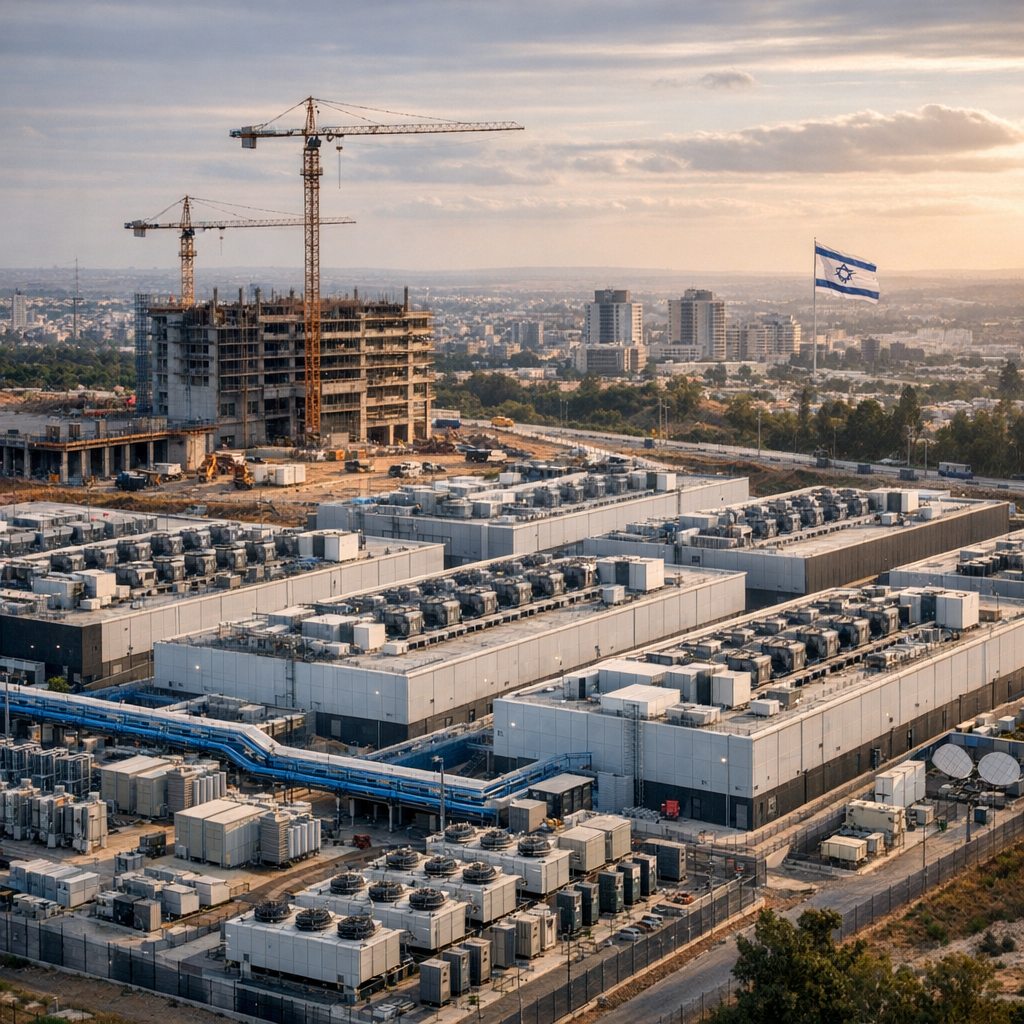
Crusoe Energy Systems plans to invest up to $10 billion in data center infrastructure in Israel, marking one of the most ambitious foreign technology investments in the country’s history, according to the Globes report titled “Crusoe to invest $10b in data centers in Israel” (full article).
The U.S.-based company, known for building energy-efficient data centers that often utilize stranded or renewable energy sources, is expected to roll out the investment over several years as demand for artificial intelligence and high-performance computing infrastructure accelerates worldwide. The initiative reflects both Israel’s growing role in the global AI ecosystem and increasing pressure on companies to secure reliable, scalable computing capacity.
According to the Globes article, Crusoe is exploring multiple sites across Israel for the construction of large-scale data center campuses. These facilities would support cloud services, AI training workloads, and other computation-heavy applications increasingly central to the tech industry. While specific locations and timelines are still being finalized, the scope of the planned investment suggests a multi-phase development strategy rather than a single project.
The move comes as global technology firms race to build out capacity to support generative AI systems and data-intensive applications. Training and operating these systems requires vast amounts of computing power and energy, leading companies to seek regions that offer a strong combination of technological talent, infrastructure, and energy innovation. Israel’s established technology sector and expertise in semiconductors, cybersecurity, and AI research make it an attractive destination despite its relatively small size.
Crusoe’s model could be particularly relevant in Israel, where energy efficiency and grid constraints are ongoing concerns. The company has built its reputation on deploying modular data centers powered by otherwise wasted or underutilized energy sources, including natural gas that would otherwise be flared. It is not yet clear how extensively that approach will be replicated in Israel, but the emphasis on sustainable and efficient energy use is likely to play a central role in regulatory approval and project design.
The investment also carries broader economic implications. Large-scale data center construction typically generates significant employment during the building phase and creates ongoing demand for highly skilled workers in engineering, operations, and cybersecurity. In addition, such infrastructure can attract further investment from global cloud providers and technology companies seeking local computing resources.
At the same time, projects of this magnitude often raise questions about environmental impact, energy consumption, and land use. Data centers are among the most energy-intensive forms of infrastructure, and their expansion can strain national power grids if not managed carefully. According to the International Energy Agency, data centers already account for a growing share of global electricity demand. Israeli authorities will likely need to balance the economic benefits of Crusoe’s investment with long-term planning around energy supply and environmental sustainability.
The announcement also reflects intensifying competition among countries to host next-generation computing infrastructure. Governments across Europe, the Middle East, and Asia have introduced incentives and regulatory frameworks designed to attract hyperscale data center projects. Israel’s ability to secure a commitment of this scale underscores its continued relevance in a shifting global technology landscape.
While the Globes report frames the investment as a major vote of confidence in Israel’s technology sector, execution risks remain. Large infrastructure projects are sensitive to regulatory delays, geopolitical uncertainty, and fluctuations in global demand for computing services. The pace at which Crusoe deploys capital will likely depend on a combination of market conditions and local permitting processes.
If realized as described, the initiative could significantly expand Israel’s digital infrastructure capacity at a time when demand for computation is growing exponentially. It may also position the country more prominently in the global network of data center hubs that underpin artificial intelligence development and deployment.
Crusoe has not publicly detailed the full financing structure or confirmed partnerships with specific cloud providers, but industry observers expect collaborations with major technology firms to emerge as the project progresses. The scale of the planned investment suggests that multiple stakeholders, including government entities and energy providers, will play a role in shaping its outcome.
The development signals that the race to build the physical backbone of the AI era is accelerating—and that Israel intends to be a meaningful participant in that transformation.