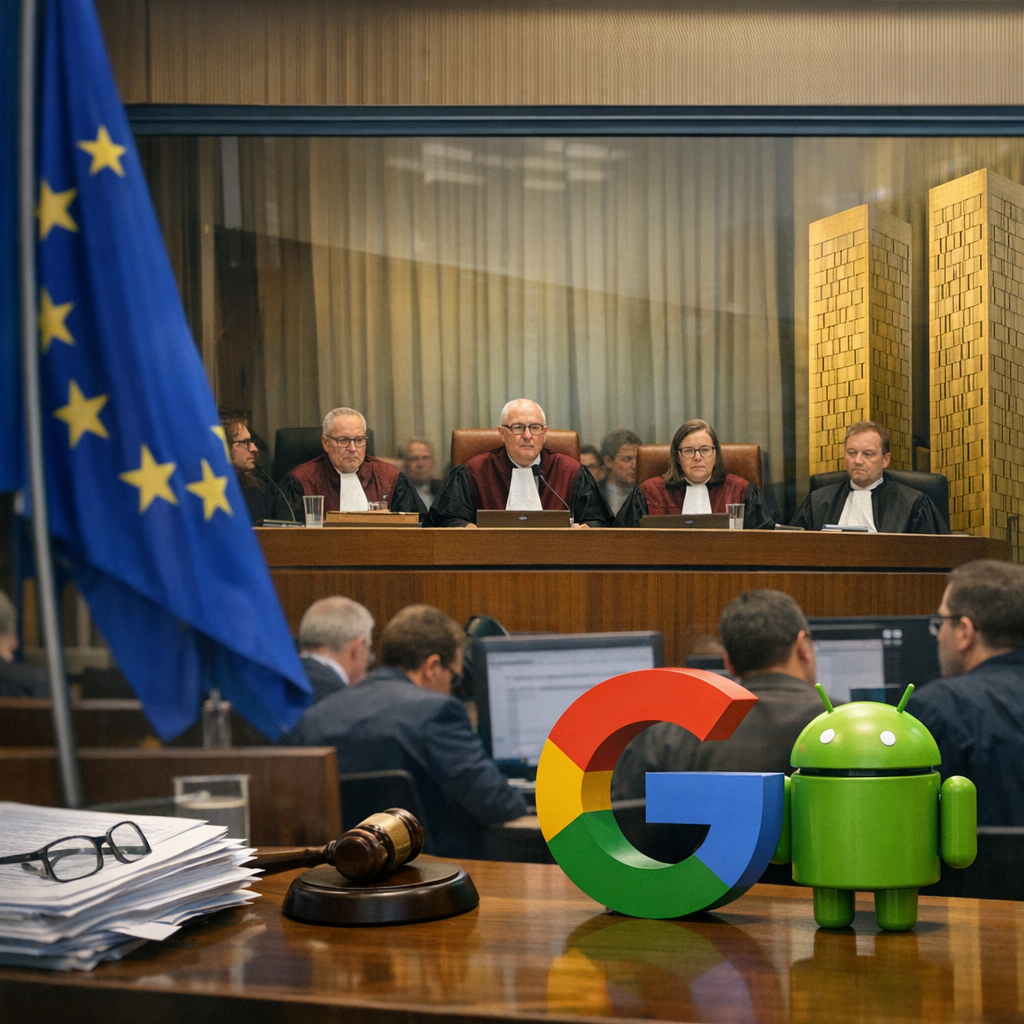
The Court of Justice of the European Union is set to deliver a decisive ruling in one of the bloc’s most consequential antitrust cases, determining whether Google must ultimately pay a record €4.1 billion fine over its Android mobile operating system practices. The case, closely watched across the global technology sector, could further define how European regulators rein in the dominance of major digital platforms.
As reported in the article “EU top court to rule on record 4.1 bn euro Google fine” published by The Economic Times, the dispute stems from a 2018 decision by the European Commission, which found that Google had illegally leveraged Android to strengthen the market position of its search engine. Regulators argued that the company imposed restrictive conditions on smartphone manufacturers, requiring them to pre-install Google Search and Chrome as part of licensing agreements for the Google Play Store.
The Commission concluded that such practices limited competition by reducing opportunities for rival search providers and browser developers to gain market share. The original penalty of €4.34 billion, later reduced to €4.125 billion by the EU’s General Court in 2022, remains the largest antitrust fine ever imposed by Brussels.
Google has consistently challenged the ruling, maintaining that Android has increased consumer choice rather than restricted it. The company argues that its business model supports a free and open ecosystem that benefits device makers and users alike. It also contends that competition in mobile operating systems remains robust, pointing to Apple’s iOS as a strong counterweight.
The upcoming judgment from the EU’s highest court will be final and cannot be appealed, making it a pivotal moment not only for Google but for the broader regulatory framework governing Big Tech in Europe. Legal observers note that the ruling could either reinforce the European Commission’s aggressive antitrust stance or set limits on how far regulators can go in policing platform behavior.
Beyond the immediate financial implications, the decision is expected to influence how large technology firms structure their services and partnerships within the European Union. A ruling that upholds the fine could embolden regulators pursuing similar cases, including ongoing investigations into digital advertising, app ecosystems, and data practices. Conversely, a decision favoring Google could prompt a recalibration of enforcement strategies at a time when the EU is also implementing sweeping rules under the Digital Markets Act.
The case reflects a broader transatlantic debate over the market power of major technology companies and the appropriate balance between innovation and regulation. While European authorities have taken a leading role in antitrust enforcement, courts have sometimes tempered the scope of Commission decisions, underscoring the legal complexity of defining digital competition harms.
With billions of euros at stake and significant implications for future regulation, the forthcoming ruling is poised to become a landmark in the ongoing effort to shape the digital economy’s competitive landscape.