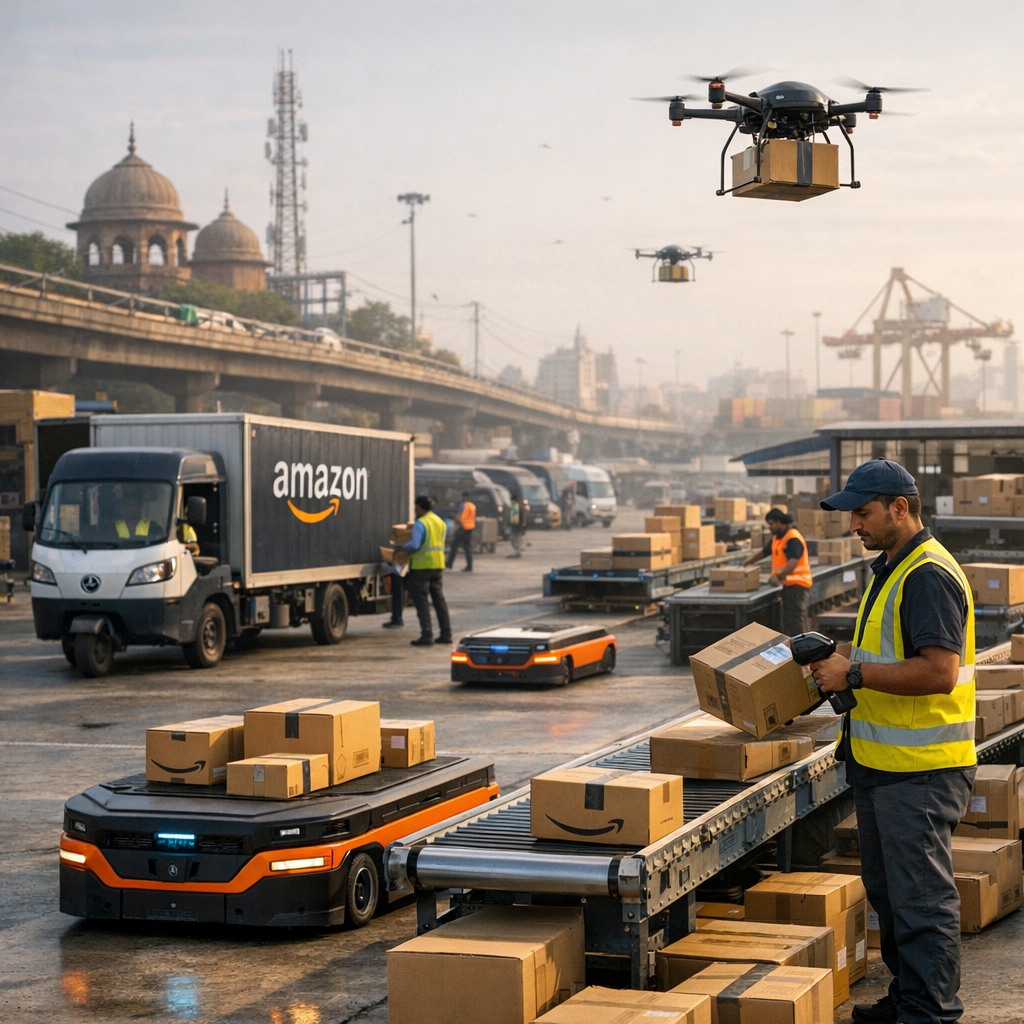
Amazon is studying India’s uniquely adaptive logistics ecosystem as it refines its global delivery strategy, according to insights from the company’s chief robotics technologist, underscoring how emerging markets are shaping the future of automation and supply chains.
In an article titled “Amazon drawing lessons from India’s clever delivery options, says chief robotics technologist,” published by The Economic Times, the company’s senior technology leadership highlighted the role of India’s dense urban environments and diverse delivery challenges in driving innovation. The executive pointed to India’s improvisational approach to last-mile delivery as a source of valuable learning for Amazon’s broader operations, particularly as it seeks to balance automation with local flexibility. The original report can be found here: Amazon drawing lessons from India’s clever delivery options.
India’s logistics landscape is marked by high population density, infrastructural variability, and a wide spectrum of consumer expectations. These conditions have forced delivery networks to become highly adaptive, often combining technology with human ingenuity to reach customers in crowded cities, informal settlements, and remote regions. According to insights on global transport and logistics systems, such environments often drive innovation under constraint. Amazon appears to be taking note of these decentralized, flexible models as it continues to invest in robotics and AI-led fulfillment systems.
The company’s robotics programs, long focused on warehouse automation and efficiency, are now being complemented by insights drawn from real-world complexities outside controlled environments. Amazon’s broader robotics efforts are documented through its Amazon Science robotics research initiatives. The ability to navigate unpredictable delivery scenarios—such as traffic congestion, narrow lanes, and inconsistent address systems—is becoming increasingly relevant as Amazon expands in global markets with similar characteristics.
The Economic Times report suggests that Amazon is not only observing but actively incorporating these lessons into its design thinking. Rather than relying solely on top-down technological solutions, the company is exploring hybrid approaches that allow automation systems to coexist with human-driven adaptability. This shift reflects a broader recognition within the logistics industry, echoed by research from McKinsey on logistics innovation, that innovation often emerges from constraints rather than ideal conditions.
India has become a significant testing ground for such hybrid models. Local delivery partners frequently employ creative methods, including dynamic routing, localized hubs, and personalized customer coordination, to ensure success in challenging environments. These practices contrast with more standardized systems in developed markets, where infrastructure is more predictable but less adaptable. Industry trends around last-mile delivery challenges are also discussed by the World Economic Forum.
Amazon’s acknowledgement of India’s influence also signals a shift in how global technology companies view emerging markets. Instead of treating them primarily as growth opportunities, they are increasingly seen as incubators for innovation that can be exported elsewhere. The lessons learned in India could inform delivery strategies in parts of Latin America, Africa, and even segments of urban Europe and North America facing logistical constraints.
At the same time, integrating such lessons into a large-scale automated system presents challenges. Robotics and AI solutions typically depend on structured data and controlled variables, whereas India’s delivery ecosystem thrives on flexibility and real-time human judgment. Bridging this gap will require new forms of machine learning that can accommodate uncertainty and adapt to rapidly changing conditions, a topic explored by Nature Machine Intelligence.
The Economic Times article highlights that Amazon’s approach is still evolving, with experimentation playing a central role. By studying how delivery partners in India solve problems on the ground, the company aims to build systems that are not only efficient but also resilient.
This convergence of grassroots ingenuity and advanced technology reflects a broader transformation in global logistics. As companies like Amazon continue to refine their operations, the influence of markets like India is likely to grow, shaping how goods are moved, tracked, and delivered worldwide.