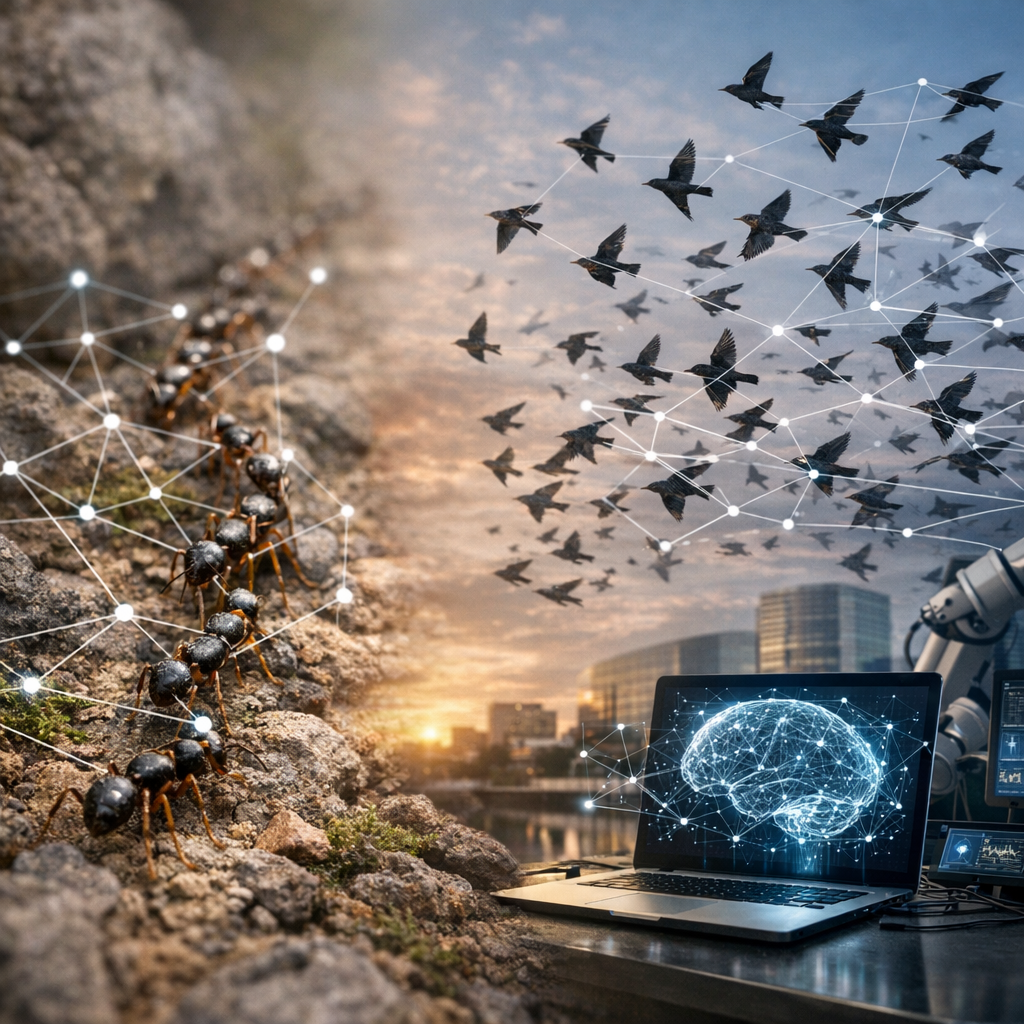
A new study highlighted by Tech Xplore, titled “Combining lessons from ants and birds for more efficient AI”, explores how insights from collective animal behavior could inform the next generation of artificial intelligence systems, particularly those designed to operate in uncertain or dynamic environments.
Researchers behind the work focus on how different species solve complex coordination problems without centralized control. Ant colonies, for instance, use decentralized decision-making and simple local interactions to find efficient routes to food sources, while bird flocks demonstrate highly synchronized movement and rapid adaptation to changing conditions. Each system reflects a different balance between exploration, communication, and responsiveness—traits that are increasingly relevant to modern AI challenges.
The study argues that integrating principles from both types of behavior could address limitations in current AI systems, especially those deployed in robotics, logistics, and autonomous networks. Traditional AI models often rely on either rigid optimization or large-scale data processing, which can struggle when conditions shift unexpectedly. In contrast, biological systems evolve to remain robust despite noise, incomplete information, and environmental variability, a concept closely related to swarm intelligence.
According to the research discussed by Tech Xplore, ant-inspired algorithms excel in distributed problem-solving. Individual agents follow simple rules, but collectively they converge on efficient solutions, such as shortest paths—a principle widely used in ant colony optimization algorithms. However, these systems can be slow to adapt once a pattern has been established. Bird-inspired models, on the other hand, emphasize rapid coordination and fluid response, enabling groups to react almost instantaneously to threats or obstacles, though sometimes at the expense of long-term efficiency.
By combining these approaches, scientists aim to design hybrid AI systems that can both discover optimal solutions and adjust quickly when conditions change. Such systems could be particularly useful in areas like traffic management, drone swarms, and supply chain logistics, where real-time adaptation is critical and centralized control is impractical.
The research also contributes to a broader trend in AI development that looks beyond purely computational strategies and instead draws from biological intelligence. This interdisciplinary approach reflects a growing recognition that evolution has already solved many of the problems engineers are now trying to address, often with remarkable efficiency and resilience.
While the work remains largely theoretical, its implications suggest a shift toward more flexible, decentralized AI architectures. As the researchers note, balancing stability and adaptability remains one of the central challenges in artificial intelligence. By studying how ants and birds manage that balance in nature, scientists hope to build systems that are not only more efficient, but also better suited to the unpredictability of real-world environments.
The findings, as reported by Tech Xplore, signal a continued convergence between biology and computer science, with practical applications that could reshape how autonomous systems are designed and deployed in the coming years.